
In This Article
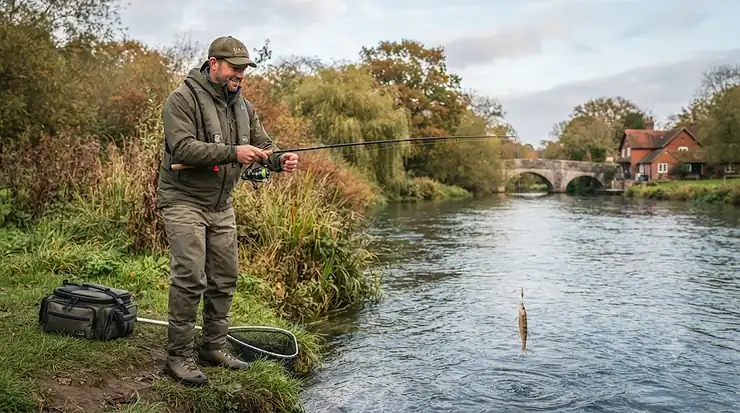
Standing on a gravelly bend with the current shoving against your waders, you quickly learn that lake tactics don’t transfer to moving water. A blade that spins beautifully in a still pond can go dead and lifeless the second it hits river flow, and a lure that’s too light just gets swept past every pocket where a pike is actually lying. Finding the best pike lures for rivers isn’t about buying the flashiest thing on the shelf — it’s about matching weight, action and retrieve speed to current, depth and structure.
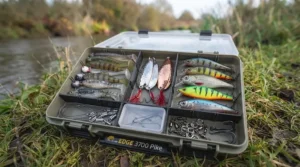
So what is river pike lure fishing, exactly? It’s the practice of using artificial lures — spinners, spoons, jerkbaits, spinnerbaits and swimbaits — to target pike in flowing water such as rivers, drains and canalised stretches, where current speed, depth and snags dictate lure choice far more than they do in stillwaters.
Pike (Esox lucius) are ambush predators that hold tight to structure — undercut banks, fallen timber, crease lines between fast and slow water — and they expect their prey to be fighting the current, not gliding through it. According to Wikipedia’s entry on the northern pike, average length runs around 40–55cm, with maximum recorded lengths up to 150cm and weights up to 28.4kg, so British rivers can genuinely produce specimens worth planning your tackle box around. This guide walks through seven real, currently available lures that handle flowing water properly, why each one earns its place, and the river-specific tactics that turn a nice day out into a net full of jack pike and the occasional twenty-pounder.
Quick Comparison: Best Pike Lures for Rivers at a Glance
| Lure | Type | Best For | Price Range |
|---|---|---|---|
| Mepps Aglia | Inline spinner | Slow-to-medium pools, clear water | Under £10 |
| Blue Fox Classic Vibrax | Vibration spinner | Coloured or turbid river flow | £6–£12 |
| Abu Garcia Toby Spoon | Casting spoon | Long casts across fast currents | £5–£12 |
| Savage Gear Da’Bush Spinnerbait | Spinnerbait | Snaggy, weedy river margins | £12–£20 |
| Rapala X-Rap XR12 | Suspending jerkbait | Slack pools and eddies | £14–£22 |
| Savage Gear 3D Hybrid Pike | Realistic swimbait | Clear, pressured rivers | £15–£25 |
| Salmo Executor Shallow Runner | Crankbait | Small rivers and canals | £10–£16 |
Looking at this spread, the pattern that emerges is depth control versus current speed: spinners and spoons excel where you need to cover water fast and stay in touch with the bottom, while suspending jerkbaits and swimbaits shine in the calmer pockets where pike actually sit. Budget-conscious anglers can build a genuinely capable river box around the Mepps Aglia and Abu Garcia Toby Spoon for well under £30 combined, while anglers chasing pressured, well-known stretches will get more follows-turned-takes from the lifelike profile of the Savage Gear 3D Hybrid Pike. Note that none of these figures are exact retail prices — always check current pricing before you buy, as tackle costs shift throughout the season.
💬 Just one click — help others make better buying decisions too!😊
Top 7 Pike Lures for Rivers: Expert Analysis
Every lure below has been selected because it’s a genuine, currently sold product with a track record in flowing water, not a theoretical “ideal” bait invented for this article. Specs are drawn from manufacturer data and retailer listings; review sentiment reflects patterns reported by anglers rather than any single cherry-picked comment.
1. Mepps Aglia — best all-round inline spinner for river pike lure fishing
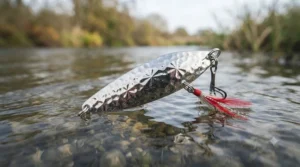
The original French spinner has been dragging pike out of moving water since the 1930s, and it remains a benchmark for a reason. Its oval blade is engineered to keep turning even on a painfully slow retrieve, which matters enormously in winter river conditions when pike won’t chase anything moving fast.
The Mepps Aglia is available across a wide size range, from #00 for light stream fishing up to #7 for large pike, with brass construction giving consistent balance at any retrieve speed. For river pike specifically, sizes #3 and #4 are the sweet spot — #3 for pike, larger perch and zander in shallow lakes, and #4 for large pike in deeper water. Based on the spec comparison with heavier spoons, the Aglia’s lighter mass means it’s better suited to shallower, slower stretches than to genuinely powerful flow.
Who should reach for this one? Beginners to river pike fishing benefit enormously, because the Aglia is close to foolproof — cast, count down, wind steadily, done. Reviewers consistently note the blade’s reliability and the brass construction’s durability over multiple seasons, with several UK anglers specifically praising its performance on Scottish river trout and pike alike. What most buyers overlook is that the dressed versions (with a bucktail or squirrel-tail skirt behind the hook) present a slightly larger profile that can trigger bigger, more territorial pike than the plain blade alone.
Pros:
- ✅ Spins reliably even on a very slow retrieve
- ✅ Wide size range matches small canals to big rivers
- ✅ Durable brass construction lasts multiple seasons
Cons:
- ❌ Lighter models struggle in genuinely fast current
- ❌ Treble hooks need a wire trace addition for safety
Priced around £4–£10 depending on size and finish, the Aglia represents outstanding value — it’s the lure most experienced river anglers keep as their confidence bait when nothing else is working.
2. Blue Fox Classic Vibrax — best for coloured or turbid river flow
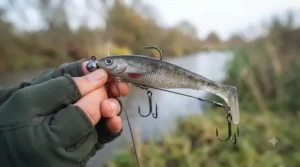
Where the Aglia relies on flash, the Vibrax leans on sound and vibration, and that distinction matters enormously after heavy rain when rivers turn the colour of tea. The Classic Vibrax’s patented two-part body emits low-frequency sound vibrations that attract fish and trigger strikes while virtually eliminating line twist, which means pike can locate it by feel through their lateral line even when they can’t see three inches in front of their nose.
The range spans six blade size and weight combinations, from a size 0 blade at 7/64 ounce up to a size 6 blade at 5/8 ounce, and it runs at depths between roughly 2 and 6 feet depending on current, line and retrieve. Here’s what the spec sheet won’t tell you, but reviewers note: the Vibrax rises toward the surface if you wind too fast, so in faster river flow you’ll want to slow your retrieve and let the current do more of the work than you would on stillwater.
This lure earns its place through honest performance in exactly the conditions where flashier lures fail. Reviewers consistently report solid results on pike, perch and pickerel-type species, and the compact bell-shaped body casts a long way into a headwind — a genuine advantage on wide, exposed river stretches. For anglers targeting flowing water pike lures specifically for low-visibility conditions, this is arguably the single most useful lure in the box.
Pros:
- ✅ Sound-based attraction works in coloured water
- ✅ Six size options cover creeks through big rivers
- ✅ Casts well even into a stiff headwind
Cons:
- ❌ Rises too fast if retrieved quickly in strong current
- ❌ Premium plated finishes cost more than basic spinners
At around £6–£12 depending on size, the Vibrax sits just above the Aglia in price but earns it back the first time you fish a swollen, chocolate-coloured river after rain.
3. Abu Garcia Toby Spoon — best for long casts across fast currents
Some lures have simply never been improved upon. Built for anglers who demand a lure with a proven history of big catches, the Toby has been putting fish in the net for around 60 years, and it’s designed with a distinct curved body that creates a fluttering, wobbling action on the retrieve, producing powerful visual and vibrational signals that provoke aggressive strikes.
The Toby is effective for fast-flowing rivers as well as trolling on large lochs, and it’s built to last thanks to durable metal construction fitted with sharp treble hooks. The range spans 7g right up to 60g, which is precisely why it earns a slot here: its dense metal body casts like a bullet and slices through strong current without ballooning off-course the way lighter plastics do. On paper this means you can cover a wide, powerful glide from a single static position on the bank — genuinely useful on rivers where wading isn’t safe or permitted.
Based on the spec comparison with inline spinners, the Toby’s advantage is distance and depth penetration rather than subtlety, so it suits searching tactics — covering large areas quickly to locate active fish before switching to a slower presentation. Reviewers note the spoon’s flutter is particularly effective in semi-clear water and that the lead-free (LF) versions perform just as well as older leaded models while being kinder to the river environment.
Pros:
- ✅ Casts exceptionally far into strong current
- ✅ Wide weight range from light streams to big rivers
- ✅ Simple, durable design with decades of proven results
Cons:
- ❌ Less subtle action than dedicated spinners
- ❌ Heavier models can be tiring to fish all day
Expect to pay somewhere in the £5–£12 range depending on weight, making the Toby one of the best value-per-cast lures in any river pike box.
4. Savage Gear Da’Bush Spinnerbait — best for snaggy, weedy river margins
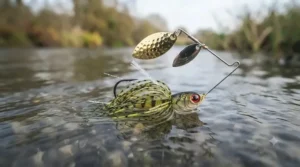
If your local river has undercut banks thick with reed and fallen branches, this is the lure that lets you fish those margins without donating half your tackle box to the riverbed. The Da’Bush features a stainless steel wire frame for exceptional strength, a high carbon forged steel hook in black nickel finish, and a closed snap eye for secure trace attachment, all wrapped around a single-hook design that rides largely weed-free.
The blades explode into an enticing helicopter movement the moment the lure hits the water, and the silicone and tinsel skirts combine with a curl-tail silicone trailer for added movement, while a weight add-on belly ring allows anglers to fine-tune casting distance and depth control. Available in sizes around 32g/160mm and up to 42g at 18cm, there’s enough range to match everything from a modest drain to a wide, snag-riddled river.
What most buyers overlook about spinnerbaits generally is that the single hook, tucked behind the blade frame, isn’t just snag-resistant — it also makes unhooking pike dramatically faster and safer than a lure bristling with two or three trebles. Reviewers on predator-fishing forums consistently describe the Da’Bush’s blade action as aggressive enough to draw pike out from genuinely thick cover, which is exactly the scenario where lures with exposed trebles simply can’t be fished with confidence.
Pros:
- ✅ Near weedless — ideal for snaggy river margins
- ✅ Single hook makes unhooking faster and safer
- ✅ Adjustable weight ring for casting and depth control
Cons:
- ❌ Bulkier profile can feel awkward to cast at first
- ❌ Higher price point than basic spinners
Priced roughly £12–£20, the Da’Bush costs more than a simple spinner, but for anyone fishing genuinely snaggy river swims it pays for itself the first time it avoids a break-off in timber.
5. Rapala X-Rap XR12 — best jerkbait for slack pools and eddies
Rivers aren’t uniform current from bank to bank — every bend creates a slack pocket, a back-eddy, or a crease line where fast water meets slow, and that’s precisely where a suspending jerkbait like the X-Rap comes into its own. The XR12 model runs at a 4-3/4 inch body length, weighs roughly 3/4 oz and dives to a running depth of 4–8 feet, giving it enough mass to punch into moderate current while still suspending on the pause.
The X-Rap’s slashbait action delivers a hard-cutting, aggressive dart with an integrated long-casting system, an irresistible internal rattle, and a classic Rapala wobble that comes to a gentle roll at rest — that rest phase is the trigger. Because it’s a suspending hard bait, it stays in the strike zone longer during twitch-and-pause retrieves, which mimics a dying baitfish stalling in an eddy — exactly the easy meal a river pike is conditioned to expect.
Here’s what the spec sheet won’t tell you: fishing this properly in a river means working the seams, not the open glide. Cast across and slightly upstream, let the current sweep it into the slack pocket, then twitch-pause-twitch. Reviewers consistently describe explosive takes on the pause rather than mid-retrieve, confirming that the suspending action is doing exactly what it’s designed to do.
Pros:
- ✅ Suspends perfectly in slack pools and eddies
- ✅ Aggressive darting action triggers reaction strikes
- ✅ Internal rattle adds an audible attractor in murky water
Cons:
- ❌ Less effective as a searching bait in open current
- ❌ Treble hooks require careful, gloved unhooking
Typically priced £14–£22, the X-Rap XR12 is a specialist tool rather than an all-rounder, but for eddy and pool fishing on rivers it has few genuine rivals.
6. Savage Gear 3D Hybrid Pike — best realistic swimbait for pressured rivers
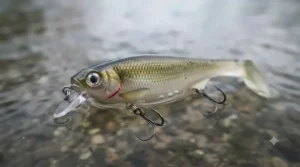
On heavily fished stretches near towns and popular access points, pike see an enormous number of lures every season, and a generic profile often gets refused with nothing more than a follow. This is where a scan-realistic swimbait earns its considerably higher price tag. Based on 3D scans of an actual baby pike, this lure delivers unparalleled realism, with a detachable tail system giving anglers two baits in one — a paddle tail for realistic swimming motion and an oversized ribbon tail designed to attract attention from greater distances.
The line-thru wiring system lets the hooks separate from the body during a fight, with a swivel in the head meaning a hooked fish can twist freely without ever getting enough leverage to throw the lure. Sizes run from around 1½oz at 17cm up toward the larger 3D Line Thru models. Reviewers consistently praise the swimming action and lifelike appearance, though it’s worth noting candidly that opinions are split — some anglers report the action needing a specific retrieve speed to look convincing, so a little experimentation on the day is worthwhile.
The honest analytical takeaway is this: on pressured rivers where pike have seen every spinner and spoon in the tackle shop, a genuinely different, lifelike silhouette can be the difference between a follow and a committed take. It’s not a lure for covering water quickly — it’s a lure for showing a suspicious, well-educated pike something it hasn’t refused a dozen times already.
Pros:
- ✅ Highly realistic profile fools pressured, wary pike
- ✅ Line-thru design prevents leverage during the fight
- ✅ Two tail styles in one bait for versatility
Cons:
- ❌ Premium pricing compared with traditional hardbaits
- ❌ Action can be retrieve-speed dependent
Expect to pay around £15–£25, positioning this firmly as a specialist, confidence-building addition rather than a first purchase for a beginner’s tackle box.
7. Salmo Executor Shallow Runner — best crankbait for small rivers and canals
Salmo has built a reputation for quality lures across predatory species, and every Executor is tank-tested before packaging, with the company confident enough in performance to offer a replacement if it doesn’t perform. The Executor Shallow Runner is a dumpy-shaped crankbait that floats and dives to around 1–1.5 metres on the retrieve, making it a natural fit for the modest depths typical of canalised rivers and smaller waterways.
The 12cm version is a particularly good match for pike in smaller venues such as canals and rivers, where average prey size tends to be modest, and it’s best fished on a faster retrieve with sharp rod movements to create an erratic, jolting swim. It’s available across sizes from 5cm through to 12cm and in numerous colour patterns, giving anglers scope to match the hatch on waters with smaller prey fish.
Based on the spec comparison with deeper-diving jerkbaits, the Executor’s shallow running depth is precisely the point — it lets you work weedbed tops and shallow, snag-free glides without constantly hanging up. What most buyers overlook is that the floating design means a pause simply lifts the lure clear of snags rather than dropping it into trouble, which is a genuinely useful safety net on unfamiliar water.
Pros:
- ✅ Ideal shallow-running depth for canals and small rivers
- ✅ Floats up and away from snags on the pause
- ✅ Manufacturer-tested with a performance guarantee
Cons:
- ❌ Light build isn’t ideal for big, wind-exposed rivers
- ❌ Smaller sizes may under-appeal to genuinely big pike
Priced around £10–£16, the Executor rounds out this list as the practical, everyday choice for anglers fishing modest, intimate waterways rather than wide open rivers.
Top 7 River Pike Lures: Full Comparison Table
| Lure | Weight Range | Running Depth | Best Retrieve | Best For |
|---|---|---|---|---|
| Mepps Aglia | 4g–13g | Sub-surface to mid | Slow, steady | Clear, slow-medium pools |
| Blue Fox Classic Vibrax | 3g–18g | 0.6m–1.8m | Steady, moderate | Coloured, turbid water |
| Abu Garcia Toby Spoon | 7g–60g | Mid to deep | Steady, long casts | Fast, powerful current |
| Savage Gear Da’Bush Spinnerbait | 21g–42g | Shallow to mid | Slow-roll | Weedy, snaggy margins |
| Rapala X-Rap XR12 | ~21g | 1.2m–2.4m | Twitch-pause | Slack pools, eddies |
| Savage Gear 3D Hybrid Pike | ~42g | Sub-surface | Slow, varied | Pressured, clear rivers |
| Salmo Executor Shallow Runner | Light | 1m–1.5m | Fast, erratic | Small rivers, canals |
Reading across this table, the clearest takeaway is that no single lure covers every river scenario — the Abu Garcia Toby Spoon and Blue Fox Classic Vibrax dominate fast or coloured water where distance and vibration matter most, while the Rapala X-Rap XR12 and Savage Gear 3D Hybrid Pike are built for the calmer, more considered presentations that slack pools and pressured fish demand. If you’re only carrying four lures on a river session, pairing a searching bait like the Mepps Aglia with a snag-proof option like the Savage Gear Da’Bush Spinnerbait covers the widest range of swims with the least risk of losing tackle.
Practical Usage Guide: Setting Up for River Pike Lure Fishing
Getting the tackle right matters as much as the lure itself. A wire or heavy fluorocarbon leader of at least 20–30lb breaking strain is non-negotiable — pike teeth will cut straight through unprotected line, and this applies whether you’re fishing a size #2 Aglia or a full-sized spinnerbait. Pair it with a medium-heavy spinning rod around 8–9ft, which gives enough backbone to work heavier spoons upstream while still having the tip sensitivity to detect a subtle jerkbait take.
In your first 30 days targeting river pike, the most common mistake is retrieving too fast to compensate for current push — this actually reduces a lure’s action rather than improving it, since most spinner blades and spoon flutters are tuned for a specific speed window. Instead, cast upstream or up-and-across, then retrieve just fast enough to stay in contact with the lure as the current sweeps it downstream past likely holding areas. Maintenance is simple but easy to neglect: rinse lures in fresh water after every session (especially anything used near brackish tidal reaches), check split rings and hook points before each trip, and replace trebles the moment a point rolls over rather than waiting for a lost fish to remind you.
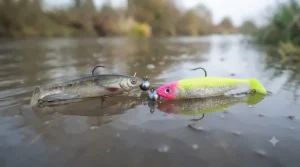
Real-World River Scenarios: Matching the Lure to the Angler
Consider a university student with £40 to spend and access to a local canalised river after lectures. Budget and portability matter more than variety here, so a Mepps Aglia in two or three sizes plus a single Abu Garcia Toby Spoon covers slow glides and faster runs without breaking the bank, and both fit easily in a jacket pocket for a spontaneous after-work session.
Now picture an experienced angler fishing a well-known, heavily pressured stretch of a lowland river every weekend through autumn. Pike here have seen every generic spinner in the shop, so the Savage Gear 3D Hybrid Pike and the Rapala X-Rap XR12 earn their place — worked slowly through the eddies and undercuts where educated fish still feel safe enough to commit. A third profile, picture a family group introducing a young angler to lure fishing on a shallow, weedy tributary: the Salmo Executor Shallow Runner is close to ideal, since its shallow-running, snag-shedding action means fewer lost lures and more chances to actually hook a fish, which matters enormously for keeping a beginner engaged. Before heading out, it’s worth checking permissions — many stretches of river and canal in England and Wales are managed by local clubs or bodies such as the Canal & River Trust, and a rod licence gives you the legal right to use a rod but doesn’t itself grant permission to fish a particular stretch — you’ll still need a permit from whoever controls the fishing rights.
Problem → Solution: Fixing Common River Pike Lure Issues
Lure spinning and line twist is the most frequent complaint from anglers new to inline spinners, and the fix is usually a quality ball-bearing swivel positioned well above the trace rather than directly on the lure clip. If your spoon or spinner keeps rising to the surface in strong current, you’re winding too fast for its designed retrieve speed — slow down and let the current do more of the work, or step up to a heavier model. Snagging on structure repeatedly points to the wrong lure choice for that swim: switch to a weedless option like the Savage Gear Da’Bush Spinnerbait or a floating, snag-shedding crank like the Salmo Executor Shallow Runner rather than persisting with an exposed-treble lure in heavy cover. Finally, if you’re getting follows but no committed takes on pressured water, that’s a strong signal to switch from a generic spinner to a more lifelike profile such as the Savage Gear 3D Hybrid Pike, and to slow your retrieve dramatically on the next few casts.
How to Choose the Best Pike Lures for Rivers
- Match weight to current speed. Faster, more powerful glides need heavier spoons or jerkbaits that hold their line and depth against the flow.
- Read the water colour. Clear rivers favour flash and realism; coloured or turbid water favours vibration and sound, which is why the Blue Fox Classic Vibrax earns its keep after rain.
- Assess snag risk before choosing hook configuration. Weedy, timber-strewn margins call for single-hook spinnerbaits; open, clean glides can carry treble-rigged crankbaits safely.
- Consider retrieve depth against water depth. A lure diving to 2.4m is wasted in a 60cm riffle, and a shallow runner will skate uselessly over a 3m pool.
- Factor in fishing pressure. Well-known, popular stretches reward realistic, unusual profiles over generic spinners that every angler on the bank has already tried.
- Check hook and hardware quality. Rivers punish soft components — rust-prone hooks and thin split rings fail faster in fast-flowing, abrasive conditions.
- Build a small, versatile core rather than a huge, unfocused collection. Three or four lures covering different depths and actions will out-fish a tackle box of twenty near-identical spinners.
Inline Spinners for River Pike: Why They Excel in Flowing Water
Inline spinners deserve a section of their own because they solve a problem unique to moving water: current provides “free” energy that keeps a blade turning even when your retrieve slows to a crawl. This matters because pike in cold, fast-flowing rivers are frequently lethargic and unwilling to chase a lure moving at lake-fishing speed. A well-designed inline spinner such as the Mepps Aglia continues spinning and flashing at a crawl, presenting a believable, catchable target rather than something that simply looks fast and unnatural.
The trade-off, honestly assessed, is depth control. Inline spinners are light for their size compared with spoons or jerkbaits, so in genuinely powerful current they get swept up toward the surface rather than staying down where pike are holding. The practical answer most experienced river anglers settle on is carrying two or three blade weights of the same pattern — lighter for slower pools, heavier for pushier glides — rather than expecting one spinner to do every job on the river.
Pike Fishing River Tactics: Reading Current and Structure
Successful pike fishing river tactics start with identifying where a fish would actually want to sit, not where it’s easiest to cast. Pike rarely hold in the fastest, most exhausting water; instead, they tuck into crease lines where fast water meets slow, behind boulders and fallen trees, along undercut banks, and at the tail of pools where food gets funnelled into a narrower lane. Reviewers and experienced river anglers alike consistently point to these transition zones — not the open, uniform glides — as the most productive water on any given day.
A practical approach is to work systematically: cast across and slightly upstream, allow the lure to sink or settle briefly, then retrieve at a pace that keeps you in contact without fighting the current unnecessarily. Cover the near bank first, since pike frequently sit closer to structure than newcomers expect, then work progressively further across. On wider rivers, don’t neglect the far bank crease — a long cast with the Abu Garcia Toby Spoon or a heavier Blue Fox Classic Vibrax can reach holding areas that shorter casts simply never touch.
Upstream Lure Pike Tactics vs Downstream Retrieves
Whether to cast upstream or downstream genuinely changes how a lure behaves, and it’s one of the most misunderstood aspects of river pike lure fishing. Casting upstream and retrieving with the current means your lure travels faster than your own reeling speed, which suits searching lures like spinners and spoons that need a certain minimum speed to maintain their action — you simply wind fast enough to stay ahead of the slack line the current creates.
Casting downstream and retrieving against the flow, by contrast, slows the lure’s effective speed and gives suspending jerkbaits like the Rapala X-Rap XR12 more time to work a twitch-pause sequence in a specific pocket. Reviewers who fish rivers regularly note that alternating between the two approaches on the same stretch, rather than committing to one method for an entire session, produces noticeably better results — pike react differently depending on whether prey appears to be fleeing downstream or struggling against the flow toward them.
Common Mistakes When Buying and Using River Pike Lures
The single most common buying mistake is purchasing a tackle box full of lures designed for stillwater bass or trout fishing and assuming they’ll simply translate to river pike. Many lightweight, finesse-oriented lures lack the mass to hold depth or cast distance in genuine current. A second frequent error is skipping the wire or heavy fluorocarbon trace to “preserve the lure’s action” — this isn’t a false economy, it’s a guaranteed way to lose fish and leave hooks in a pike’s mouth. Buyers also commonly underestimate hook quality; a treble that looks sharp in the packet often needs honing or replacing after just a handful of fish, and rivers with abrasive, gravelly bottoms accelerate this wear. Finally, many anglers buy based purely on colour and packaging appeal rather than considering running depth and action relative to their specific stretch of water — a beautiful lure that runs at the wrong depth for your river will simply not get bites, regardless of how convincing it looks in the shop.
River Pike Lures vs Still-Water Pike Lures
| Factor | River Lures | Still-Water Lures |
|---|---|---|
| Weight | Generally heavier, for current resistance | Can be lighter, no current to fight |
| Retrieve speed | Adjusted constantly against flow | Consistent, angler-controlled |
| Snag risk | Higher — timber, undercuts, gravel | Lower — more open, predictable bottom |
| Action style | Vibration/flash favoured in coloured water | Realism/subtlety often favoured |
| Casting distance | Often critical to reach far-bank creases | Less critical, especially from a boat |
The core difference, once you interpret this table, is that current turns every retrieve into an active negotiation rather than a passive presentation. A lure that’s perfectly balanced for a stillwater retrieve can behave completely differently the moment it’s dragged sideways by flow, which is exactly why lures like the Blue Fox Classic Vibrax and Savage Gear Da’Bush Spinnerbait — both explicitly built to maintain action and avoid snags in moving water — consistently outperform generic, stillwater-oriented tackle on genuine river venues.
Safety, Regulations and Responsible River Pike Fishing
Before you cast a single lure into a river in England or Wales, you need a rod fishing licence if you’re fishing for salmon, trout, freshwater fish, smelt or eel with a rod and line — this applies even on private land such as angling club waters, and you can be fined up to £2,500 for fishing without a valid licence when asked to show one. You can buy or renew a rod fishing licence directly through GOV.UK, and it’s worth doing before you head out rather than risking a fine on the bank.
Beyond the legal requirement, responsible handling matters enormously for pike specifically, given their size, teeth and vulnerability to poor handling. Once a pike is netted, minimise air exposure, support its weight properly along the body rather than gripping it awkwardly, and use long-nosed forceps or pliers to remove hooks quickly. The principles set out by organisations focused on catch-and-release best practice — such as the Wild Trout Trust’s guidance on catch and release — apply broadly across predatory species: minimise handling time, keep the fish wet wherever possible, and never squeeze the body near the heart and gills. Barbless or crimped hooks also make for noticeably faster, safer releases without meaningfully reducing your hook-up rate.
Long-Term Cost and Maintenance of Your River Pike Lure Box
A starter river pike lure collection — say two Mepps Aglias, one Toby Spoon, and a Da’Bush Spinnerbait — typically costs somewhere in the £35–£55 range, which is a modest one-off investment against years of use if the lures are cared for properly. The real long-term cost driver isn’t the lures themselves but the consumables around them: trebles corrode and need replacing roughly once a season with regular use, wire traces should be swapped whenever kinks appear, and split rings weaken with repeated casting against snags and structure.
Rinsing lures in clean water after every session and drying tackle boxes fully before storage prevents the rust that quietly destroys hook points over a winter in a damp shed. Measured against a season of fishing, a well-maintained £10 spoon that lasts three years works out cheaper per outing than a £6 budget lure replaced every few months after hook failures — a genuine total-cost-of-ownership argument for buying slightly better hardware from the outset rather than the absolute cheapest option on the shelf.
Frequently Asked Questions
❓ What is the best lure for pike in a river?
❓ Do you need a wire trace for river pike fishing?
❓ What size spinner is best for river pike?
❓ Can you catch pike on lures all year round in rivers?
❓ Are spinnerbaits or spoons better for snaggy rivers?
Conclusion
River pike fishing rewards anglers who think about current before they think about colour or brand names. The seven lures covered here — the Mepps Aglia, Blue Fox Classic Vibrax, Abu Garcia Toby Spoon, Savage Gear Da’Bush Spinnerbait, Rapala X-Rap XR12, Savage Gear 3D Hybrid Pike, and Salmo Executor Shallow Runner — cover the full range of scenarios you’ll actually encounter on flowing water, from snaggy weedy margins to fast, powerful glides and slack, pressured pools.
Start with a small, versatile core rather than trying to buy every lure at once: a spinner for searching, a spoon for distance and current, and a snag-resistant option for the margins will cover the vast majority of river sessions. As your understanding of a particular stretch develops — where the pike actually hold, how the current behaves at different flows — you’ll naturally know which specialist lures, like the suspending X-Rap or the realistic 3D Hybrid Pike, are worth adding for pressured or technical water. Whatever you choose, a wire trace, a valid rod licence, and careful handling are non-negotiable parts of the kit, every single trip.
✨ Ready to Build Your River Pike Tackle Box?
🔍 Take your pike fishing river tactics to the next level with lures chosen specifically for flowing water. Click through to check current pricing and availability on any of the picks above, and build a box that actually matches the rivers you fish!
Recommended for You
- Best Pike Lures 2026: 7 Proven UK Picks That Actually Work
- Best Baitcasting Reel for Pike 2026: 7 Reels That Actually Handle Them
- Best Pike Reel Under £60: 7 Cracking Options for 2026
Disclaimer: This article contains affiliate links. As an Amazon Associate, I earn from qualifying purchases. If you purchase products through these links, we may earn a small commission at no additional cost to you.
✨ Found this helpful? Share it with your friends! 💬🤗
