In This Article
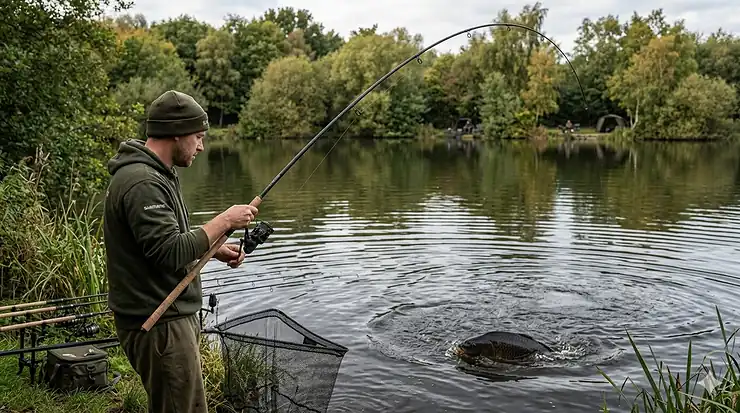
Choosing which test curve for carp fishing can feel like navigating a minefield, especially when you’re standing in a tackle shop surrounded by rods ranging from 2lb to 4lb ratings. I remember my first rod purchase—I grabbed a 3.5lb beast thinking “bigger is better,” only to discover it was about as subtle as using a telegraph pole to play a 10lb common at close range!
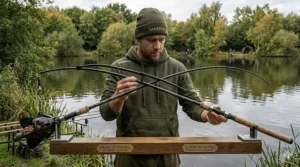
Here’s the thing most tackle dealers won’t tell you straight away: test curve is the weight required to bend your rod tip to a 90-degree angle from the butt. But what does that actually mean for your fishing? A 3lb test curve rod needs exactly 3 pounds of force to achieve that right angle. According to research from eTackle, this measurement has been the industry standard since the 1950s, yet it remains one of the most misunderstood aspects of carp tackle.
The confusion deepens because test curve alone doesn’t tell the whole story—rod action, blank construction, and your specific fishing situation all play crucial roles. You might fish intimate estate lakes where precision trumps distance, or vast reservoirs where reaching the far margins means the difference between blanking and bagging up. This comprehensive guide cuts through the marketing waffle to help you choose which test curve for carp fishing genuinely suits your angling.
Quick Comparison Table
| Rod Model | Test Curve | Length | Price (£) | Best For | Rating |
|---|---|---|---|---|---|
| NGT Carp Max | 2.75lb | 12ft | £29.95 | Budget beginners | 4.0/5 |
| Shakespeare Firebird | 3.0lb | 12ft | £49.99 | Entry-level all-rounder | 4.2/5 |
| Korda Kaizen Green | 3.5lb | 12ft | £119.99 | Mid-range versatility | 4.7/5 |
| Shimano TX-5A | 3.5lb | 12ft | £169.99 | Premium performance | 4.8/5 |
| Korda Kaizen Platinum | 3.5lb | 12ft | £399.99 | Elite long-range | 4.9/5 |
| CARP ON HOTROD | 3.0-3.5lb | 10ft | £89.99 | Stalking specialist | 4.5/5 |
| Matt Hayes Adventure | 2.5lb | 11ft | £24.99 | Ultra-budget option | 3.8/5 |
💬 Just one click – help others make better buying decisions too!😊
Top 7 Carp Rods for Different Test Curves: Expert Analysis
1. NGT Carp Max 12ft 2.75lb – The Budget Champion
The NGT Carp Max remains Britain’s best-selling starter rod for good reason. With its 2.75lb test curve and fibreglass construction, this 12-foot two-piece rod delivers remarkable value for money. I’ve witnessed countless newcomers land their first double-figure carp on these rods, and they consistently punch above their weight class.
Key Specifications:
- Test Curve: 2.75lb
- Material: Fibreglass
- UK Price: £29.95 (often £65 for a set of three with reels)
UK buyers consistently praise its casting smoothness, with one reviewer stating they “caught a 20lb carp on it and it held up fine.” The NGT Carp Max handles leads up to 3oz comfortably and is perfectly suited for commercial fisheries and smaller venues where you’re fishing within 80-100 yards.
✅ Pros:
- Exceptional value—often under £30
- Suitable for 2oz-3oz leads
- Forgiving action for beginners
❌ Cons:
- Heavier than carbon equivalents
- Limited to short-medium range
The 2.75lb test curve hits the sweet spot for learning proper fish-playing techniques without the harshness of stiffer rods. Perfect for small-to-medium carp in snag-free venues.
2. Shakespeare Firebird Carp 12ft 3.0lb – Reliable All-Rounder
Step up slightly in budget and you’ll discover the Shakespeare Firebird Carp, a rod that bridges the gap between beginner and intermediate tackle. This 3.0lb test curve model features a progressive action that’s become legendary amongst UK carp anglers working commercial waters.
Key Specifications:
- Test Curve: 3.0lb
- Construction: Lightweight carbon composite
- UK Price: £49.99-£59.99
According to customer feedback from UK buyers, the Shakespeare Firebird offers “great value for money” with its DPS reel seat, titanium oxide guides, and modern EVA handles. The progressive action means it bends beautifully through the blank when playing fish, yet retains enough backbone for casting 3-4oz leads to respectable distances.
✅ Pros:
- Titanium oxide insert guides
- Cushioned DPS reel seat
- Good mid-range casting performance
❌ Cons:
- Slightly stiff for close-range work
- No cloth bag included
This 3lb test curve configuration represents what Korda’s research describes as the “modern sweet spot”—powerful enough for 100+ yard casts whilst remaining enjoyable for playing fish under the rod tip.
3. Korda Kaizen Green 12ft 3.5lb – Mid-Range Marvel
When Korda announced they’d produce a budget version of their premium Platinum range, scepticism ran high. The Korda Kaizen Green silenced doubters spectacularly. This 3.5lb test curve rod costs under £120 yet delivers performance that embarrasses rods costing three times as much.
Key Specifications:
- Test Curve: 3.5lb
- Blank: Japanese carbon with fast-taper profile
- UK Price: £119.99
Team Korda angler Darrell Peck describes the 3.5lb model as representing “incredible quality at an almost unimaginable price point,” capable of casting 4oz leads beyond 100 yards whilst maintaining superb fish-playing characteristics. UK buyers consistently report adding 10+ yards to their casting distance immediately upon switching to the Kaizen Green.
✅ Pros:
- Exceptional casting distance
- Lightweight Japanese carbon construction
- Matt finish looks premium
❌ Cons:
- May feel overpowered for small waters
- Requires proper casting technique
The 3.5lb test curve makes this the quintessential all-rounder for UK carp fishing, equally at home flicking rigs to margin spots or bombing leads to far bank features on large reservoirs.
4. Shimano TX-5A 12ft 3.5lb – Premium Performer
Shimano’s Tribal range brought Japanese rod-building excellence to carp fishing, and the Shimano TX-5A represents the pinnacle of mid-priced performance. The 3.5lb test curve model combines HPC200 and Biofibre carbon in ways that make casting feel effortless.
Key Specifications:
- Test Curve: 3.5lb (also available in 2.75lb, 3.0lb, 3.25lb)
- Blank Technology: HPC200 + Biofibre carbon
- UK Price: £169.99
High Pressure Carbon construction creates blanks that are stiffer and more responsive than conventional carbon fibre. The Shimano TX-5A weighs just 330g yet handles the punishment of extreme-range casting with aplomb. The Winn Grip handle material provides exceptional grip even when your hands are soaking wet—a godsend during those autumn dawn sessions.
✅ Pros:
- SeaGuide Zirconia guides
- Extremely lightweight (330g)
- Excellent warranty support
❌ Cons:
- Premium price point
- May be overkill for small venues
According to Angling Times’ 2026 testing, the TX-5A achieves casting distances beyond 135 yards with minimal technique changes, making it ideal for targeting showing fish on big pits.
5. Korda Kaizen Platinum 12ft 3.5lb – Elite Investment
The Korda Kaizen Platinum represents four years of development by some of carp fishing’s brightest minds. This 3.5lb test curve flagship model uses ZERO90 Japanese carbon in just two layers with minimal resin content, creating blanks that feel telepathic in your hands.
Key Specifications:
- Test Curve: 3.5lb (range: 3.0-4.0lb available)
- Construction: ZERO90 super-tensile Japanese carbon
- UK Price: £399.99-£449.99
Danny Fairbrass designed the Kaizen Platinum to be “an absolute joy to use—so lightweight, but powerful, with really light rings that move through the air so easily.” The fast-tapered profile delivers incredibly crisp tip speeds, translating directly into extended casting range. Team Korda measured casts exceeding 200 yards in real fishing situations at France’s Iles3.
✅ Pros:
- Fuji DPS reel seat
- Ti forged American Tackle guides
- UK-made craftsmanship
❌ Cons:
- Premium pricing (£400+)
- Requires skilled casting
The 3.5lb test curve in the Platinum configuration offers what Korda describes as “the perfect all-rounder”—capable of delicate precision flicks on intimate waters through to 35+ wrap blasts on continental venues.
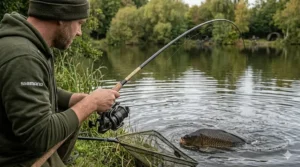
6. CARP ON HOTROD 10ft 3.0-3.5lb – Stalking Specialist
Not all carp fishing requires 12-foot rods and horizon-seeking casts. The CARP ON HOTROD brings Korean carbon technology to the stalking and margin fishing market with exceptional results. Available in 3lb, 3.25lb, and 3.5lb test curves, this 10-foot extender rod excels in tight swims.
Key Specifications:
- Test Curve: 3.0lb, 3.25lb, or 3.5lb options
- Length: 10ft (3m)
- UK Price: £89.99
The two-piece part-telescopic design with full cork handle provides excellent grip during those heart-stopping moments when a big mirror charges toward an overhanging willow. UK buyers report the ultra-light high-grade carbon construction makes all-day stalking sessions far less fatiguing than traditional 12-foot setups.
✅ Pros:
- Ideal for stalking and margin work
- Full cork handle
- Korean carbon construction
❌ Cons:
- Limited casting distance capability
- Specialist application only
For anglers working intimate estate lakes or targeting showing fish in margins, the shorter length combined with test curves from 3.0-3.5lb delivers pinpoint accuracy impossible with longer rods.
7. Matt Hayes Adventure 11ft 2.5lb – Ultra-Budget Option
Sometimes you need a spare rod, a travel option, or simply an affordable way to introduce youngsters to carp fishing. The Matt Hayes Adventure fills this niche admirably with its 2.5lb test curve and budget-friendly pricing.
Key Specifications:
- Test Curve: 2.5lb
- Construction: Fibreglass
- UK Price: £24.99
This three-piece 11-foot rod won’t win design awards, but UK customer reviews consistently mention its ability to handle carp up to 20lbs without drama. The 2.5lb test curve provides excellent cushioning for lighter lines, making it perfect for float fishing or stalking with minimal terminal tackle.
✅ Pros:
- Exceptional value under £25
- Three-piece travel-friendly design
- Forgiving 2.5lb action
❌ Cons:
- Fibreglass construction feels dated
- Limited casting distance
- Basic components
One UK reviewer noted: “Nice budget rod though—if you are a more serious angler looking to catch bigger fish then I would spend more money.” That’s fair assessment. For learning curve, exploring new venues without risk, or backup tackle, the Matt Hayes Adventure delivers surprising value.
Understanding Test Curves: The Science Behind the Numbers
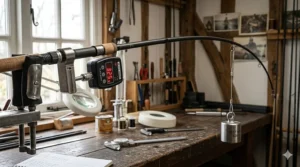
The test curve measurement might seem like arcane tackle-shop jargon, but understanding it transforms your rod selection process. Imagine clamping a rod horizontally by its handle, then attaching weights to a line threaded through the guides. When the tip reaches precisely 90 degrees to the butt section, the weight you’ve attached equals the test curve rating.
What Test Curve Actually Tells You
According to CPS Tackle’s technical analysis, higher test curves indicate stiffer rods capable of handling heavier leads and larger fish. However, stiffness comes with trade-offs—a 3.5lb rod delivers exceptional casting power but requires more skill to play fish smoothly at close range compared to a softer 2.5lb model.
Here’s what surprised me most when researching this guide: two rods with identical 3lb test curves can feel dramatically different. Rod action—whether the blank bends primarily in the tip (fast action), through the middle (moderate action), or all the way to the butt (through action)—affects performance as much as test curve rating.
The UK Standard Explained
British rod manufacturers typically offer test curves from 2lb through 3.75lb for carp fishing, though specialist rods reach 4lb or beyond. Research from Fishing Mood confirms this range covers virtually all UK carp fishing scenarios:
- 2.0-2.5lb: Small commercials, float fishing, light tactics
- 2.75lb: Medium-range general fishing
- 3.0lb: Modern all-rounder favourite
- 3.25-3.5lb: Long-range and specimen work
- 3.75lb+: Extreme distance or heavy snag fishing
The measurement has remained relevant since its 1950s introduction because it provides a standardised comparison point, even if it doesn’t tell the complete story about rod performance.
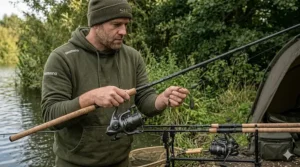
Test Curve Categories: Matching Power to Purpose
Light Test Curves (2.0-2.5lb): Finesse and Feel
Rods in the 2.0-2.5lb test curve range excel when sensitivity matters more than brute force. Commercial fisheries, small estate lakes, and float fishing scenarios benefit from these softer rods. You’ll experience every head shake, every lunge, every moment of the fight with startling clarity.
These lighter test curves also protect light hooklinks—if you’re fishing 8-10lb fluorocarbon in clear water conditions, a 2.5lb rod cushions the fish’s runs beautifully, reducing the risk of hook pulls or line breakage. According to Barbel Fishing World, through-action rods in this test curve range can still handle surprisingly large fish through superior energy absorption.
Ideal Applications:
- Commercial fisheries under 2 acres
- Float fishing for surface-feeding carp
- Stalking with minimal terminal tackle
- Waters holding predominantly single-figure fish
Medium Test Curves (2.75-3.0lb): The Sweet Spot
Walk into any UK tackle shop and you’ll find the 2.75-3.0lb test curve range dominates the carp rod section. There’s solid reasoning behind this—these test curves represent the perfect compromise between casting performance and fish-playing enjoyment for most British venues.
A 3lb test curve rod handles leads from 2-4oz comfortably, casting them 80-120 yards depending on your technique. That’s sufficient for the vast majority of UK day-ticket waters and club lakes. Angling Direct’s buyer’s guide confirms anglers working venues under 10 acres rarely need more power.
Ideal Applications:
- General-purpose day-ticket fishing
- Medium-range work (60-100 yards)
- Waters with varied features requiring accuracy
- Balanced all-round performance
The 3lb test curve has become what professional anglers call “the modern standard”—powerful enough for serious fishing yet forgiving enough to enjoy every moment of the fight.
Heavy Test Curves (3.25-3.75lb): Distance and Control
When your target showing fish patrol areas 120+ yards from the bank, or when heavy weed beds demand immediate control over hooked fish, step up to the 3.25-3.75lb test curve range. These are casting weapons first, fish-playing rods second—though modern carbon technology has narrowed that gap considerably.
Research from Total Fishing Tackle reveals premium 3.5lb rods now achieve distances that required 4lb+ monsters a decade ago, thanks to advances in carbon fibre construction and guide technology. The Korda Kaizen range, for example, uses fast-tapered profiles that concentrate power delivery for exceptional tip speeds.
Ideal Applications:
- Large reservoirs and gravel pits (10+ acres)
- Long-range fishing beyond 100 yards
- Heavy weed or snag fishing requiring instant control
- Continental venues with huge fish
One critical consideration: these stiffer rods demand proper casting technique. Muscle alone won’t maximise their potential—smooth, progressive loading of the blank through correct timing matters far more than brute strength.
Factors Beyond Test Curve: The Complete Picture
Rod Action and Taper Design
Test curve measures static load, but rod action determines how that power distributes through the blank during casting and fish-playing. A fast-action 3.5lb rod bends primarily in the top third, creating crisp, powerful casts but requiring careful handling of fish under the rod tip. Through-action rods of the same test curve bend progressively from butt to tip, sacrificing some casting efficiency for superior cushioning during the fight.
Korda’s technical documentation explains their fast-tapered profile creates higher compression strength—the blank resists collapsing under extreme loads, maintaining casting efficiency even with heavy 4-5oz leads.
Blank Construction Materials
Modern carp rods employ carbon fibres ranging from basic woven carbon through to exotic Japanese ZERO90 material. Higher modulus carbon creates stiffer, more responsive blanks from less material, reducing weight without sacrificing strength. The Shimano TX-5A’s HPC200 carbon, for instance, undergoes high-pressure curing that evenly distributes resin through the carbon matrix, increasing blank strength by approximately 35% over conventional construction.
Guide Configuration and Spacing
Guide placement affects casting distance and fish-playing action significantly. Widely spaced guides with larger diameters reduce friction during the cast but can create more “slap” as the line settles. Tighter guide spacing with smaller rings increases friction marginally but improves accuracy and reduces tangles. American Tackle’s Ti Forged guides on the Kaizen Platinum use forward-facing profiles specifically designed to minimise line tangling during extreme-distance casting.
Choosing Which Test Curve for Carp Fishing: Decision Framework
Consider Your Primary Fishing Venue
Small commercial fisheries (under 3 acres): 2.5-2.75lb test curve rods provide ample power whilst maximising enjoyment. You’ll rarely cast beyond 50 yards, so distance capability matters less than accurate, controlled casting and superb fish-playing characteristics.
Medium day-ticket waters (3-10 acres): The 3.0lb test curve dominates this category. Sufficient power for 80-100 yard casts when needed, yet forgiving enough for margin fishing and playing fish smoothly under the rod tip.
Large reservoirs and gravel pits (10+ acres): Step up to 3.25-3.5lb test curves. These venues demand distance capability, and fish often require firm handling away from far-bank snags or weed beds. The extra power proves invaluable.
Match Test Curve to Target Fish Size
Carp to 15lb: 2.5-3.0lb test curves handle these fish comfortably in all but the snaggi
est conditions. The lighter test curve actually improves your landing percentage by cushioning runs and reducing hook pulls.
Carp 15-25lb: The 3.0-3.25lb range provides the sweet spot. Sufficient backbone to control these fish near snags whilst retaining enough give to prevent hook pulls during powerful lunges.
Carp 25lb+: Consider 3.5lb+ test curves, particularly if fishing weedy or snaggy venues. Big carp combine weight with power—you’ll need immediate control to prevent them reaching sanctuary.
Factor in Casting Requirements
Short range (under 60 yards): Any test curve from 2.0-3.0lb works beautifully. Prioritise fish-playing action over raw casting power.
Medium range (60-100 yards): The 2.75-3.25lb sweet spot delivers comfortable casting distances without requiring tournament-level technique.
Long range (100+ yards): Invest in 3.25-3.75lb test curves with fast-action blanks. Distance casting rewards proper rod loading and timing—practice your technique to unlock these rods’ full potential.
Assess Snag and Weed Conditions
Open water venues: Lighter test curves enhance sport without compromising fish safety. A 2.75lb rod provides ample control when hazards aren’t immediately threatening.
Moderate snags/weed: The 3.0-3.25lb range offers good security without turning every battle into a winch-and-hope scenario.
Heavy snags/weed: Don’t compromise—use 3.5lb+ test curves. The first few seconds after the take determine success or failure in snaggy swims. You need immediate, commanding power to turn fish away from danger.
Test Curve Myths Debunked
Myth 1: “Heavier Test Curves Always Cast Further”
Partially true but massively oversimplified. Casting distance depends on rod action, blank recovery speed, guide configuration, and angler technique as much as test curve rating. A well-designed 3.0lb rod with fast-taper action outperforms poorly designed 3.75lb rods routinely. Focus on overall rod quality rather than chasing test curve numbers.
Myth 2: “You Can’t Play Big Fish on Light Test Curves”
Complete nonsense. According to forum discussions on Maggotdrowning, experienced anglers regularly land 30lb+ carp on 1.5-2.0lb test curve rods. Test curve measures static load, not breaking strain. A quality 2.5lb rod handles enormous pressure when the angler plays fish correctly—the blank’s progressive action absorbs lunges that would straighten hooks on stiffer rods.
Myth 3: “Test Curve Determines Line Strength”
The “multiply test curve by five” rule provides rough guidance—a 3lb test curve pairs reasonably with 15lb mainline—but it’s not gospel. Modern braided lines, fluorocarbon leaders, and varied fishing scenarios make this calculation overly simplistic. Match your line to the fish you’re targeting and the venue’s snag levels, then choose a rod test curve that handles that line comfortably.
Myth 4: “Stiffer Rods Mean More Hook Pulls”
Context matters enormously. Yes, poker-stiff rods can cause hook pulls if you manhandle fish, but the solution is better fish-playing technique, not automatically choosing softer rods. In snaggy conditions, a 3.5lb rod’s immediate control prevents fish reaching sanctuary—you’ll land more fish despite the stiffer action because fewer escape into snags.
Test Curve and Casting Weight Relationship
The 3:1 Rule Explained
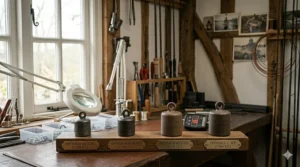
A general guideline suggests multiplying test curve by three to find optimal casting weight. A 3lb test curve rod theoretically casts 3oz leads most efficiently. However, modern rod designs blur these boundaries—some fast-action 3lb rods comfortably handle 4oz leads whilst certain through-action 3.5lb rods feel overloaded with anything beyond 3oz.
Practical Weight Ranges
2.5lb Test Curve: 1.5-3oz leads
- Sweet spot: 2-2.5oz
- Maximum: 3.5oz (technique-dependent)
3.0lb Test Curve: 2-4oz leads
- Sweet spot: 2.5-3.5oz
- Maximum: 4.5oz (with proper technique)
3.5lb Test Curve: 2.5-5oz leads
- Sweet spot: 3-4oz
- Maximum: 5oz+ (specialist long-range work)
According to Go Saltwater Fishing, exceeding these ranges risks blank damage, whilst fishing significantly below them underutilises the rod’s casting potential.
Rod Length and Test Curve Interaction
Standard 12-Foot Configuration
The 12-foot length dominates UK carp fishing because it balances casting leverage with manoeuvrability beautifully. Combined with test curves from 2.75-3.5lb, these rods handle 90% of British fishing situations admirably. The extra length over 10-foot rods improves line pick-up—crucial when setting hooks at distance—whilst remaining manageable in swims with overhead cover.
Shorter Rods (10-11 Feet)
Recent innovations from Korda and others bring 10-foot rods in test curves from 3.0-4.0lb. These excel in boat fishing, tight stalking situations, and margin work. The reduced length sacrifices some casting distance but gains exceptional accuracy and manoeuvrability. Continental anglers fishing from boats particularly favour these configurations.
Longer Rods (13 Feet)
Thirteen-foot rods in 3.5-4.0lb test curves are distance specialists. The additional length creates greater casting leverage, with skilled anglers achieving 150+ yard casts. However, they’re unwieldy in confined swims and heavier to fish all day. Choose these only if your primary venues genuinely demand extreme casting range.
Comparing Test Curves Across Rod Types
| Application | Recommended TC | Rod Length | Typical Price | Key Features |
|---|---|---|---|---|
| Commercial fishery | 2.5-2.75lb | 11-12ft | £30-£80 | Through action, forgiving |
| General day-ticket | 3.0lb | 12ft | £50-£150 | Versatile all-rounder |
| Big-pit fishing | 3.25-3.5lb | 12-13ft | £120-£400 | Fast taper, distance casting |
| Stalking/margin | 2.5-3.5lb | 10ft | £80-£200 | Accuracy over distance |
| Extreme range | 3.5-4.0lb | 13ft | £200-£500 | Specialist distance tools |
Test Curve Selection by Experience Level
Beginners (First Season)
Start with 2.75-3.0lb test curves in 12-foot configurations. These rods forgive technical mistakes whilst providing sufficient power for learning proper casting and fish-playing techniques. Avoid the temptation to buy ultra-stiff rods—they’ll frustrate learning and reduce your enjoyment. Budget £30-£80 per rod for quality entry-level options like the NGT Carp Max or Shakespeare Firebird.
Intermediate Anglers (1-3 Seasons)
Once you’ve developed consistent casting technique and fish-playing skills, explore the 3.0-3.25lb range. These rods unlock longer casting distances whilst remaining enjoyable for playing fish. Consider investing £100-£200 per rod—the Korda Kaizen Green or Shimano TX-5A deliver noticeable performance improvements over budget alternatives.
Advanced Anglers (3+ Seasons)
Experienced anglers often own multiple rods in different test curves, selecting appropriate tackle for specific venues and situations. A typical advanced setup might include:
- 10ft 3.5lb rods for stalking
- 12ft 3.0lb rods for general work
- 12ft 3.5lb rods for distance fishing
- 13ft 4.0lb specialist rods for extreme range
Investment in premium rods like the Kaizen Platinum becomes justifiable when marginal performance gains translate to tangible results.
Seasonal Test Curve Considerations
Spring and Summer Fishing
Warmer water temperatures see carp feeding aggressively and fighting powerfully. Many anglers favour slightly heavier test curves (3.0-3.5lb) during these seasons, as fish battle harder and weed growth creates additional challenges. The extra backbone helps control fish away from weed beds without excessive pressure.
Autumn and Winter Fishing
Colder water reduces carp metabolism and fight intensity. Lighter test curves (2.5-3.0lb) enhance bite detection and provide more enjoyable sport with less aggressive fish. However, if targeting winter fish in heavy weed or snags, maintain heavier test curves (3.25-3.5lb) for control.
Maintenance and Care Tips for Different Test Curves
Heavier test curve rods withstand abuse better than their lighter counterparts, but all rods benefit from proper care:
After Each Session:
- Wipe down blank and guides with damp cloth
- Check for guide damage or loose wrappings
- Store in protective sleeves or holdalls
Monthly:
- Inspect line guides for cracks or chips
- Check reel seat for tightness
- Test blank for dead spots by flexing gently
Annually:
- Deep clean with warm soapy water
- Inspect joints for wear on multi-piece rods
- Consider professional blank inspection for high-end rods
Lighter test curve rods (under 2.75lb) require gentler handling—their softer blanks damage more easily from impacts. Heavier rods (3.25lb+) tolerate rougher treatment but still deserve respect. A £400 Kaizen Platinum deserves better care than being thrown loose in a van!
FAQ
❓ What test curve rod is best for beginners learning carp fishing?
❓ Can you use a 3.5lb test curve rod on small lakes?
❓ How does test curve affect casting distance in carp fishing?
❓ What's the difference between 3.0lb and 3.5lb test curve rods?
❓ Is a 2.5lb test curve too light for 20lb carp?
Conclusion: Making Your Test Curve Choice
Selecting which test curve for carp fishing ultimately depends on matching rod power to your specific fishing scenarios. We’ve examined seven exceptional rods spanning test curves from 2.5-3.5lb and prices from £25-£400, revealing that success comes from appropriate selection rather than maximum power.
For most UK carp anglers, a 3.0lb test curve in 12-foot configuration delivers optimal versatility. Rods like the Shakespeare Firebird or Korda Kaizen Green handle the vast majority of British venues admirably, providing sufficient casting range whilst remaining enjoyable for playing fish. Budget-conscious anglers find excellent value in the NGT Carp Max (2.75lb), whilst those pursuing maximum performance discover the Korda Kaizen Platinum or Shimano TX-5A (both 3.5lb) deliver measurable advantages.
Remember that test curve represents just one specification amongst many. Rod action, blank construction, guide quality, and your casting technique influence performance significantly. Two 3lb test curve rods can feel dramatically different depending on their taper profiles and carbon grades. Whenever possible, handle rods before purchasing—the “feel” in your hands matters enormously.
As carp fishing evolves, so does rod technology. Modern 3.5lb rods deliver distances that required 4lb+ monsters a decade ago, whilst playing fish more enjoyably than older designs. This progression means yesterday’s conventional wisdom about test curves needs updating. Don’t automatically dismiss lighter test curves for big fish, nor assume heavier rods guarantee distance—focus on overall rod quality and suitability for your fishing.
Your perfect test curve awaits amongst these seven options. Match it thoughtfully to your venues, target fish, and skill level, and you’ll discover carp fishing becomes more successful and infinitely more enjoyable.
Recommended for You
- 7 Best Spod Rods in 2026 – Expert UK Guide & Reviews
- 7 Best Carp Stalking Rods UK 2026
- 7 Best 13ft Carp Rods UK 2026 | Expert Distance Casting Guide
Disclaimer: This article contains affiliate links. If you purchase products through these links, we may earn a small commission at no additional cost to you. Prices shown are approximate and may vary.
✨ Found this helpful? Share it with your mates! 💬🤗
