

In This Article
If you’ve ever watched your bait drift downstream whilst barbel and bream feed contentedly just metres away, you’ll understand the frustration that drives anglers to cage feeders. These ingenious devices have revolutionised river fishing across the UK, transforming how we present groundbait, pellets, and particles to target species. Whether you’re stalking trophy barbel on the River Trent or targeting slab-sided bream in your local canal, cage feeders offer unmatched versatility and effectiveness.
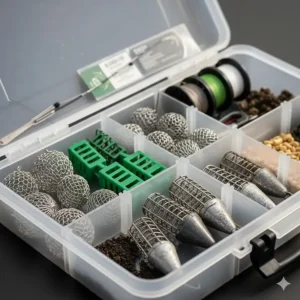
Unlike method feeders or block-end designs, cage feeders feature an open mesh construction that allows bait to disperse at a controlled rate, creating an attractive feeding zone around your hookbait. This makes them particularly effe
ctive in flowing water, where the current carries scent trails downstream, drawing fish upstream to your carefully positioned rig. From budget-friendly options perfect for beginners to precision-engineered models favoured by match anglers, today’s cage feeders represent remarkable value and performance.
In this comprehensive guide, we’ll explore the seven best cage feeders available on Amazon.co.uk in 2026, complete with specifications, real user feedback, and expert recommendations to help you choose the perfect feeder for your fishing style.
Quick Comparison Table: Top Cage Feeders at a Glance
| Product | Weight Options | Price Range | Best For | Rating |
|---|---|---|---|---|
| Preston ICS Inline Cage | 20g-45g | £2.99-£5.99 | Quick-change systems | 4.3/5 |
| Preston Hexmesh Plastic | 20g-30g (pack of 3) | £13.49 | Rapid bait release | 4.0/5 |
| Guru Commercial Cage | 25g-30g | £2.75 | Match fishing | 4.5/5 |
| FLADEN Wire Cage (10pk) | 20g-25g | £11.14 | Budget bulk buying | 4.3/5 |
| Korum River Cage | 30g-90g | £2.25-£4.99 | Fast-flowing rivers | 4.2/5 |
| BZS Alloy Steel Round | 10g-60g | £11.99 | Complete weight range | 4.4/5 |
| Drennan Stainless Oval | 20g-70g | £2.15-£3.50 | Low-profile design | 4.7/5 |
💬 Just one click – help others make better buying decisions too!😊
Top 7 Cage Feeders: Expert Analysis & Real User Feedback
1. Preston Innovations ICS Inline Cage Feeder – The Quick-Change Champion
The Preston Innovations ICS Inline Cage Feeder represents a genuine game-changer for UK match anglers who value efficiency. Compatible with Preston’s innovative ICS (Interchange System), these feeders allow you to swap between different sizes and weights without dismantling your entire rig—a massive advantage when conditions change mid-session.
Key Specifications:
- Available in Small (20g, 30g), Medium (20g, 30g, 45g), Large (30g, 45g)
- Weight-forward design for casting accuracy
- Durable plastic frame construction
UK anglers consistently praise these feeders for their reliability and casting performance. One reviewer noted they’re “perfect for commercials and natural venues alike,” whilst another highlighted the convenience of the quick-change system for adapting to different fishing scenarios. However, some buyers mentioned receiving fewer feeders than expected based on product images, so always check the quantity carefully.
✅ Pros: Quick-change compatibility, accurate casting, durable construction
❌ Cons: Premium pricing, can be confusing regarding pack quantities
Price: £2.99-£5.99 | Best for: Match anglers using ICS systems
2. Preston Innovations Hexmesh Plastic Cage Feeder – Revolutionary Bait Release Technology
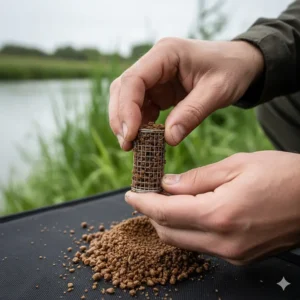
The Preston Hexmesh Plastic Cage Feeder utilises Preston’s proprietary Hexmesh material to deliver what the company claims is “optimum bait release.” This advanced mesh design creates larger holes than traditional wire cages, allowing groundbait and pellets to disperse more rapidly—crucial when targeting fast-feeding species like F1 carp on commercial fisheries.
Key Specifications:
- Sold in packs of 3
- Micro (30g), Large (20g), Medium (20g, 30g) sizes
- Advanced Hexmesh material construction
British anglers appreciate the rapid bait discharge, particularly effective on shallow island margins where explosive bait presentation triggers immediate responses from feeding fish. The three-pack format offers decent value, though at £13.49, these represent a premium investment compared to traditional wire cage feeders.
✅ Pros: Rapid bait release, perfect for commercials, durable plastic
❌ Cons: Premium price point, limited size options
Price: £13.49 (pack of 3) | Best for: Commercial fishery specialists
3. Guru Commercial Cage Feeder – Match Fishing Excellence
The Guru Commercial Cage Feeder has earned its reputation amongst UK match anglers through thoughtful design and outstanding build quality. Featuring a weight-forward design that aids accurate casting, these feeders come with both inline and swivel stems, plus compatibility with Guru’s X-Safe system for ultra-quick rig changes.
Key Specifications:
- Mini (25g), Small (25g), Medium (30g), Large (30g)
- Interchangeable tube system (inline/swivel)
- X-Safe compatible for rapid feeder changes
UK customers rave about the “super-strong durable frame” and the large holes that facilitate rapid bait release. The Guru camo finish helps the feeder blend into the riverbed, reducing fish wariness—a significant advantage on pressured venues. At £2.75, these offer exceptional value for match anglers who demand professional-grade equipment without premium pricing.
✅ Pros: Interchangeable stems, X-Safe compatible, excellent value
❌ Cons: Limited to lighter weights, camo finish may wear over time
Price: £2.75 | Best for: Commercial match anglers
4. FLADEN 10 x Wire Cage Swim Feeders – Budget Bulk Champion
For anglers who like to stock up or fish sessions where feeder loss is a real possibility (looking at you, snaggy rivers!), the FLADEN 10 x Wire Cage Swim Feeders offer unbeatable value. Choose from round, square, or hexagon shapes, all constructed from robust wire mesh with quality swivels.
Key Specifications:
- Pack of 10 feeders
- Round, square, or hexagon designs
- 20g or 25g weight options
British anglers consistently praise these feeders for their build quality and value proposition. One reviewer commented they’re “better than expected for the price” and noted they cast well despite their budget-friendly nature. At approximately £1.11 per feeder, they’re perfect for beginners or as spare feeders for experienced anglers. The variety of shapes allows experimentation to see which design works best in your local venues.
✅ Pros: Exceptional value (10-pack), shape variety, good build quality
❌ Cons: Limited weight options, basic design
Price: £11.14 (10-pack) | Best for: Budget-conscious anglers, beginners
5. Korum River Cage Feeder – The Flowing Water Specialist
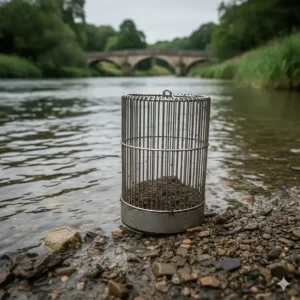
The Korum River Cage Feeder features a hydrodynamic design specifically engineered for fast-flowing rivers—precisely where barbel, chub, and other powerful species feed. Its low-profile design grips the riverbed better than standard round feeders, whilst the closed rear design enables use of larger particle baits in deeper water with a slower, more controlled release.
Key Specifications:
- Weights from 30g up to 90g for XL version
- Hydrodynamic design for flowing water
- Super-strong metal mesh frame
UK river anglers appreciate the camo finish for ultimate camouflage and the feeder’s ability to hold bottom in strong currents. The closed-end design is particularly clever, allowing you to fish larger particles like cubed meat or whole pellets without losing them on the cast. These feeders represent excellent value for serious river specialists targeting specimen fish.
✅ Pros: Excellent river performance, strong construction, camo finish
❌ Cons: Heavier weights only, not ideal for stillwaters
Price: £2.25-£4.99 | Best for: River specialists, barbel anglers
6. BZS Alloy Steel Round Black Cage Metal Feeder – Complete Weight Range Solution
The BZS Alloy Steel Round Black Cage Metal Feeder offers perhaps the most comprehensive weight range available, from delicate 10g models for canal fishing right up to hefty 60g versions for distance work or powerful currents. This versatility makes them ideal for anglers who fish varied venues.
Key Specifications:
- Available in 10g, 15g, 20g, 25g, 30g, 40g, 50g, 60g
- Alloy steel construction with black finish
- Quality swivel snap attachments
British customers praise the build quality, with over 600 reviews averaging 4.4 stars. The black finish reduces glare and provides good camouflage across most riverbeds and lake bottoms. At £11.99 for the multi-weight pack, they offer outstanding value, though confirm exactly which weights you’re purchasing as pack contents can vary.
✅ Pros: Comprehensive weight range, quality construction, good value
❌ Cons: Pack contents vary, basic round design
Price: £11.99 (multi-weight pack) | Best for: Multi-venue anglers
7. Drennan Stainless Oval Cage Feeder – Low-Profile Perfection
The Drennan Stainless Oval Cage Feeder represents British engineering at its finest. The oval shape hugs the bottom more effectively than round designs whilst being less obvious to wary fish—a crucial advantage on pressured venues. Drennan’s distinctive camo bronze finish and anti-flash coating ensure minimal fish disturbance.
Key Specifications:
- Weights from 20g to 70g (Heavyweight range)
- Oval shape for enhanced bottom contact
- Stainless steel mesh with camo bronze finish
UK anglers consistently rate these feeders highly for their versatility across rivers and stillwaters. According to the Environment Agency’s fishing byelaws, proper feeder use helps maintain sustainable fishing practices, and Drennan’s design facilitates this through controlled bait release. The mesh releases bait faster than solid-walled alternatives whilst the flat bottom prevents rolling on slopes.
✅ Pros: Low-profile design, versatile, quality British engineering
❌ Cons: Premium pricing, limited availability
Price: £2.15-£3.50 | Best for: Versatile all-round performance
✨ Don’t Miss These Exclusive Deals!
🔍 Take your match fishing to the next level with these carefully selected cage feeders. Click on any highlighted item to check current pricing and availability on Amazon.co.uk. These tools will help you create authentic feeding zones your target species will love!
Understanding Cage Feeders: How They Work & Why They’re Essential
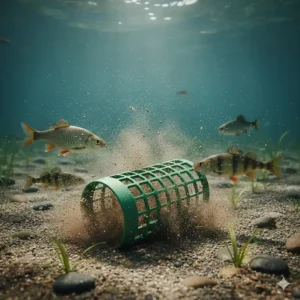
Cage feeders function through elegantly simple physics combined with clever angling nous. When cast into position, the feeder settles on the riverbed or lake bottom with your hookbait positioned nearby via a hooklength. As water flows through the mesh cage—or as fish investigate and bump the feeder—groundbait, pellets, or particles gradually disperse, creating an attractive feeding zone.
The open mesh construction offers several advantages over solid-walled alternatives. Firstly, bait release begins immediately upon hitting the water, creating instant attraction. Secondly, the mesh allows scent molecules to escape more readily, establishing those crucial scent trails that draw fish from considerable distances. Finally, the graduated release ensures your swim remains baited throughout your session rather than dumping all feed instantly.
According to research by The Barbel Society, feeders are particularly effective for targeting bottom-feeding species, as they deposit bait precisely where fish naturally forage. This controlled presentation significantly outperforms hand-feeding in flowing water, where current disperses loose offerings unpredictably.
Distance Cage Feeders: Mastering Long-Range Presentation
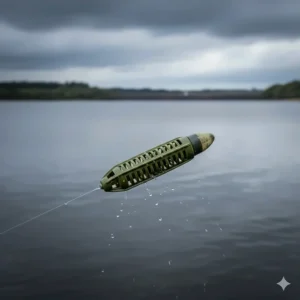
Distance cage feeders represent a specialised category designed for situations requiring maximum casting range. Whether you’re fishing large reservoirs, wide rivers, or simply need to reach features far from the bank, distance feeders incorporate aerodynamic profiles and weight-forward designs that slice through headwinds and deliver pinpoint accuracy at range.
The key to distance feeder success lies in understanding weight distribution. Most premium distance feeders position the lead weight towards the front, creating a “nose-heavy” design that flies true even in challenging conditions. Preston’s ICS range and Guru’s Commercial Cage Feeders both employ this principle, enabling casts exceeding 40 metres whilst maintaining accuracy within a rod-length.
When fishing at distance, consider these expert tips:
- Use slightly heavier feeders than you’d normally choose to combat wind resistance
- Employ a shock leader (8-10lb fluorocarbon) to protect your mainline during powerful casts
- Ensure your feeder holds bottom—there’s no point reaching the swim if current drags your rig downstream
- Pack groundbait firmly to survive the journey; loose mixes disintegrate mid-flight
Inline Feeders Setup: Step-by-Step Configuration Guide
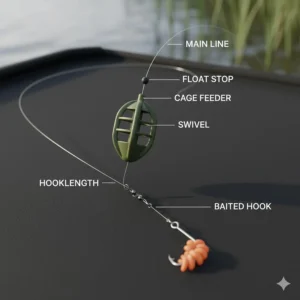
Inline feeder rigs offer significant advantages for wary species and safety-conscious anglers. The inline design allows the mainline to pass through the feeder body, creating a free-running setup where hooked fish can move away without feeling immediate resistance. This configuration also ensures lost feeders can slide off if your mainline breaks—crucial for fish welfare.
Setting Up Your Inline Cage Feeder:
- Thread your mainline through the feeder’s inline tube, ensuring the heavier end faces your rod
- Add a small rubber bead to protect your knot from feeder impact
- Tie on a size 11 or 10 rolling swivel using a five-turn grinner knot
- Attach your hooklength (typically 60-120cm for cage feeders) to the swivel
- Add your chosen hook and bait
The Preston ICS Inline Cage Feeders excel in this application thanks to their quick-change capability. Simply clip the feeder onto your rig’s inline stem, and you can swap to different sizes or weights within seconds—invaluable when conditions change or you’re targeting different species.
Window Feeders: Innovative Bait Presentation Technology
Window feeders—sometimes called “method cages”—combine elements of both cage and method feeder designs. They feature a solid base with mesh sides and often include a raised “window” area where your hookbait sits. This design creates explosive bait presentation whilst keeping your hookbait prominently positioned.
The window design works brilliantly on commercial fisheries where carp and F1s respond aggressively to concentrated feed. As the groundbait breaks down, it forms a cloud around your hookbait, whilst the mesh sides allow particles like pellets or corn to escape gradually, maintaining fish interest.
For optimal window feeder performance:
- Use sticky groundbait mixes that hold together firmly
- Press 4-6mm pellets into the exposed groundbait for added attraction
- Position your hookbait in the window recess for perfect presentation
- Experiment with different groundbait colours; darker mixes work well in clear water
Feeder Weights Guide: Matching Conditions to Specifications
Selecting appropriate feeder weight represents one of coarse fishing’s most crucial yet overlooked skills. Too light, and current sweeps your rig downstream; too heavy, and you sacrifice casting distance whilst potentially spooking fish with a heavy impact.
General Weight Guidelines:
Light Feeders (10-20g):
- Stillwaters and gentle-flowing canals
- Short to medium range (up to 25 metres)
- Targeting smaller species or fishing delicately
Medium Feeders (25-40g):
- Moderate river flow
- Medium range work (25-40 metres)
- Versatile all-round choice for most UK venues
Heavy Feeders (45-70g+):
- Fast-flowing rivers during high water
- Long-range casting (40+ metres)
- Strong winds or when maximum accuracy essential
The Korum River Cage Feeders and Drennan Heavyweight range specialise in heavier weights, making them ideal for challenging river conditions. Conversely, the FLADEN pack and BZS multi-weight sets cover lighter applications perfectly.
Feeder Casting Accuracy: Professional Techniques Revealed
Consistent casting accuracy separates successful feeder anglers from frustrated beginners. According to match fishing experts, landing your feeder within a metre-square area repeatedly throughout a session dramatically improves catch rates by concentrating feed and hookbaits.
Six Steps to Perfect Feeder Accuracy:
Technique 1: Choose a Far-Bank Reference Point
Select a distinctive feature—tree, post, building—directly behind your target area. This gives you a precise aiming point throughout your session.
Technique 2: Clip Up Your Line
After measuring your distance with the first cast, engage your reel’s line clip. This ensures identical casting distance every time.
Technique 3: Master the Overhead Thump
The overhead cast provides maximum accuracy. Start with the rod tip low, accelerate smoothly, and “punch” the rod forward at approximately 1 o’clock position.
Technique 4: Feather Your Cast
As the feeder approaches your target area, gently touch the spool rim to slow descent. This prevents overshooting and reduces impact splash.
Technique 5: Account for Wind Drift
Crosswinds push feeders sideways during flight. Aim slightly upwind, allowing the breeze to drift your feeder onto target.
Technique 6: Practice Shallow Water Sessions
Spend time practicing on quiet venues where you can watch your feeder land. Visual feedback accelerates learning dramatically.
Weight-forward designs like the Preston Hexmesh and Guru Commercial range significantly aid casting accuracy through their aerodynamic profiles. The weight concentration pulls the feeder straight, reducing tumbling during flight.
Open-End vs Cage Feeders: Comprehensive Comparison
Open-end feeders feature capped ends that contain groundbait until impact, whereupon the mix explodes outward creating instant attraction. Cage feeders, conversely, allow gradual bait release throughout their journey and whilst resting on the bottom. Understanding these differences helps you select appropriate tackle for specific situations.
Cage Feeder Advantages:
- Gradual bait release creates sustained feeding periods
- Mesh design withstands snags better than plastic block-ends
- Excellent in flowing water where scent trails draw fish
- Works with various baits: groundbait, pellets, particles, chopped worm
Open-End Feeder Advantages:
- Explosive bait release triggers immediate feeding response
- Better for heavily pressured waters where instant attraction crucial
- Easier to load—simply pack with groundbait and cap
- Ideal for stillwaters where concentrated feed holds fish
For UK river fishing—particularly when targeting barbel, chub, or bream—cage feeders generally outperform open-ends. The flowing water carries scent downstream whilst the mesh construction survives the rocky, snag-strewn river environments that define British waterways. Research published onFisheries.co.uk suggests bream respond particularly well to cage feeder presentation in river situations.
Flowing Water Feeders: River-Specific Strategies
River fishing demands specialised feeder tactics that account for current, depth variation, and the powerful species inhabiting flowing water. Success requires understanding how current affects your presentation and adapting your approach accordingly.
Current Speed Assessment:
Drop an unweighted feeder into the margin and observe how quickly it moves. Fast drift requires heavier feeders; gentle movement suggests lighter weights suffice. The Korum River Cage Feeder’s hydrodynamic design excels in moderate to fast flows, whilst lighter FLADEN or BZS feeders suit calmer river sections.
Groundbait Consistency for Rivers:
Flowing water demands firmer mixes than stillwaters. Prepare groundbait slightly wetter than usual, then allow it to firm up for 30 minutes before use. This creates a sticky consistency that survives the cast yet breaks down gradually on the riverbed. According to BadAngling’s barbel guide, block-end or open-ended feeders work effectively with stiff groundbait as carriers for hempseed or pellets in rivers.
Positioning for Current:
Fish holding stations in rivers typically lie slightly downstream of obstructions—behind weedbeds, rocks, or underwater features. Position your feeder slightly upstream of these zones, allowing current to wash scent and particles into the holding area.
Species-Specific Feeder Strategies for UK Waters
Barbel Fishing with Cage Feeders
Barbel represent the ultimate river quarry, and cage feeders have revolutionised how UK anglers target these powerful fish. The species’ bottom-feeding nature makes them perfect candidates for feeder fishing, whilst their preference for flowing water suits the gradual bait release cage feeders provide.
Optimal Setup:
- Heavy feeders (45-70g) to hold bottom in barbel swims
- 90-120cm hooklengths in 8-12lb fluorocarbon
- Hemp, pellets, or chopped meat in the feeder
- Halibut pellet, luncheon meat, or boilies on the hook
Bream Fishing Excellence
According to Angling Times’ feeder fishing guide, nothing beats the feeder for river bream. The method puts your bait close to feed whilst keeping everything stationary on the bottom—exactly what bream demand.
Winning Approach:
- Medium feeders (25-35g) for typical bream swims
- 60-100cm hooklengths
- 50:50 sweet and fishmeal groundbait mix
- Chopped worm and casters in the feeder
- Worm or double caster hookbait
Essential Accessories for Cage Feeder Success
Quality feeders represent just one component of successful feeder fishing. These accessories transform good sessions into exceptional ones:
Feeder Beads & Links:
Protect knots and prevent tangles. Preston and Guru both produce excellent feeder link systems that streamline rig construction whilst reducing tangle risk.
Bait Moulds:
Consistency matters tremendously in feeder fishing. Dedicated groundbait moulds ensure every cast delivers identical feed quantities, crucial for match fishing or when establishing feeding patterns.
Feeder Rod & Reel:
A proper feeder rod (11-13ft, 1.5-2.5lb test curve) provides the backbone needed for long-range casting whilst offering sensitivity to detect delicate bites. Match this with a quality reel featuring smooth drag—essential when barbel make their characteristic powerful runs.
Groundbait Bowls & Riddles:
Professional-quality mixing bowls and riddles ensure lump-free, perfectly textured groundbait. This attention to detail separates consistent performers from occasional lucky catches.
Advanced Techniques: Maximising Your Feeder Fishing
The Helicopter Rig for Cage Feeders
This sophisticated setup positions your hookbait directly above the feeder, creating a natural falling presentation that triggers aggressive takes. Particularly effective on commercial fisheries when targeting carp or F1s feeding in upper water layers.
Running Feeder Rigs for Wary Fish
When targeting pressured or cautious species, a true running rig—where the feeder slides freely on the mainline stopped only by a leger stop 45cm from the hook—can make the difference between success and failure. Fish feel minimal resistance when picking up the bait, resulting in confident takes.
The Duo Feeder Method
Some adventurous anglers employ two feeders—one heavy anchor feeder with a short hooklength for the main rod, plus a lighter feeder positioned slightly upstream on a second rod. This “feeder chain” creates an extended feed area, drawing fish from wide swathes of river.
Seasonal Feeder Fishing: Year-Round Strategies
Spring Tactics (April-June)
Post-spawning fish resume feeding cautiously. Lighter feeders with modest bait quantities work best as fish haven’t yet developed competitive feeding. Focus on natural baits—worms, casters, maggots—presented simply.
Summer Approach (July-September)
Peak feeding periods demand confidence. Heavier feeders packed with pellets and sweetcorn exploit fish at maximum activity. Dawn and dusk sessions produce spectacular results, particularly for barbel and bream.
Autumn Excellence (October-November)
Many specimen hunters consider autumn peak feeder fishing season. Cooling water temperatures trigger intensive feeding as fish prepare for winter. Bold tactics—large feeders, strong baits, regular recasting—yield impressive catches.
Winter Challenges (December-March)
Reduced metabolism means lighter feeding. Small feeders with minimal bait prevent overfeeding the swim. Worms and maggots outperform pellets as fish seek high-protein foods. Patience becomes paramount—bites may be hours apart.
Frequently Asked Questions About Cage Feeders
❓ What's the best cage feeder weight for UK rivers?
❓ Can you use cage feeders in stillwater venues?
❓ How do I stop my cage feeder tangling during casting?
❓ What's the difference between inline and swivel cage feeders?
❓ Are expensive cage feeders worth the extra money?
Conclusion: Choosing Your Perfect Cage Feeder
Cage feeders represent an investment in your angling success that pays dividends across every session. Whether you’re chasing your first barbel, building match-winning bream weights, or simply enjoying peaceful hours beside your local river, the right feeder makes all the difference.
For versatile performance across multiple venues, the Preston ICS Inline Cage Feeder offers unmatched flexibility through its quick-change system, whilst the Guru Commercial Cage Feeder provides professional quality at recreational prices. River specialists should seriously consider the Korum River Cage Feeder for its exceptional flowing-water performance, and budget-conscious anglers can’t go wrong with the FLADEN 10-pack for incredible value.
Remember that successful feeder fishing extends beyond equipment selection. Understanding water craft, mastering casting accuracy, and adapting to seasonal patterns transform good gear into great catches. Start with a quality feeder matched to your primary venue, practice your casting technique, and experiment with groundbait consistencies until you discover what works in your local waters.
The seven cage feeders reviewed today represent the finest options available to UK anglers in 2026. Each offers distinct advantages for specific situations, ensuring there’s a perfect feeder for every angler, venue, and target species. Invest wisely, fish confidently, and watch your catch rates soar.
Tight lines and bent rods!
Recommended for You
- 7 Best Method Feeders UK 2026: Expert Reviews & Buying Guide
- 7 Best Coarse Fishing Hooks UK 2026
- 7 Best Braided Line for Coarse Fishing UK 2026
Disclaimer: This article contains affiliate links. If you purchase products through these links, we may earn a small commission at no additional cost to you. Prices shown are approximate and may vary. All products featured are independently selected based on performance, quality, and value for UK anglers.
✨ Found this helpful? Share it with your mates! 💬🤗
