
In This Article
A twelve-foot dinghy has roughly the deck space of a generous dining table, and about as much tolerance for clutter. Add two rods, a landing net, a bait tub and a flask, and something is going to meet the water sooner or later. That’s the quiet case for a clip-on boat rod rest for small boats. It turns the top edge of your hull into a rod station without a single screw hole, and it comes off again when you want your boat back.
What Is a Clip-On Boat Rod Rest for Small Boats?
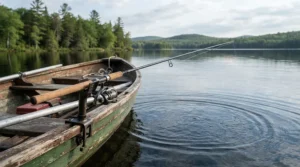
A clip-on boat rod rest for small boats is a removable rod support that clamps onto the gunwale without drilling or fixings. It cradles the rod butt and blank at an adjustable angle, freeing your hands for trolling, static bait fishing or pouring tea. It also moves between boats in minutes.
Most “best of” lists simply recycle spec sheets. This guide weighs seven real, currently listed clamp-style holders against the things that decide a day afloat. How thick a gunwale will the clamp swallow? Does the rod stay put when a pike hits? Can two rods share a stern without turning into a bird’s nest?
Prices are ranges captured at the time of research, and availability on amazon.co.uk can change week to week, so check the current price before buying. Along the way you’ll find dedicated sections on rod holders for small angling boats, gunwale clamp fit, rod retention and tangle prevention. In my analysis, those four matter more than any marketing bullet point.
Quick Comparison: Best Clip-On Boat Rod Rest for Small Boats at a Glance
| Product | Clamp Style | Cradle Style | Price Range | Best For |
|---|---|---|---|---|
| Fox Rage Predator Boat Rod Rest | Wide bracket, sides up to ~100mm | Fixed, indexed swivel, slotted front rest | Under £30 | Thick gunwales, predator fishing |
| Savage Gear MP Rodholder | Wide-gape G-clamp | Fold-out arms, closed rear/open front | Around £30 | Tight decks, occasional trolling |
| Savage Gear MP Pro Rod Holder Flex Mount | Aluminium clamp | Flexible coated arm | Around £40 | Anglers who change angle often |
| Kinetic Boat Rod Holder Open Arm | Wide-gape G-clamp | Open cradle | Under £25 | Budget second rod |
| Kinetic Boat Rod Holder Closed Arm | G-clamp | Closed cradle | Budget; check current price | Choppy water on a budget |
| Ultimate Rod-Lock Holder | Stainless G-clamp, up to 4.5cm | Closed cradle | Check current price | Pike trolling, best-reviewed |
| Scotty 230 Powerlock with 449 Portable Clamp Mount | Portable clamp, up to 2in | Open cradle with locking ring | Roughly £60-£85 combined | Owners of several craft |
Looking at the comparison above, the Fox Rage Predator Boat Rod Rest is the only one with a clearly published large clamp capacity, which makes it the safest bet for chunky gunwales. The Kinetic Boat Rod Holder Open Arm wins on pure cost. The Scotty 230 Powerlock with 449 Portable Clamp Mount looks dearest because you’re buying a system rather than a single rest. Budget buyers should note that open-cradle designs trade security for speed.
💬 Just one click — help others make better buying decisions too!😊
Top 7 Clip-On Boat Rod Rest for Small Boats: Expert Analysis
Seven holders, three budget bands, and one honest rule: a spec only counts once we’ve said what it means in a boat. Here’s the line-up.
1. Fox Rage Predator Boat Rod Rest — best clamp reach for thick gunwales
The headline is reach. The bracket is listed for hull sides up to around 100mm (4 inches) thick, so it swallows the chunky rubbing strakes and aluminium extrusions that defeat narrower clamps.
The extruded aluminium bracket is described as flex-free. In plain English, the rod doesn’t bob and chatter every time someone shifts their weight. An indexed swivel plate clicks into set positions, so a rod pointed over the quarter stays there under load. The oversized hand grip is there for numb, wet fingers in March. The rubber-overmoulded front rest has a slot that lets line run freely, so a taking fish isn’t dragging braid across a hard edge.
Based on the spec comparison, this suits predator anglers running static deadbaits or trolling lures who want one rest to fit awkward hulls. It also accepts a bite alarm. Fox lists a near-identical Fox Boat Rod Rest (model PAC004) at a slightly higher price, and the feature lists read almost word for word. Compare before paying extra for the badge.
Reviewer sentiment: only a single review was listed on the retailer page I checked, so there is no meaningful consensus to report yet.
Pros:
- ✅ Clamp reaches roughly 100mm gunwale thickness
- ✅ Indexed swivel locks the angle positively
- ✅ Slotted rubber front rest protects blank and line
Cons:
- ❌ Bulkier to stow than a compact G-clamp
- ❌ Very little independent review data
Price: under £30 at the time of research. That’s strong value for the clamp capacity, but check the current price.

2. Savage Gear MP Rodholder — fold-away arms for tight decks
Where this earns its place is the fold-out arms. They tuck away when you need the deck back, and they can sit on top of the clamp or on its side.
Underneath is a wide-gape G-clamp, and the arms rotate fully. The closed rear rest plus open front rest is the clever bit. The closed back cup stops the butt skating out in a swell, while the open front lets you lift the rod on a strike without threading it free. Retailer listings describe aluminium and stainless steel construction with a rubberised rest, which should keep the blank from rattling.
My read of the specs: this is a sensible pick where the gunwale is narrow and the deck is crowded, because side-mounting should keep the rod low and out of your elbow’s way. The maker pitches it at occasional trolling rather than all-day downrigger duty, which is honest positioning. The clamp opening isn’t published in the listings I saw, so measure your gunwale first.
Reviewer sentiment: a European price-comparison listing for the silver version showed a 4.0 out of 5 average compiled from several review sources (checked July 2026). That’s an aggregate and only indicative, and I couldn’t find a large UK review set.
Pros:
- ✅ Fold-out arms stow neatly
- ✅ Closed rear and open front balance security and strike speed
- ✅ Arms mount on top or side of the clamp
Cons:
- ❌ Clamp opening not published in listings
- ❌ Pitched for occasional, not heavy, trolling
Price: around £30 at the time of research, which is fair for the flexibility. Check the current price.
3. Savage Gear MP Pro Rod Holder Flex Mount — tool-free flex-arm adjustment
Flexibility is the whole pitch. Instead of loosening a knob and wrestling an arm into a new position, you bend this holder’s coated aluminium-wire arm by hand and it holds its shape.
The supporting cast matters more than it first appears. A nylon-reinforced carbon block sits at the stress point, non-slip rubber coating grips the rod butt, and the newer edition adds an aluminium clamp for improved strength and grip, per the retailer description. Flex arms tend to fail at the base and the clamp, so reinforcing exactly those spots is a sensible move.
On paper, this is a trolling and live-baiting tool for anglers who change rod angle constantly. Run it shallow for flat-lined lures, or steeper to keep a livebait clear of the prop wash. Flexible arms do trade rigidity for convenience, though. If you’re running heavy gear in lumpy water, a fixed-arm rest like the Fox Rage Predator Boat Rod Rest is the sturdier call.
Reviewer sentiment: I couldn’t find usable independent reviews for this model, because the review section on the retailer page showed none. The case for it rests on specs and brand reputation, not proven longevity.
Pros:
- ✅ Angle changes by hand, no tools
- ✅ Rubber-coated arm grips the rod butt
- ✅ Reinforced base and aluminium clamp
Cons:
- ❌ Flex arm is less rigid than fixed designs
- ❌ Priciest clamp-only option, with no reviews found
Price: around £40 at the time of research. That’s a premium for convenience, so it’s only worth it if you adjust often. Check the current price.
4. Kinetic Boat Rod Holder Open Arm — budget-friendly open-arm workhorse
The standout is the price-to-clamp ratio. Kinetic builds this around a G-clamp with a wide gape (the maker says it grips all but the most awkward gunwales) and pairs it with a 360° rotating open arm in aluminium and stainless steel.
Open means the rod simply lies in a U-shaped cradle. That’s quick, because you can lift the rod the instant something nibbles. It also means nothing physically stops the rod sliding out if the boat lurches or a fish bolts. In practice, an open arm is a half-solution unless you pair it with a rod leash, which we cover in the rod retention section.
The wording on this holder and the Savage Gear MP Rodholder is strikingly similar, so expect a comparable clamp design. The Savage adds fold-out arms and a closed rear rest. The aluminium-and-stainless mix should shrug off freshwater use, while salt anglers should rinse after every trip.
Reviewer sentiment: I couldn’t verify a meaningful set of buyer reviews for this exact model on the UK listings I checked, so I won’t pretend otherwise.
Pros:
- ✅ Budget pricing for a metal-bodied clamp
- ✅ Full 360° rotation
- ✅ Aluminium and stainless construction
Cons:
- ❌ Open cradle needs a leash for security
- ❌ No published clamp width
Price: under £25 at the retailers I checked (an Irish shop lists it near €20). It’s good value for a sheltered lake, but check the current price.
5. Kinetic Boat Rod Holder Closed Arm — closed cradle for choppy water
The closed arm is the whole story. The butt sits inside an enclosed cradle, so a sudden lurch or a fish bolting doesn’t flip the rod out sideways.
The listing describes heavy-duty, corrosion-resistant aluminium combined with durable polypropylene. It’s sold as a portable holder for anglers who use several boats. Translated: the clamp is intended to go on and off quickly, and the plastic elements keep weight down and corrosion away. As with its open sibling, the clamp width isn’t published, so a tape measure is your friend.
Here’s what the spec sheet won’t tell you but common sense will. A closed cradle gives up a little strike speed, because you lift the rod up and out rather than simply plucking it sideways. In exchange you get real retention on a boat that pitches. That trade suits trolling and unattended-rod situations far better than it suits anglers hovering over a bite alarm.
Reviewer sentiment: I couldn’t verify buyer reviews for this exact model, so there’s no honest consensus to report.
Pros:
- ✅ Closed cradle keeps the butt seated in a swell
- ✅ Corrosion-resistant aluminium and polypropylene mix
- ✅ Easy to swap between boats
Cons:
- ❌ Slower to free the rod than an open arm
- ❌ Clamp width not published
Price: budget-friendly, sitting close to its open-arm sibling at the retailers I checked. I couldn’t confirm a current UK price, so check it before you decide.
6. Ultimate Rod-Lock Holder — best-documented pike-trolling clamp
Evidence is its edge. Of the seven, this holder has the largest published review sample: 37 reviews averaging 4.0 out of 5 on the manufacturer’s own webshop.
The specs are straightforward. A stainless steel G-clamp with a wide opening takes boat edges up to 4.5cm thick, and a closed polypropylene cradle rotates through 360°. It’s sold for trolling lures for pike and other predators. The closed shape holds the rod through a take, yet the maker says it lifts out easily. The stainless clamp shouldn’t leave rust streaks down your hull after a season of rain.
The 4.5cm ceiling is the number to check. It suits typical aluminium dinghy lips and many fibreglass edges, but not the chunky rubbing strakes the Fox bracket accepts. Polypropylene is light and corrosion-proof but, on paper, less rigid than extruded aluminium. Expect a little more give with a heavy rod in big water.
Reviewer sentiment: reviewers on the maker’s site mostly praise the solid materials and say rods of all sorts fit and adjust easily. Because those reviews sit on the brand’s own store, treat the score as encouraging, not independent.
Pros:
- ✅ Stainless-steel clamp resists corrosion
- ✅ Closed cradle holds firm through a take
- ✅ Largest review sample in this group
Cons:
- ❌ 4.5cm clamp limit rules out thick gunwales
- ❌ Polypropylene body is less rigid than aluminium
Price: I couldn’t confirm a current UK price at the time of research, so check it before judging value.
7. Scotty 230 Powerlock with 449 Portable Clamp Mount — modular locking system
This one is about system thinking. You’re buying a portable clamp mount (the 449, opening up to 2 inches) plus a locking rod holder (the 230 Powerlock), and both slot into Scotty’s wider post-mount range.
The 230 Powerlock is an open-style cradle with an interior diameter of roughly 50mm. A front locking ring stops the rod escaping when you’re travelling, and the holder swivels 360° horizontally and tilts vertically. The 449 clamps on and off in seconds. It ships with a 241 side/deck mount, so the holder drops straight in.
In plain terms, this is the best option for anglers who juggle craft, such as a dinghy on Saturday and a kayak on Sunday, because the holder transfers to other Scotty mounts. The catch is double-buying. The 230 is typically sold with its own 241 mount and the 449 includes one too, so check bundles to avoid paying for a spare. The 2in limit also rules out thick gunwales.
Reviewer sentiment: I couldn’t verify a meaningful pool of UK buyer reviews for this combination, so there’s nothing honest to summarise.
Pros:
- ✅ Locking ring keeps the rod in during transit
- ✅ Holder moves between Scotty mounts, kayaks included
- ✅ Fast on/off portable clamp
Cons:
- ❌ Two-part purchase can mean a spare mount
- ❌ 2in clamp opening limits thick gunwales
Price: the holder with mount sits in the mid-£30s, and the clamp mount runs roughly £25-£50 depending on retailer, so around £60-£85 combined. That makes sense if you’d otherwise buy separate rests for each craft. Check the current price.
Top 7 Specs and Evidence Compared
| Product | Clamp Capacity | Cradle | Main Materials | Price Range | Review Evidence |
|---|---|---|---|---|---|
| Fox Rage Predator Boat Rod Rest | ~100mm | Fixed swivel, slotted front rest | Extruded aluminium, rubber | Under £30 | 1 review listed |
| Savage Gear MP Rodholder | Wide gape (no figure) | Closed rear/open front | Aluminium, stainless | Around £30 | 4.0/5 aggregate (silver version, European listing) |
| Savage Gear MP Pro Rod Holder Flex Mount | Aluminium clamp (no figure) | Flexible coated arm | Aluminium wire, rubber, nylon-carbon block | Around £40 | None found |
| Kinetic Boat Rod Holder Open Arm | Wide gape (no figure) | Open | Aluminium, stainless | Under £25 | None verified |
| Kinetic Boat Rod Holder Closed Arm | Not published | Closed | Aluminium, polypropylene | Budget; check price | None verified |
| Ultimate Rod-Lock Holder | Up to 4.5cm | Closed | Stainless clamp, polypropylene | Check price | 4.0/5 from 37 (maker’s site) |
| Scotty 230 Powerlock with 449 Portable Clamp Mount | Up to 2in | Open with locking ring | See listing | Roughly £60-£85 combined | None verified |
The pattern is clear: only two of the seven publish a hard clamp figure, and only one has a sizeable review pool. That makes the Ultimate Rod-Lock Holder the lowest-risk buy on evidence and the Fox Rage Predator Boat Rod Rest the lowest-risk buy on clamp capacity. For the rest, measure twice and treat the missing numbers as questions to ask the seller.
Fitting Your Clip-On Boat Rod Rest for Small Boats: A 10-Minute Setup Guide
Listings tell you the clamp fits “most boats”. They rarely tell you how to fit it well. Here’s a routine that works for any clamp-style holder.
- Measure the lip. Run callipers or a tape across the gunwale where you plan to mount, and compare it with the capacities in the table above.
- Pick the spot. Choose a place aft of the rowlocks where the rod tip clears your oars, your engine’s swing and your own elbows.
- Pad the jaws. A strip of non-slip rubber matting under each jaw protects gelcoat and adds friction, which fights the slow creep that loosens clamps.
- Tighten, then test. Wind it snug by hand, then shove the rod butt firmly in each direction. Any movement means re-seat and re-tighten.
- Set the angle. Go shallow, close to horizontal, for flat-lined trolling. Go steeper for static baits where you want to watch the tip.
- Add a leash. Loop a lanyard from the rod butt to a thwart or cleat, never to the holder itself.
The first 30 days bring three classic mistakes. People forget to re-check tightness after the first hour of engine vibration. They leave salt to dry on aluminium and stainless parts. And they over-torque polypropylene bodies, which can crack. Rinse with fresh water after every salty trip, check threads monthly, and add a smear of light grease to the screw at season’s end.
Three Anglers, Three Boats: Real-World Scenarios
These are illustrative profiles built from the specs above, not testimonials.
The weekend pike troller. A 12ft aluminium dinghy on a lake, a £60 budget for two rests, and long, patient drifts. A pair of closed-cradle clamps, such as the Ultimate Rod-Lock Holder, keeps rods seated through takes and stays on budget. The 4.5cm clamp limit is fine for a thin aluminium lip.
The estuary deadbaiter. A 14ft fibreglass punt with a thick rubbing strake, two rods and a bite alarm. Clamp capacity is the problem here, so the Fox Rage Predator Boat Rod Rest with its roughly 100mm reach is the logical fit. Its slotted front rest lets line run cleanly when a fish takes.
The two-craft angler. A dinghy on weekends and a fishing kayak on quiet evenings. The Scotty 230 Powerlock with 449 Portable Clamp Mount makes sense, because the locking holder transfers between mounts and the portable clamp comes off in seconds. Budget £60-£85 and accept the 2in clamp limit.
✨ Ready to Rig Up Your Boat?
🔍 Take your boat fishing to the next level with these carefully selected clamp-on rests. Click on any highlighted product name to check current pricing and availability. The right clip-on boat rod rest for small boats will help you create a calmer, safer, tangle-free day on the water! 🎣
Problem → Solution: Fixing the Most Common Clamp-Rest Headaches
Problem: the clamp creeps loose. Engine vibration and wet surfaces slowly back off the screw. Fit a rubber pad under the jaws, snug it, and re-tighten after the first hour. A wide-bracket design like the Fox Rage Predator Boat Rod Rest also spreads the load across more hull.
Problem: the rod pops out in a swell. Switch from an open cradle to a closed one, such as the Kinetic Boat Rod Holder Closed Arm, or add a leash to the Kinetic Boat Rod Holder Open Arm. The Scotty 230 Powerlock with 449 Portable Clamp Mount solves it with its locking ring.
Problem: gelcoat scuffs. Metal-on-gelcoat vibration leaves marks. Pad the jaws and keep the contact faces clean, since grit acts like sandpaper.
Problem: line fouls on the rest. Braid dragging across a hard edge frays fast. The slotted, rubber-overmoulded front rest on the Fox Rage Predator Boat Rod Rest exists for exactly this, and the rubber coating on the Savage Gear MP Pro Rod Holder Flex Mount helps too.
Problem: you keep changing the angle. If you’re forever fiddling with knobs, the flex arm on the Savage Gear MP Pro Rod Holder Flex Mount is the one case where paying more genuinely buys convenience.
How to Choose a Clip-On Boat Rod Rest for Small Boats
The short answer: match clamp capacity to your gunwale, cradle style to your fishing, and rest count to your licence. Six steps get you there.
- Measure your gunwale lip. If it’s thicker than about 4.5cm, the Ultimate Rod-Lock Holder is out and wide-bracket designs like the Fox Rage Predator Boat Rod Rest come into play.
- Pick open or closed. Open cradles suit attentive bait fishing, and closed cradles suit trolling and unattended rods.
- Count your rods. In England and Wales, a standard freshwater licence covers up to two rods, with a separate three-rod option. The rod licence rules on GOV.UK set the limits, so plan your rest stations accordingly.
- Match materials to water. Stainless and aluminium handle salt better, but all of them want a freshwater rinse.
- Think stowage. Fold-away arms, like those on the Savage Gear MP Rodholder, earn their keep on crowded decks.
- Budget for retention. A £5-ish leash protects a £30 rest and a £100 rod, which is arguably the best value in this whole article.
Clamp On Rod Rests for Gunwales: Fit, Thickness and Hull Material
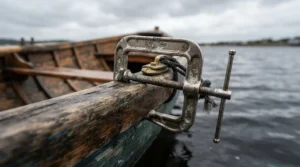
Not every hull edge is a clamp’s friend. A gunwale clamp needs something firm to bite, which means a rigid lip of aluminium, fibreglass or timber. Thin plastic mouldings can flex, crack or let the clamp walk.
Start with thickness. Published capacities in this round-up run from about 45mm to about 100mm, and several listings give no figure at all. For those, “wide gape” is marketing, not a measurement. Ask the seller or check the product page for a stated figure before you order.
Then look at shape. Tapered or rounded edges give jaws less to grip, which is why padded jaws help. Clamps that sit on a flat, horizontal lip tend to stay put, whereas clamps on sloping topsides rely more on friction.
Even old patents for gunwale mounts talk up non-invasive clamping as a way to avoid drilling or hole-punching a hull. That logic hasn’t changed. Clamp on rod rests for gunwales protect resale value, and they let you relocate a rest when your fishing changes.
Rod Retention: Keeping the Rod When a Big Fish Hits
Rod retention is where cheap clamps either earn respect or cost you a rod. Three layers matter: cradle shape, rubber grip and a physical tether.
Cradle shape is the first layer. Closed designs, like the Kinetic Boat Rod Holder Closed Arm and Ultimate Rod-Lock Holder, wrap the butt. Open designs, like the Kinetic Boat Rod Holder Open Arm, rely on gravity and friction. The Savage Gear MP Rodholder splits the difference with a closed rear and an open front.
Grip is the second layer. Rubberised rests stop the butt skating, but they also protect the blank from rattle damage.
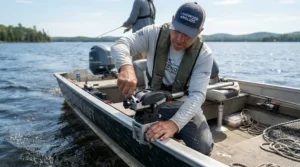
The third layer is non-negotiable: tether the rod. Even the Railblaza Rod Holder II, a screw-mounted rather than clamp-on holder, comes with a strong manufacturer recommendation to tether, and lost rods aren’t covered by warranty. If a respected maker says that, believe it. Run a lanyard from the butt to a thwart or cleat, keep it short enough to prevent a long drop, and keep it clear of the reel handle.
Tangle Prevention: Layouts That Keep Lines Apart
Tangle prevention starts at the planning stage, not when you’re teasing knots apart. Trolling guides note that outriggers spread multiple lines wider and reduce the chance of them fouling, and the same logic scales down to a small boat.
Space your rests as far apart as the hull allows, with each rod angled outward rather than straight back. Stagger line lengths and lure depths, so two lines never share the same water. Put one rest on each quarter, rather than both on one side.
Turn wide and slow. A tight turn swings trailing lures across each other, so wind in one line first if you need to turn sharply. If you run a fixed rest such as the Fox Rage Predator Boat Rod Rest on one side and a flex-arm holder such as the Savage Gear MP Pro Rod Holder Flex Mount on the other, use the flex arm’s adjustability to fan the lines out. Finally, give the rod nearest the outboard the shortest line, because prop wash is the enemy of tidy water.
Rod Holders for Small Angling Boats: Clip-On vs Flush vs Rail Mount
Rod holders for small angling boats come in three broad families, and the right one depends on how permanent you want the commitment to be.
| Mount Type | Installation | Hull Impact | Rigidity | Best For |
|---|---|---|---|---|
| Clip-on | Tool-light clamp on gunwale | None if padded | Good with wide brackets | Hire boats, multi-boat owners; try the Fox Rage Predator Boat Rod Rest or Ultimate Rod-Lock Holder |
| Flush mount | Cut and fixed into the hull | Permanent hole | Highest | Dedicated fishing boats |
| Rail mount | Clamps to tubular rails | Minimal | Good on solid rails | Boats with grab rails; check holders rated for rails |
Looking at the comparison above, clip-on wins whenever flexibility, resale value or hull protection matter. Flush mounts win on raw strength, but only if you’re certain where you want them and are happy to cut your boat. For most small boats, a good gunwale clamp gets you 90% of the benefit with none of the commitment.
Long-Term Cost and Maintenance
A £30 rest used on 20 days a year for five years costs 30p per outing. That’s cheaper than a sandwich, so low prices shouldn’t tempt you into skipping the features that protect your rod.
| Tier | Price Range | Examples | Typical Trade-Off |
|---|---|---|---|
| Budget | Under £25 | Kinetic Boat Rod Holder Open Arm | Open cradle, unpublished clamp width |
| Mid | £25-£35 | Fox Rage Predator Boat Rod Rest, Savage Gear MP Rodholder | Fewer extras, but solid clamps |
| Premium | £40+ | Savage Gear MP Pro Rod Holder Flex Mount, Scotty 230 Powerlock with 449 Portable Clamp Mount | Convenience and modularity cost more |
The real long-term spend isn’t the rest, it’s the damage a poor one can do. Budget for a leash and for regular maintenance. Rinse after salt, check the clamp screw monthly, and watch for polypropylene fading or cracking at the end of each season. Replace any clamp that has started to bend, because a deformed jaw loses grip long before it fails outright.
Safety, Licences and Rules
A rod rest makes fishing easier, but it doesn’t make a small boat safer. The RNLI’s angling safety page reports that 41 anglers lost their lives fishing around the UK coast between 2019 and 2024, and that many of those lives might have been saved by a lifejacket. Wear one, tell someone where you’re going, and keep your rest set-up from becoming a trip hazard.
On the legal side, freshwater rod fishing in England and Wales needs a licence and the landowner’s or fishery’s permission, and rod limits apply. Sea fishing generally doesn’t need a rod licence in England, but local byelaws and fishery rules differ, and some waters restrict trolling. Always check before you launch. None of the products here carries any special legal status, so the responsibility for compliance sits with you.
FAQ
❓ Can a clamp-on rod holder damage a fibreglass gunwale?
❓ How many rod holders do I need on a 12ft dinghy?
❓ Do I need a licence to use a rod rest when trolling in England?
❓ Will a clamp-on rest fit an inflatable boat?
❓ Can I use a bite alarm with a clip-on boat rod rest?
Conclusion: Which Clip-On Boat Rod Rest for Small Boats Should You Choose?
There’s no single winner, but there is a sensible shortlist. For thick gunwales and general predator work, the Fox Rage Predator Boat Rod Rest offers the most generous published clamp capacity. For tight decks and occasional trolling, the Savage Gear MP Rodholder gives you fold-away flexibility. For anglers who constantly tweak angles, the Savage Gear MP Pro Rod Holder Flex Mount justifies its premium. For tight budgets, the Kinetic Boat Rod Holder Open Arm and Kinetic Boat Rod Holder Closed Arm are the obvious starting points. For the best evidence trail, the Ultimate Rod-Lock Holder has the largest review sample. And if you fish from several craft, the Scotty 230 Powerlock with 449 Portable Clamp Mount makes modularity pay.
Whatever you pick, measure your gunwale, choose a cradle style that matches your fishing, and always tether the rod. A clip-on boat rod rest for small boats is only as good as its fit, and the best £30 you’ll spend on your boat this year might be the leash you attach to it.
Recommended for You
- Boat Rod And Reel Combos For Beginners: 7 Best Picks (2026)
- Two Piece Boat Rods For Travelling To Charters: 7 Best Buys (2026)
- Short Boat Rods For Small Charter Boats: 7 Proven Picks (2026)
Disclaimer: This article contains affiliate links. As an Amazon Associate, I earn from qualifying purchases. If you purchase products through these links, we may earn a small commission at no additional cost to you.
✨ Found this helpful? Share it with your friends! 💬🤗
