
In This Article
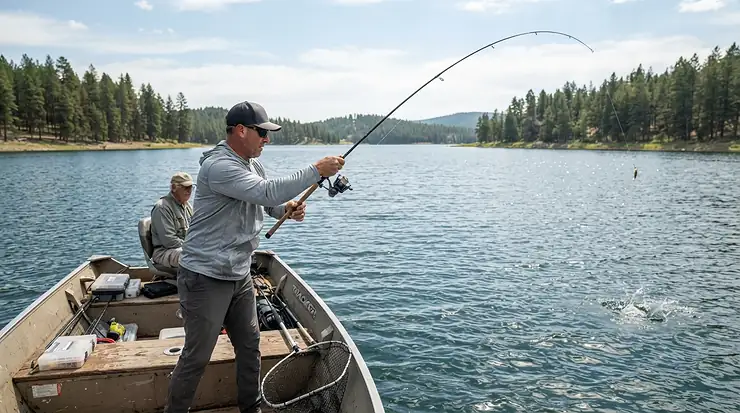
Picture the scene. The anchor bites, the boat swings round on its rope, and a hard tide sluices past the hull like a river running late. Drop a lead straight down and your rig streams out behind the stern, into the wash, where no self-respecting fish is waiting. Cast up-tide instead, beyond the anchor rope, and the bait lands in a clean lane of moving water, pinned to the seabed, right where hungry fish are lined up facing the current. That is the job of uptide rods for shore-style distance casting from a boat.
They borrow a beachcaster’s overhead power, shrink it to a length a boat can tolerate, and add a soft tip that shows bites through a heavy lead. The physics is old news: a longer rod gives you more leverage, because a bigger arc means a faster tip and a faster launch for the terminal tackle. The trick is balancing that reach against deck space, tide strength and your budget.
This guide compares seven real rods across budget, mid-range and premium territory. It covers long uptide rods for anchored boat fishing and the setups that suit casting over sandbanks. It also unpicks the spiked tip, a phrase that causes more confusion than it should. Everything here rests on published specifications, retailer listings and genuine reviewer commentary. I haven’t tested these rods myself, and where verified review data was thin, I say so rather than pretend. Prices move constantly, so treat every figure as a range and check live listings.
Quick Comparison: 7 Uptide Rods for Shore-Style Distance Casting from a Boat at a Glance
Here’s the whole field on one screen before we dig into each rod.
| Rod | Length | Casting weight | Standout trait | Price bracket | Best For |
|---|---|---|---|---|---|
| Shakespeare Omni Uptide | 9ft 6in | 6-10oz | Cushioned reel seat, lined guides | Around £50 | First-time uptiders on a budget |
| Shakespeare Salt Uptide | 2.70m (some listings say 9ft 6in) | 170-300g | Extra-fast composite blank | Check current price | Hard-tide cod and rays on a budget |
| Daiwa Seahunter Z Uptide | 10ft or 13ft listed | 4-10oz | Hi-viz tip, long variant | £60-£110 tracked range | All-round value and extra reach |
| Greys Advent Uptide | Check variant | Two ratings | Hi-viz tip, braid-safe guides | Check current price | Rays, smoothhounds and tope |
| Greys Advent Plus Uptide | Extendable handle | 4-6oz | Cam-lock extending handle | Check current price | Light-lead ground needing reach |
| Penn Prevail III LE SW Uptide | 3.00m | 70-300g | Very wide casting range | Check current price | Mixed tides and changing lead weights |
| Penn Regiment IV Uptide | 3.04m | 70-300g | 30T carbon, SLS3 blank | £160-£180 range | Committed anglers wanting a premium blank |
Look at the casting weights first. The three rods with 70-300g (about 2.5-10.5oz) ratings give you the widest lead range, which suits anglers whose tides change through the day. The two Shakespeare rods and the Daiwa Seahunter Z Uptide target the classic 6-10oz window for fast-tide cod. For long casts on a budget, the Daiwa Seahunter Z Uptide is the only rod here with a listed 13ft variant.
💬 Just one click — help others make better buying decisions too!😊
Top 7 Uptide Rods for Shore-Style Distance Casting from a Boat: Expert Analysis
1. Shakespeare Omni Uptide — the budget way into boat casting
The Shakespeare Omni Uptide is the rod you buy to find out whether uptiding suits you before the tackle bill gets silly. It’s a classic format: 9ft 6in long, rated 6-10oz (roughly 170-285g), with lined guides, a cushioned reel seat and glazed tip. In practice, 9ft 6in is the sweet spot for charter decks: long enough to build useful arc speed, short enough not to threaten the angler beside you. The 6-10oz rating means a proper spiked lead and a meaty bait won’t leave the blank gasping.
Based on the spec sheet, this is a sensible occasional-use rod: a few charter trips a season, winter cod, perhaps summer smoothhounds. What a spec sheet can’t tell you is blank refinement. At entry-level prices, expect a little more weight and a little less finesse than premium carbon, which is typical of the tier rather than a flaw. I couldn’t find a verified pool of aggregated customer reviews for this exact model, so I won’t quote ratings.
Pros:
- ✅ Classic 9ft 6in layout with heavy 6-10oz rating
- ✅ Lined guides and glazed tip suit saltwater use
- ✅ Very low cost of entry
Cons:
- ❌ No verified review pool to lean on
- ❌ Entry-level blank unlikely to match premium refinement
Around £50 at one UK retailer in April 2026; good value if you fish a handful of sessions each season.
2. Shakespeare Salt Uptide — extra-fast action for hard tides
The Shakespeare Salt Uptide swaps the usual moderate feel for an extra-fast, tip-led action. Listings describe a two-piece composite blank, 170-300g casting weight (about 6-10.5oz), saltwater-proof zirconium guides, a DPS reel seat and easy-clean EVA grips. An extra-fast action means the tip does most of the bending while the blank below stays stiff. That helps a spiked lead hold in a strong run while the tip still nods at a bite.
One caution: retailer listings disagree on length. One cites 9ft 6in, another 2.70m (roughly 8ft 10in). Check the exact variant before you order, because a rod nearly 8in shorter gives away reach. For smaller boats it’s no bad thing, since a compact rod is easier to swing in tight quarters. The honest take is that it suits anglers who want a stiff, no-nonsense stick for rays and cod without paying premium money.
I couldn’t verify independent review data for this model; the available descriptions are manufacturer-style marketing.
Pros:
- ✅ Extra-fast tip aids bite registration
- ✅ Saltwater-proof zirconium guides fitted
- ✅ Strong DPS reel seat
Cons:
- ❌ Conflicting length listings across retailers
- ❌ No verified independent reviews found
I couldn’t confirm a reliable current price, so check the live listing; it sits in budget-to-mid territory by reputation. Worth it if the length checks out.
3. Daiwa Seahunter Z Uptide — the long-reach value pick
The Daiwa Seahunter Z Uptide is the rod here that best serves long uptide rods for anchored boat fishing, because it’s listed in both 10ft and 13ft versions. It’s rated 4-10oz, uses a long-tip, short-butt layout, and carries a hi-viz tip, ceramic-lined guides and a full EVA handle. The hi-viz tip matters more than it sounds: when you’re staring at a tip against grey sea and sky, a bright tip makes a nod readable at a glance.
Based on the spec comparison, the 4-10oz window covers everything from light cod work to heavier ray leads. The 13ft version buys extra casting arc, but it demands deck space and a confident casting stroke. A review aggregator scores the rod 8.1/10 overall, with 8.5 for value and 8.0 for playing fish. It also reports a 4.8/5 average from 35 verified buyer reviews across three sources. Forum opinions on World Sea Fishing were more mixed, and the main drawback flagged is extra weight compared with lighter rods.
Pros:
- ✅ Hi-viz tip makes bites easy to spot
- ✅ Long 13ft variant for extra reach
- ✅ Strong value scores from verified buyers
Cons:
- ❌ Heavier than lighter uptide rods
- ❌ Long version needs generous deck space
Tracked pricing in 2026 has swung between roughly £60 and £110, so check current price and buy on a dip. At the lower end it’s among the best-value rods in this list.
4. Greys Advent Uptide — high-vis tip, braid-ready guides
The Greys Advent Uptide earns its place with a tip you can see “high in the air”, as the maker puts it, and a progressive high-modulus carbon action. It comes in two ratings, so you can pick a lighter or heavier version, and it carries SiC braid-safe guides and EVA grips. Braid-safe guides matter because braid cuts grooves in cheap guide rings; SiC inserts shrug that off, so you can run modern thin line for extra casting distance.
The manufacturer pitches it at rays, smoothhounds and tope, which fits a progressive action that bends deep under load without folding. That’s the sort of blank that forgives a slightly sloppy cast, which is useful when you’re fishing in the dark with cold fingers. A retailer page displayed a 95% buyer rating for this rod. I’d treat that as a pointer rather than proof, since I couldn’t see how many reviews sit behind it.
Pros:
- ✅ High-visibility tip shows bites clearly
- ✅ Braid-safe SiC guides fitted
- ✅ Progressive carbon action forgives casting errors
Cons:
- ❌ Retailer showed it out of stock at research time
- ❌ Review count behind the rating unclear
I couldn’t confirm a reliable current price. Check availability first, because stock appears patchy; value looks solid if you find one.
5. Greys Advent Plus Uptide — the extendable long-reach specialist
The Greys Advent Plus Uptide is the quirky one: a 4-6oz rod with a cam-lock extending handle, positioned as the top of the Greys uptide range. Extending the butt gives you a longer lever for the cast, then shortening it makes the rod easier to fight a fish on. A Planet Sea Fishing review praises its ample lower-blank power and nine braid-friendly SiC guides. The same review notes it’s heavy and not the best long downtide rod, but calls it reasonable value, especially with a good fixed-spool reel.
That pairing advice is the real insight. Uptiding with braid and a fixed-spool reel can be very effective, even though some UK anglers still sneer at it. One mechanical caution applies to all extension handles: twist-lock and cam-lock designs can stick if over-extended, so keep them clean and don’t force them.
Pros:
- ✅ Extending handle adds casting leverage
- ✅ Nine braid-friendly SiC guides
- ✅ Plenty of lower-blank power
Cons:
- ❌ Heavy for long sessions
- ❌ Extension mechanism needs careful upkeep
I couldn’t verify a current price; check live listings. The 4-6oz rating suits lighter-lead ground, so it’s good value only if that’s your style.

6. Penn Prevail III LE SW Uptide — wide casting range for mixed tides
The Penn Prevail III LE SW Uptide is a 3.00m rod rated 70-300g and pitched for bass, cod and pollack. That 70-300g span (about 2.5-10.5oz) means one rod can handle a 3oz lead on a slack neap and a 10oz lead on a springs flood. Its predecessor, the Prevail II LE Uptide, was reviewed in Sea Angler by a Bristol Channel charter skipper. He found the same casting range covers almost everything an inshore angler needs.
If the Mk III follows the same blueprint, the older spec is useful context: 10ft, two sections, ten guides, a graphite blank, glazed tip and graphite screw-winch reel seat, at around 520g. Treat that as a lineage guide rather than a guarantee for this model. The honest verdict is that it suits anglers who fish several marks and can’t afford a rod that only works in one lead range.
I couldn’t find aggregated reviews specific to the Mk III, so nothing here is a rating claim.
Pros:
- ✅ Very wide 70-300g casting range
- ✅ Suits bass, cod and pollack work
- ✅ Predecessor praised by a charter skipper
Cons:
- ❌ No model-specific review data found
- ❌ Spec details inferred partly from predecessor
I couldn’t confirm a current price, so check live listings. Likely mid-range value, and strong if lead weights vary through your season.
7. Penn Regiment IV Uptide — the premium blank for committed anglers
The Penn Regiment IV Uptide is the high-end option, launched for 2025 on a short-butt, long-tip format. It’s built from 30T high-modulus carbon with SLS3 (Spiral Layer Structure) construction, which Penn says gives a slim, light, strong blank. The 3.04m two-piece is rated 70-300g, carries nine saltwater-proof SeaGuide TiXOG guides, a heavy-duty DPS reel seat and a rubber bulb in the butt for support during a fight. It packs down to 186cm, handy if you’re carrying it on public transport to a charter.
Here’s what the spec sheet doesn’t spell out: at roughly 530g it isn’t a featherweight. The extra money buys a slimmer, more refined blank and better guides, not necessarily a lighter rod. I found no verified customer reviews at the retailers I checked, so there’s no sentiment data to cite yet. That’s typical for a recent release, but it means you’re buying on spec and brand reputation.
Pros:
- ✅ 30T carbon with refined SLS3 blank
- ✅ Saltwater-proof titanium-frame guides
- ✅ Compact 186cm transport length
Cons:
- ❌ No verified reviews found yet
- ❌ Premium price for a rod that isn’t ultra-light
Around £160-£180 range across UK retailers. It’s strong value if you fish uptide weekly; for occasional use, the budget rods above make more sense.
What Are Uptide Rods for Shore-Style Distance Casting from a Boat?
Uptide rods for shore-style distance casting from a boat are long-tipped, short-butted boat rods, typically around 9ft 6in to 10ft and rated for 6-10oz leads, built to cast baited rigs up-current from an anchored boat. The rig settles on the seabed away from the hull, avoiding tangles and presenting bait naturally in moving water.
The method has a famous origin. Planet Sea Fishing credits Bob Cox and John Rawle, who ran charter boats from Bradwell on the Thames Estuary, as its leading proponents, with Cox’s book “Uptide and Boatcasting” regarded as the definitive work. A Sea Angler piece explains that Daiwa’s early blanks set the blueprint: a 9ft 6in overall length with a short butt section and a longer top section. That layout lets you get both hands on the grip for a proper casting stroke, which is why reel-seat position is the first thing to check on any uptider.
How to Choose Uptide Rods for Shore-Style Distance Casting from a Boat
Use this seven-step checklist before you click anything.
- Match the rating to your lead. Cod uptiders are commonly rated 4-10oz or, better still, 6-10oz. A rod rated well above your usual lead will feel dead.
- Pick a length for your deck. 9ft 6in to 10ft is the norm; go longer only if you’ve got space and a clear casting lane.
- Prioritise a soft tip over a stiff mid-section. You want the tip to nod at bites but the blank beneath to hold firm in a hard run.
- Check the reel seat position. A short butt lets you reach both hands and cast with power.
- Insist on braid-safe guides. SiC inserts handle modern braid without grooving.
- Weigh the whole package. Rods in this guide range from around 520g to 530g in known specs; balance matters more than headline weight.
- Decide on an extending handle. It adds leverage but adds a mechanism to maintain.
Long Uptide Rods for Anchored Boat Fishing: When Extra Length Pays Off
Long uptide rods for anchored boat fishing earn their keep when you need to clear the anchor rope and land bait in a distant lane of water. The physics favours length: a bigger arc gives the tip more speed. That’s the case for a 13ft Daiwa Seahunter Z Uptide or an extendable Greys Advent Plus Uptide, both of which push you beyond the standard 9ft 6in.
But more rod means more problems. Long rods are heavier, harder to swing in tight spaces and easier to tangle with neighbours. Casting on a boat full of people is dangerous, a point made repeatedly by anglers on UK forums, so a long rod is only worth taking if you’ve room to cast safely. Most decent uptide rods double as long downtide rods too, which makes a longer rod a versatile buy if you often switch methods. On a crowded charter, though, a standard-length rod is the safer, friendlier choice.
Uptide Rods for Casting Over Sandbanks: Reading the Ground
Sandbanks are where uptide rods for casting over sandbanks really come into their own. Talk Sea Fishing’s smoothhound guide notes that uptide rods were once the main weapon for smoothhounds and remain popular in The Wash, the Thames Estuary and inside the Bristol Channel.
The same guide offers a smart tactic for a light-to-medium run: cast a plain lead well out and slightly uptide, beyond other anglers, from the stern. Let it swing round with the tide until it stops at the base of a sandbank, where smoothhound work along the edge for food washed in by the current. Don’t keep landing in the same spot. Vary your distance and use your arc to explore the ground yard by yard.
For this job, a wide rating helps. A 70-300g rod such as the Penn Prevail III LE SW Uptide or Penn Regiment IV Uptide lets you step lead weight up or down as the tide builds. Reach matters too, because banks often sit beyond the comfortable range of a short boat rod.
The Spiked Tip Explained: Spiked Leads, Rod Tips and Break-Outs
The phrase spiked tip gets used loosely. Most often it refers to the wired or spiked end of an uptide lead, which digs into the seabed to hold your bait. Sometimes it describes the rod tip that works with it. They’re a partnership, so here’s how both behave.
A Sea Angler guide to uptiding describes two kinds of bite: delicate nodding of the rod tip, or a classic break-out, when a fish pulls the spiked lead from the seabed and the loaded tip flicks back. Don’t strike in either case. If the tip is nodding, pick up the rod and swiftly retrieve the slack. If the lead has broken out, establish a straight line of contact immediately.
That’s why a good tip needs to be soft enough to flex under tidal pull but visible enough to read. Hi-viz tips on the Daiwa Seahunter Z Uptide and Greys Advent Uptide are built for exactly that. A bright spiked tip signal against dull water saves you from guessing.
Uptide Rods vs Traditional Boat Rods vs Beachcasters
Choosing the wrong rod type is the commonest and costliest mistake, so here’s the comparison.
| Rod type | Typical length | Strength | Weakness | Best For |
|---|---|---|---|---|
| Uptide rod | 9ft 6in-10ft (longer variants exist) | Casts heavy leads from a boat; soft tip for bites | Needs casting room; awkward when crowded | Anchored fishing in strong tides |
| General boat rod | Shorter, often 6-8ft | Compact; strong for fishing straight below | Little casting ability | Drifting and downtide fishing |
| Beachcaster | Longer, often 12ft and up | Maximum distance from the shore | Too long for most boats | Shore fishing from beaches |
An uptide rod sits in the middle: more casting power than a general boat rod and far more manageable than a beachcaster on a deck. A general boat rod is purpose-built for fishing below the boat, so it won’t do the job. If you only ever fish downtide or on the drift, you don’t need an uptider at all. If your boat sits on an anchor in a fast tide, nothing else matches it.
Features That Actually Matter (And Those That Don’t)
What matters:
- Guides: braid-safe SiC or similar inserts protect your line.
- Tip visibility: a hi-viz tip makes bite detection easier.
- Reel seat: a secure DPS-style seat holds a heavy reel through hard casts.
- Handle design: EVA grips stay comfortable when wet and cold.
What matters less:
- Carbon grade numbers: the Penn Regiment IV Uptide advertises 30T carbon, while the older Squadron III used 24T. The number hints at refinement but doesn’t guarantee a better day’s fishing.
- Fancy cosmetics: a rod’s paint job won’t help you land a ray.
- Extreme casting weight ratings: as one Sea Angler review noted of an early Daiwa uptider, a headline top-end rating can be optimistic. Rods often perform best in the lower half of their rating.
Common Mistakes When Buying Uptide Rods
- Buying too light. A rod rated 2-4oz will struggle with proper 6oz spiked leads in strong tides.
- Ignoring the reel. A fixed-spool reel with braid can be extremely effective, but only if the rod’s guides can take it.
- Over-extending twist-lock handles. They can stick, so extend gently and keep them clean.
- Buying 13ft for a small boat. Extra length is useless if you can’t swing it safely.
- Trusting a single retailer listing. Lengths, ratings and stock vary; the Shakespeare Salt Uptide is a good example.
- Forgetting the downtide fallback. Most decent uptiders work as long downtide rods, so don’t dismiss versatility.
- Spending premium money for occasional use. If you fish a few times a year, a budget rod like the Shakespeare Omni Uptide makes more sense than a rod costing three times as much.
Practical Usage Guide: Setting Up Your First Uptide Rod
Start at home. Assemble the rod, check the guides line up, and confirm the reel seat is tight. Spool your reel and consider a shock leader for heavy leads. Then put on a lifejacket. The RNLI’s angling safety guidance urges anglers to wear one when fishing from a boat or exposed shoreline and to check weather and tides before heading out.
On the boat, agree casting lanes with your skipper and neighbours before the first cast. Face up-tide, check behind you, and use a smooth, powerful stroke rather than a wild swing. Lower the rod tip to the water as the lead lands, tighten up to the weight, and let the spiked lead bed in.
For the first 30 days, watch for three problems. First, a stuck extension handle, so clean and lightly grease as the maker advises. Second, salt build-up, so rinse the rod and reel with fresh water after every trip. Third, guide damage, so check inserts for chips. Store the rod upright or in a tube to protect the blank.
Real-World Scenarios: Three Anglers, Three Rods
The weekend charter beginner. You fish four or five charter trips a year with a budget of around £50-£100. The Shakespeare Omni Uptide is the low-risk starter. If you want a rod with proven buyer feedback, the Daiwa Seahunter Z Uptide is worth a look at the bottom of its tracked price range.
The Thames Estuary smoothhound regular. You fish from your own boat, anchored near sandbanks, up to twice a month through summer. Reach is your priority. A 13ft Daiwa Seahunter Z Uptide or an extendable Greys Advent Plus Uptide gets bait over the bank, provided your deck allows it.
The Bristol Channel winter cod angler. You fish fast, shifting tides weekly with heavy leads. A wide-range blank such as the Penn Prevail III LE SW Uptide copes with changing conditions. The Penn Regiment IV Uptide is the upgrade if you want a more refined blank and fish often enough to justify it.
Buyer’s Decision Framework: If This, Choose That
- If you’re new and unsure, choose the Shakespeare Omni Uptide, because low cost limits regret.
- If you want strong reviewer backing, choose the Daiwa Seahunter Z Uptide, which has the most verified buyer feedback here.
- If you need maximum reach, choose the 13ft Daiwa Seahunter Z Uptide or Greys Advent Plus Uptide, because length and extension add leverage.
- If tides and lead weights vary, choose the Penn Prevail III LE SW Uptide, because 70-300g covers a wide window.
- If you fish weekly and want refinement, choose the Penn Regiment IV Uptide, because the blank and guides justify the premium.
- If you want a stiff, tip-led feel on a budget, choose the Shakespeare Salt Uptide, once you’ve confirmed its length.
- If you love a progressive, forgiving action, choose the Greys Advent Uptide, provided you can find it in stock.
Safety, Rules and Regulations Guide
Rules matter because uptiding often targets bass in the same tidal lanes. The MMO’s 2026 bass fishing guidance on GOV.UK sets seasonal catch-and-release periods, daily retention limits for recreational anglers and a 42cm minimum conservation reference size for retained bass. Regional IFCA summaries confirm that from 1 January to 31 January and 1 April to 31 December 2026, up to three bass may be retained per person per day. From 1 February to 31 March, fishing is catch-and-release only, and these rules apply whether you fish from a boat or the shore.
Check your local IFCA for byelaws, as these can add further restrictions. Beyond the legal side, treat rod safety seriously too. Cast only when your lane is clear and your skipper agrees. Never swing a loaded rod on a crowded deck.
Long-Term Cost & Maintenance: What Each Rod Really Costs
Cost per trip is a better yardstick than sticker price. As a simple illustration: a rod bought for £50 and used 30 times costs about £1.67 per trip, while one bought for £170 and used 30 times costs about £5.67. Fish 100 times and the premium rod drops to £1.70 per trip. Frequency decides value.
| Rod | Price bracket | Value verdict | Best For |
|---|---|---|---|
| Shakespeare Omni Uptide | Around £50 | Strong for occasional use | Casual charter anglers |
| Shakespeare Salt Uptide | Check current price | Likely good if length confirmed | Budget fast-tide work |
| Daiwa Seahunter Z Uptide | £60-£110 tracked range | Excellent near the low end | Value-seekers wanting reach |
| Greys Advent Uptide | Check current price | Solid if in stock | Progressive-action fans |
| Greys Advent Plus Uptide | Check current price | Reasonable for its niche | Extension-handle fans |
| Penn Prevail III LE SW Uptide | Check current price | Strong for variable tides | Mixed-tide anglers |
| Penn Regiment IV Uptide | £160-£180 range | Worth it for frequent use | Committed regulars |
The pattern is clear: cheap rods win for occasional anglers, and premium rods win when you fish constantly. The Daiwa Seahunter Z Uptide looks like the sweet spot when priced near the low end of its tracked range. Maintenance costs are small but real: rinse after every trip, clean extension mechanisms, and check guides regularly.
FAQ: Uptide Rods for Shore-Style Distance Casting from a Boat
❓ Can I use a fixed-spool reel with an uptide rod?
❓ What lead weight do I need for uptiding?
❓ Can I use an uptide rod for downtide fishing too?
❓ Is a budget uptide rod good enough to start with?
❓ How many bass can I keep when uptiding in 2026?
Conclusion: Which Rod Should You Cast With?
Uptide rods for shore-style distance casting from a boat solve one problem brilliantly: getting bait into moving water, away from the hull, where fish are feeding. The right rod depends on your boat, your marks and how often you fish.
If you’re starting out, the Shakespeare Omni Uptide keeps costs low. For the best balance of verified buyer sentiment and reach, the Daiwa Seahunter Z Uptide stands out, especially at the lower end of its tracked price range. Anglers wanting a stiff tip-led feel might consider the Shakespeare Salt Uptide, and those who like a progressive action can look at the Greys Advent Uptide. If you need extra leverage for sandbanks, the Greys Advent Plus Uptide offers an extendable handle. Anglers who fish changing tides will appreciate the wide range of the Penn Prevail III LE SW Uptide. And if you fish weekly and want a premium blank, the Penn Regiment IV Uptide is the refined choice.
Whichever you pick, wear a lifejacket, agree casting lanes and check the bass rules before you sail.
Recommended for You
- Clip-On Boat Rod Rest For Small Boats: 7 Proven Picks (2026)
- Boat Rod And Reel Combos For Beginners: 7 Best Picks (2026)
- Two Piece Boat Rods For Travelling To Charters: 7 Best Buys (2026)
Disclaimer: This article contains affiliate links. As an Amazon Associate, I earn from qualifying purchases. If you purchase products through these links, we may earn a small commission at no additional cost to you.
✨ Found this helpful? Share it with your friends! 💬🤗
