
In This Article
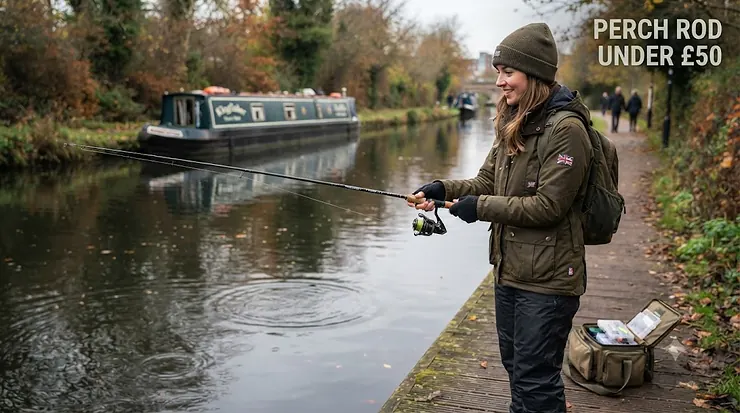
You don’t need to spend £150 on a Japanese blank to catch perch. Some of the scrappiest, most aggressive stripey takes you’ll ever feel come through a rod that cost less than a decent pair of wading boots. A good perch rod under £50 genuinely can deliver most of what a premium rod offers for casual canal and stillwater lure fishing — sensitivity to feel the tap of a perch nosing a jig, enough backbone to set the hook, and light enough in hand to flick spinners for hours without your wrist giving out.
What is a perch rod under £50? In practical terms, it’s an ultra-light to light spinning rod, typically 6-8ft, rated to cast roughly 3-15g lures, built to a price that still uses carbon composite blanks and stainless guides rather than the cheapest fibreglass. At this price point you’re trading refinement — guide count, blank taper precision, cork grade — for accessibility, not trading away the ability to actually catch fish.
We’ve researched seven real budget rods sold in the UK, pulled apart what the spec sheets actually mean for a day on the bank, and worked out which suits which kind of perch angler. Before you buy any rod, it’s worth remembering you’ll also need a valid Environment Agency rod fishing licence to fish most UK inland waters — an easy step to forget when you’re excited about new gear.
Prices below are UK ranges only; check current pricing before buying, since retailer prices shift throughout the season.
Quick Comparison Table
| Product | Length | Casting Weight | Best For | Price Range |
|---|---|---|---|---|
| Shakespeare Agility | 7ft | 3-15g | All-round lightweight lure work | £25-£35 |
| Daiwa Ninja Spinning Rod | 7ft/8ft | 5-21g | Best build quality under £50 | £35-£50 |
| Ron Thompson Trout and Perch Stick | 2pc, various | Light | Dedicated perch action | £40-£49 |
| NGT X-Treme 4pc Travel Rod | 9ft | Medium | Ultra-budget, travel-friendly | £15-£25 |
| Daiwa Megaforce Telespin | 9-11ft | Medium | Telescopic convenience | £20-£35 |
| Wychwood Truespin | 3pc | Light | Finesse jig and spinner work | £35-£48 |
| Sonik SK3 | 10ft | Medium | Longer casts on open stillwaters | £35-£45 |
Scanning this table, the split isn’t purely price versus quality — it’s design intent. The Shakespeare Agility and Wychwood Truespin are built for finesse work with small lures, while the Sonik SK3‘s extra length favours distance casting on bigger, more open waters. The Daiwa Ninja sits as the best-specced all-rounder here, and if your budget genuinely tops out near £50, it’s worth stretching to rather than settling for the cheapest option on the list.
💬 Just one click — help others make better buying decisions too!😊
Top 7 Perch Rods Under £50: Expert Analysis
1. Daiwa Ninja Spinning Rod — best build quality this close to £50
The Daiwa Ninja is the rod that regularly gets mentioned by anglers who bought cheaper first and wished they’d started here. It uses a premium carbon spinning blank with a DPS downlocking reel seat, AAA-grade cork handle, and stainless steel frame guides with titanium oxide rings — spec normally reserved for rods well above this price bracket.
Those titanium oxide guide rings matter more than they sound: they resist the grooving that cheaper ceramic or plain metal guides develop over time from braided line, which is the line most perch anglers use for its low stretch and bite sensitivity. Combined with a carbon blank tuned for lure fishing rather than dead-bait ledgering, the Ninja translates a subtle perch pluck into something you can actually feel through the rod, not just guess at.
This is the rod for anglers who want one purchase to last several seasons rather than a stopgap. Aggregated review sentiment across tackle retailers consistently praises the Ninja’s sensitivity-to-price ratio, with the most common criticism being that the cork handle marks relatively easily if not wiped down after wet or muddy sessions.
Pros:
- ✅ Titanium oxide guide rings resist braid wear
- ✅ AAA-grade cork handle feels premium for the price
- ✅ Sensitive carbon blank detects light perch bites
Cons:
- ❌ Sits near the top of the £50 budget ceiling
- ❌ Cork handle needs care to avoid staining
At around £35-£50, the Ninja is the closest thing to a “buy once” rod on this list, and arguably the best value pick if you can stretch to the top of the budget.
2. Shakespeare Agility Spinning Rod — best all-round lightweight for small lures
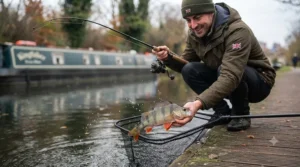
The Agility range is Shakespeare’s dedicated lightweight lure offering, and the 7ft and 8ft models are specifically pitched at trout and perch work with small spinners and lures. It’s a slim, powerful carbon blank with a matt satin finish, zirconium oxide guides, and a proper engraved aluminium reel seat rather than the plastic seats found on rods a notch cheaper.
What stands out on the spec sheet is the four-section breakdown supplied in a Cordura tube — genuinely useful if you’re walking canal towpaths or cycling to venues rather than driving with a full-length rod holdall. The trade-off with any multi-section rod is a very slight loss of blank consistency at the ferrule joints compared to a one- or two-piece rod, though on a lure rod this size the difference is marginal rather than something you’ll notice mid-retrieve.
It suits anglers who value portability as much as raw performance — commuting anglers, students, or anyone fishing multiple venues in a session. Reviewers consistently rate it as one of the best value lightweight lure rods available, with occasional comments that the tip section benefits from a careful eye during transport since it’s the most vulnerable point on any four-piece blank.
Pros:
- ✅ Four-section breakdown fits in a rucksack easily
- ✅ Zirconium oxide guides handle braid well
- ✅ Aluminium reel seat, not plastic, at this price
Cons:
- ❌ Four sections mean slightly more ferrule joints than a 2pc
- ❌ Tip section needs careful handling in transit
Priced around £25-£35, the Agility undercuts several rivals on this list while matching most of their build quality — a strong pick if portability matters as much as pure blank sensitivity.
3. Ron Thompson Trout and Perch Stick — purpose-built dedicated perch action
Unlike general-purpose spinning rods repurposed for perch, the Ron Thompson Trout and Perch Stick is built specifically around this style of fishing from the ground up. It’s a two-piece, 24-ton carbon blank tuned to a lighter action than most all-round spinning rods, designed around the exact casting weights UK perch anglers actually use.
That 24-ton carbon rating matters in practice: higher-modulus carbon means a stiffer, more responsive blank for the same weight of material, which translates to crisper bite detection without adding bulk. On a rod this specifically targeted, you get a tip sensitive enough to register the subtle “tap-tap” of a perch mouthing a soft plastic, while still retaining enough mid-section power to set the hook cleanly rather than just bouncing off.
This is the rod for anglers who’ve already decided perch (and the occasional trout as bycatch) are their focus, rather than wanting one rod for everything from pike to bass. Forum discussion around this model consistently flags it as punching above its price bracket specifically for perch work, with the main caveat being it’s less suited to bigger lures or pike bycatch than the more general-purpose options on this list.
Pros:
- ✅ Purpose-built action specifically for perch, not adapted
- ✅ 24-ton carbon blank for crisp bite detection
- ✅ Genuinely light in hand for long roving sessions
Cons:
- ❌ Less versatile for pike bycatch than all-round rods
- ❌ Sits at the very top of the £50 ceiling
Typically priced around £40-£49, this is the rod to pick if you know perch is your target species and you’d rather have one tool that’s excellent at one job than adequate at several.
4. NGT X-Treme 4pc Travel Rod — ultra-budget entry point that still works
If your budget is closer to £20 than £50, the NGT X-Treme is a genuine option rather than a compromise too far. It’s a 9ft, four-piece glassfibre rod built primarily for versatility across coarse and light sea fishing, but it copes perfectly well with light spinning duties for perch on a budget.
The key word there is glassfibre rather than carbon — NGT builds this rod to a price using a heavier, more durable fibre composite instead of pure carbon. In practice that means slightly less blank sensitivity than the carbon rods on this list, so you’ll feel big, confident takes clearly but may miss the very lightest finicky perch nips that a carbon tip would register. What you gain is genuine durability; glassfibre shrugs off the odd knock against a bankside branch far better than a premium carbon blank would.
This is the rod for absolute beginners deciding whether perch lure fishing is for them before investing further, or for anyone who wants a genuinely disposable-budget spare rod to leave in the car. Aggregated feedback describes it as “does exactly what it says” rather than exciting — an honest, unglamorous verdict for an honest, unglamorous price.
Pros:
- ✅ Lowest price point on this entire list
- ✅ Glassfibre construction is genuinely durable
- ✅ 4-piece breakdown is easy to transport
Cons:
- ❌ Less sensitive than carbon rods to light bites
- ❌ Heavier in hand over long roving sessions
At roughly £15-£25, the X-Treme is squarely a starter or spare rod — the value proposition is “will it work,” and honestly, yes, it does.
5. Daiwa Megaforce Telespin — genuine telescopic convenience without a big compromise
Telescopic rods have a reputation for being a compromise too far for serious lure fishing, but the Daiwa Megaforce Telespin is one of the better-regarded exceptions, largely on the strength of the Daiwa name carrying through even into their budget telescopic range. Available in 9ft, 10ft and 11ft lengths, it collapses down to a fraction of its extended length for genuinely easy transport.
The trade-off inherent to any telescopic design is a small loss of blank consistency at each of the multiple telescoping sections compared to a two-piece rod — more joints mean more potential points of very slight flex inconsistency through the cast. Daiwa’s build quality narrows that gap more than most budget telescopic rods manage, which is exactly why this model gets recommended repeatedly in angling forums as “the telescopic rod that doesn’t feel like a compromise.”
It suits anglers who fish opportunistically — a lunch break session, a spontaneous stop while out walking, anyone who wants a rod that fits in a rucksack side pocket rather than requiring a dedicated rod bag. Reviewers note the trade-off is worth it specifically because it means the rod actually gets used more often, rather than left at home because a full-length rod felt like too much hassle to bring.
Pros:
- ✅ Collapses to a fraction of its extended length
- ✅ Daiwa build quality even in the budget telescopic range
- ✅ Available across three lengths for different venues
Cons:
- ❌ Slightly less blank consistency than a 2pc rod
- ❌ Telescopic sections need periodic cleaning to avoid sticking
Priced around £20-£35 depending on length, the Megaforce Telespin is the pick for convenience-first anglers who’d rather have a slightly-compromised rod that’s always in the boot than a perfect one gathering dust at home.
6. Wychwood Truespin — finesse-focused action for light jigs and spinners
The Wychwood Truespin has built a following specifically among finesse-focused lure anglers, and the three-piece breakdown hasn’t stopped it being recommended repeatedly as a genuine step up in feel from more generic budget spinning rods. It’s tuned toward lighter lure weights than some rivals on this list, prioritising tip sensitivity over raw casting distance.
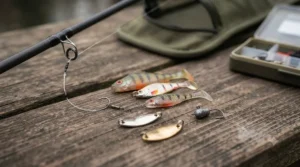
That finesse-first tuning shows up most clearly with small jig heads and light spinners in the 2-8g range that dominate canal and margin perch fishing — exactly the technique most UK perch anglers rely on for winter and pressured-water sessions. Where a stiffer all-round rod can mask a subtle take until the fish has already felt resistance and dropped the lure, the Truespin’s more forgiving tip gives you a longer window to register the bite and react.
This is the rod for anglers targeting pressured or finicky perch on smaller, clearer venues rather than blasting spinners across open reservoirs. Forum comparisons against stiffer alternatives consistently favour the Truespin for bite detection specifically, with the trade-off being it feels comparatively underpowered if you hook an unexpectedly large pike as bycatch.
Pros:
- ✅ Genuinely forgiving tip for detecting subtle bites
- ✅ Well matched to 2-8g jigs and light spinners
- ✅ Three-piece breakdown for easy transport
Cons:
- ❌ Underpowered for accidental pike bycatch
- ❌ Less suited to heavier lures over 15g
At around £35-£48, the Truespin is worth the spend specifically for anglers fishing pressured waters where every missed bite matters more than raw casting distance.
7. Sonik SK3 — best choice for longer casts on open stillwaters
Rounding out the list, the Sonik SK3 trades some of the finesse focus of the Truespin and Ninja for extra length and casting range. At around 10ft, it’s the longest rod on this list, built to get lures further out across bigger stillwaters and reservoirs where perch shoal well off the margins.
That extra length comes with genuine trade-offs worth understanding before buying: a longer blank needs more careful casting technique to load properly with light lures, and it’s noticeably less nimble for the tight, precise flicks needed around snaggy margins or overhanging branches. What it buys you is real distance — on big, open venues where perch sit well beyond margin-casting range, the SK3 covers water a 7ft rod simply can’t reach.
This is the rod for anglers whose local venue is a big gravel pit or reservoir rather than a narrow canal or small pond. Angler feedback consistently describes it as capable and dependable for the price, with occasional notes that its extra length takes a session or two to get used to if you’re switching from a shorter, more compact rod.
Pros:
- ✅ Genuine extra casting distance over shorter rods here
- ✅ Copes well with medium lure weights on open water
- ✅ Dependable build for the price point
Cons:
- ❌ Less nimble for tight, snaggy margin fishing
- ❌ Takes some adjustment if switching from a shorter rod
Typically priced around £35-£45, the SK3 earns its place specifically for open-water anglers who need reach more than they need pinpoint finesse.
Perch Rod Beginner Setup
Getting started doesn’t require overthinking the whole kit at once — the rod is genuinely the first decision, and everything else follows from it. Match your reel size to the rod: a 1000-2500 size fixed-spool reel balances well with any of the light rods above, giving you enough line capacity for braid without adding unnecessary weight to your arm over a long session.
Braided main line is worth prioritising over mono from day one if your budget allows, since braid’s minimal stretch is exactly what lets a light rod tip register a subtle perch take rather than absorbing it. A short fluorocarbon leader, roughly a rod-length long, adds abrasion resistance and reduces visibility near the lure without needing to run fluorocarbon through the whole reel. In your first few sessions, don’t worry about a huge lure collection — a handful of small soft plastics on light jig heads, one or two small spinners, and a shallow-diving crankbait will cover most UK perch scenarios while you’re still learning how your specific rod loads and casts.
The single most common beginner mistake is over-lureing a light rod — forcing a 20g lure onto a rod rated to 3-15g strains the blank and kills casting accuracy. Stay within the rod’s printed casting weight range and you’ll get a far more enjoyable, accurate first season.
It also helps to understand what you’re actually targeting. The European perch is a shoaling predatory species found throughout UK canals, rivers and stillwaters, and its habit of hunting in loose packs around structure is exactly why a light, sensitive rod tip pays off — you’re often working a lure past several fish in one retrieve, and feeling the first tentative interest is what lets you adjust before the whole shoal loses interest.
Real-World Scenarios: Which Budget Perch Rod Fits Your Session
Consider three anglers. First, a student fishing local canals after lectures, budget genuinely capped near £20, wanting something that survives being shoved in a backpack. The NGT X-Treme suits this exactly — durable glassfibre, dirt cheap, and forgiving of the odd knock against a lock gate or towpath railing.
Second, a weekend angler with a proper £45-50 budget who wants one rod to last several seasons of serious perch fishing on mixed venues — canals, small stillwaters, the occasional river. The Daiwa Ninja is the clear fit here: the build quality genuinely holds up, and the sensitivity difference over cheaper rods becomes obvious within the first few sessions.
Third, an angler who fishes a big local reservoir where perch sit well off the bank and casting distance genuinely matters more than finesse. The Sonik SK3‘s extra length earns its keep here in a way it simply wouldn’t on a narrow canal, where the Wychwood Truespin‘s shorter, more precise action would be the better tool instead.
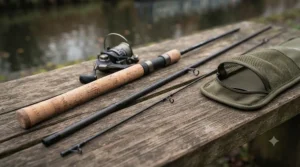
Affordable Perch Fishing Rod: What “Affordable” Actually Buys You
It’s worth being honest about what separates a £30 rod from a £150 one, because the gap isn’t as dramatic as premium marketing suggests for casual perch fishing. Premium rods generally offer more consistent blank tapering (smoother power transfer through the cast), higher guide counts (reduces line slap and improves casting distance marginally), and lighter overall weight from higher-modulus carbon.
What an affordable perch fishing rod under £50 typically sacrifices is refinement at the margins rather than core function — you’ll still feel bites, still cast lures accurately within the rated weight range, and still land perch without drama. Where the gap shows up most is on very long sessions, where a lighter premium blank reduces arm fatigue, and in guide durability under heavy repeated braid use over multiple seasons.
For most UK perch anglers fishing a handful of sessions a month rather than daily, that gap simply doesn’t justify the price difference. The honest advice from aggregated angler feedback is consistent: buy the best rod your realistic budget allows within this bracket, don’t assume you need to spend more to actually catch fish, and put any spare budget into a decent reel instead — a mismatched cheap reel undermines a good rod far more than a budget rod undermines a good reel.
Best Value Perch Rod Review: How We Judged “Value” Here
Value isn’t simply “cheapest rod that still works” — it’s the ratio between what you pay and what you actually get in bite detection, durability, and casting performance. On that basis, the Daiwa Ninja and Ron Thompson Trout and Perch Stick score highest specifically because their component spec (titanium oxide guides, dedicated perch action, higher-modulus carbon) meaningfully outperforms their price bracket rather than just meeting it.
The Shakespeare Agility scores well on a different axis entirely — value-for-portability rather than value-for-raw-sensitivity, which matters enormously if you’re the kind of angler who fishes multiple venues in a single session. The NGT X-Treme, meanwhile, delivers value in the most literal sense: it’s simply the cheapest way to establish whether lure fishing for perch suits you before spending more.
None of the seven rods here are poor value at their respective price points — the differentiation is really about matching a rod’s specific strengths to your actual fishing style, venue type, and how many seasons you expect it to last, rather than one single rod winning outright on every axis.
Cheap Perch Rod Worth Buying: Red Flags to Avoid at This Price
Not every sub-£50 rod on the market is worth buying, even within genuine, well-known brands’ budget ranges. The clearest red flag is a rod with no stated casting weight range at all — reputable manufacturers always specify this, and its absence usually signals a generic import rather than a properly engineered blank. Similarly, be wary of rods advertising extremely long lengths (11ft-plus) at extremely low prices; length is cheap to manufacture but genuinely difficult to build well, and an ultra-long, ultra-cheap rod usually means a soft, whippy blank that struggles to load lures accurately.
Plastic reel seats that flex noticeably under hand pressure are another warning sign — all seven rods recommended here use metal or reinforced composite seats specifically because a flexing seat loosens over a season of use and affects both casting accuracy and reel security. Finally, treat suspiciously generic “spinning rod” listings with no brand history and no aggregated review base; the products covered in this guide all have a track record across UK tackle retailers and angling forums, which matters far more than a glossy product photo.
FAQ
❓ What is the best perch rod under £50?
❓ What length rod is best for perch fishing?
❓ Do I need an expensive rod to catch perch?
❓ What casting weight is right for a perch rod?
❓ Can a budget perch rod handle an accidental pike bycatch?
Conclusion
There’s no single best perch rod under £50 for every angler — the right pick depends on your venue, your budget ceiling within that £50, and whether you value finesse, portability, or casting distance most. If you can stretch close to the full £50, the Daiwa Ninja delivers the strongest all-round spec on this list. If your local venue is a narrow canal or pressured stillwater, the Wychwood Truespin‘s forgiving tip will show you bites a stiffer rod would miss.
What matters more than any single spec sheet is matching the rod’s design intent to how you actually fish — a rod built for finesse jig work on tight margins will frustrate you on a big open reservoir, and vice versa. Whichever you choose from this list, pair it with a properly sized reel and don’t forget your rod fishing licence via Canal & River Trust’s guidance before your first session — an easy step to overlook when you’re excited about new gear.
✨ Don’t Miss These Exclusive Deals!
🔍 Take your perch fishing to the next level with these carefully selected budget rods. Click on any highlighted product to check current pricing and availability. A genuinely enjoyable, affordable season on the bank is one rod away!
Recommended for You
- Perch Fishing Rod: 7 Best Rods & Buying Guide (2026 UK)
- Treble Hook Size for Pike Deadbait: 7 Best Picks (2026 Guide)
- Treble Hooks for Pike: 7 Best UK Picks Reviewed for 2026
Disclaimer: This article contains affiliate links. As an Amazon Associate, I earn from qualifying purchases. If you purchase products through these links, we may earn a small commission at no additional cost to you.
✨ Found this helpful? Share it with your friends! 💬🤗
