
In This Article
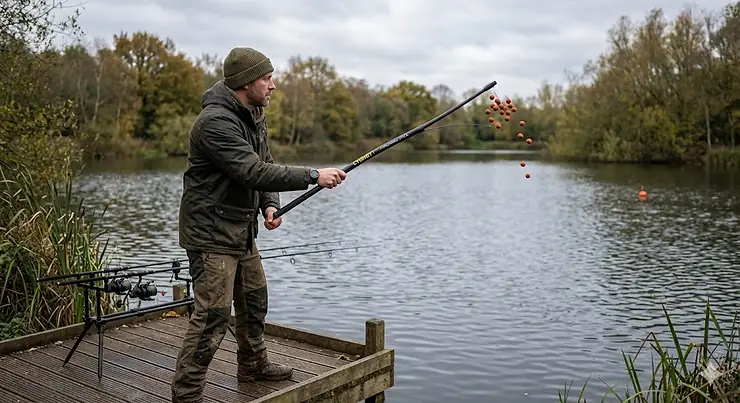
There’s a moment every carp angler knows. You’ve found the spot — that far-bank crease, the gravel bar at ninety metres, the subtle depression you spotted on the echo sounder — and then you reach for your catapult. Thwack. Boilies scatter in a wide arc, maybe half landing where you actually want them. The fish are spooked, the swim is ruined, and you’re already regretting not investing in a proper set of throwing sticks for boilies.
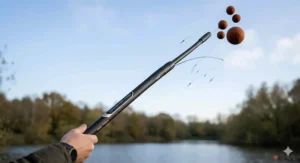
A well-chosen throwing stick changes the game entirely. At its most basic, it’s a curved tube. What it actually does is transform a modest arm movement into a tight, accurate grouping of bait at distances that a catapult simply cannot match — reliably putting boilies at 80, 90, even well over 100 metres with consistent practice. For serious carp fishing on British venues, that precision is the difference between a bite and a blank.
But walk into a tackle shop or scroll through Amazon.co.uk and you’ll find everything from under-a-tenner budget efforts to premium carbon construction sticks that cost more than a good reel. The diameter matters. The material matters. The shape of the curve matters more than most manufacturers will admit. And buying the wrong one — too large a bore for your bait size, too heavy for a dawn session — quietly undermines every cast you make.
This guide cuts through the noise. We’ve researched every credible option currently available on Amazon.co.uk, cross-referenced with real UK angler feedback, and given you the honest expert commentary the product listings conveniently leave out. Whether you’re new to carp fishing or you’re just replacing a stick you sat on (it happens to everyone), you’ll find your match below.
What are throwing sticks for boilies? A throwing stick is a curved, open-ended tube — typically 16–26mm in diameter — used to propel individual boilies through the air at distances beyond catapult range. The curved tube imparts backspin on the bait as it exits, which lifts the boilie in flight and dramatically increases both range and accuracy. Most experienced UK carp anglers consider it an essential piece of kit for open-water fishing.
Quick Comparison: Top Throwing Sticks for Boilies at a Glance
| Product | Material | Boilie Size | Best For | Approx. Price Range |
|---|---|---|---|---|
| Korda Eazi-Stik | Polycarbonate | 20mm | All-round use, beginners & experts | Under £20 |
| Fox Rangemaster | Flexible plastic | 20mm / 26mm | Distance casting, everyday use | £15–£25 |
| JRC Extreme TX | T36 carbon | 16mm / 22mm | Long sessions, premium performance | £30–£45 |
| Hunter Pro Fantastik | Plastic | 10–24mm | Versatility, mixed bait sizes | Under £15 |
| DNA Leisure Steel Stick | Steel | 15–20mm | Durability on a budget | Under £15 |
| Ultimate Bionic Carbon | Carbon composite | 20mm / 25mm | Big baits, distance specialists | £35–£50 |
| Prologic Boilie Cruzade | Lightweight plastic | 20mm / 24mm | Clean accuracy, mid-range budget | £10–£20 |
The table above reveals a clear pattern: plastic sticks occupy the affordable end and suit most anglers perfectly well, while carbon options justify their premium through genuine weight savings during long pre-baiting sessions. The sweet spot for most UK carp anglers fishing standard 20mm boilies sits firmly in the mid-range — around £15–£25 — where you get solid construction without paying for marketing gloss.
💬 Just one click — help others make better buying decisions too! 😊
✨ Don’t Miss These Exclusive Deals!
🔍 Take your carp fishing to the next level with these carefully selected throwing sticks for boilies. Click on any highlighted product name to check current pricing and availability on Amazon.co.uk — these picks will help you find exactly what you need!
Top 7 Throwing Sticks for Boilies: Expert Analysis 🇬🇧
1. Korda Eazi-Stik Throwing Stick — The Nation’s Favourite for Good Reason
The Korda Eazi-Stik is arguably the most used throwing stick on British carp venues, and after spending time with it, you understand why. Made from ultra-lightweight polycarbonate plastic, its distinctive J-shaped curve isn’t just aesthetic — the extended bend imparts significant backspin on each boilie as it exits, which physically lifts the bait in flight. The result is noticeably greater distance compared to a conventional straight or mildly curved stick.
The 20cm rubberised handle is textured to prevent twisting on the downward stroke — a small detail that matters enormously when you’re putting out 200 boilies before a session and your grip starts to tire. One important caveat the spec sheet doesn’t mention: this stick is remarkably susceptible to damage if you clip the ground on the follow-through, and prolonged exposure to summer heat (the four days of British summer, as one manufacturer wryly noted) can warp the polycarbonate. Store it in the sleeve, keep it out of direct sun, and treat it with a modicum of respect.
Who’s this for? Beginners through to experienced anglers fishing standard 20mm boilies who want a proven, lightweight tool that simply works. It’s not indestructible, but it’s the benchmark by which other sticks are judged.
UK buyers should note it’s widely available on Amazon.co.uk with Prime delivery, often qualifying for free next-day dispatch.
✅ Proven J-curve design for genuine distance gains
✅ Extremely lightweight — reduces fatigue during long baiting sessions
✅ Widely available on Amazon.co.uk, trusted brand
❌ Can warp in sustained heat; fragile if grounded hard
❌ Only suits 20mm boilies — limited versatility
Price range: under £20 — exceptional value for what it delivers.
2. Fox Rangemaster Throwing Stick — CAD-Engineered for Carp, Not Just Cheap Plastic
Fox has been making carp tackle for British anglers since before most of its current customer base started secondary school, and the Rangemaster Throwing Stick reflects that institutional knowledge. Rather than simply extruding a tube and calling it done, Fox used CAD design to optimise the curve’s geometry — specifically to maximise the velocity and spin imparted at the moment of release. The difference is measurable in metres.
Formed from a flexible, highly robust tube, this stick handles the aggressive whipping motion of distance casting without the brittleness that plagues cheaper alternatives. The non-slip rubberised handle maintains grip even in the inevitable British rain, which anyone who’s fished a drizzly November morning on a Midlands reservoir will recognise as non-negotiable. Available in 20mm and 26mm — and this is where the Fox really distinguishes itself: the 26mm variant handles larger baits, including the 24–26mm boilies that have become increasingly popular for big fish targeting on pressured venues like Linear Fisheries or Yateley.
This is the stick for anglers who fish regularly in wet conditions and want something that will last two seasons rather than six months.
✅ CAD-optimised curve for maximum range and spin
✅ Available in 20mm and 26mm — suits a wider range of bait sizes
✅ Solid all-weather performance; robust construction
❌ Slightly heavier than polycarbonate alternatives
❌ 26mm variant is less commonly available on Amazon.co.uk
Price range: £15–£25 — well worth the few extra pounds over budget options.
3. JRC Extreme TX Throwing Stick — When You’re Serious About Distance
Let’s be clear about what the JRC Extreme TX is for: it’s for the angler who pre-baits heavily before major sessions, spends long hours at the rod, and has started to notice the cumulative toll a throwing stick takes on the forearm and wrist. This is a fatigue problem, and T36 carbon fibre is the solution.
The T36 carbon construction isn’t marketing fluff — T36 refers to a specific tensile-strength grade of carbon, and it produces a stick that is measurably lighter than plastic equivalents while being significantly more rigid and durable. The 1K woven carbon finish with matt surface treatment looks purposeful rather than showy, and the Japanese heat-shrink rubber handle provides the kind of precise grip feel that makes distance throwing more controlled. Crucially, it comes supplied with a luxury neoprene protective sleeve — a small but telling detail that signals JRC knows this stick is an investment worth protecting.
Available in 16mm and 22mm variants on Amazon.co.uk. The 16mm is quite specialist — excellent for smaller bottom baits and pop-ups on venue-dominated by wary fish — while the 22mm suits the majority of standard boilie fishing.
Who should buy this? Anglers who fish two or more nights per week, regularly bait at distance, and understand the value of buying once rather than replacing cheap kit annually.
✅ T36 carbon: genuinely lighter and more durable than plastic
✅ Available in 16mm for precise small-boilie applications
✅ Comes with neoprene protective sleeve
❌ Premium price — harder to justify for occasional anglers
❌ Carbon can be damaged by sharp impact if dropped on hard bankside
Price range: £30–£45 — a considered purchase for committed carp anglers.
4. Hunter Pro Fantastik Throwing Stick — The Versatility Champion
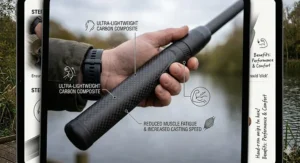
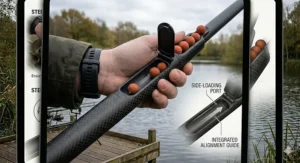
Most throwing sticks force you to buy one for 16mm boilies and another for 20mm. The Hunter Pro Fantastik’s defining feature — and frankly, its entire reason for existing — is its handle-loading design that accommodates any boilie between 10mm and 24mm. That’s nearly every standard bait size the UK market produces, from small match-style hook baits through to larger specimen baits, covered by a single tool.
The tapered end aids accuracy on distance throws, and the comfortable moulded thumb grip gives you tactile feedback on your release point — something cheaper sticks ignore entirely. There’s also a lanyard attached, which sounds trivial until you’ve watched a throwing stick skip off a muddy bank and into the margins on a grey Tuesday morning. UK anglers have been there. The lanyard matters.
In terms of material, it’s a sturdy plastic construction — not carbon, not the lightest option on this list — but for an angler who wants flexibility without doubling their spend on multiple sticks, it punches well above its price point.
UK availability: sold directly through Amazon.co.uk with various delivery options depending on seller.
✅ Handles 10–24mm boilies — exceptional versatility
✅ Lanyard included — practical on slippery, wet banks
✅ Moulded thumb grip for improved accuracy
❌ Heavier and bulkier than single-size specialist sticks
❌ Mixed build quality reports from some UK reviewers
Price range: under £15 — remarkable value for an all-size solution.
5. DNA Leisure Steel Throwing Stick — Underdog Durability at a Bargain Price
Here’s one most anglers overlook. The DNA Leisure steel throwing stick isn’t glamorous — steel isn’t the material choice of premium tackle brands, and it shows on the shelf — but durability is its entire argument, and it makes that argument convincingly. While polycarbonate and carbon sticks can crack or warp under sustained use or accidental impact, steel simply does not.
Designed for 15–20mm boilies with a non-slip handle, it’s specifically positioned for medium-range boilie fishing rather than maximum-distance specialists. Think 50–70 metre accuracy rather than 90-metre heroics. For many UK venues — the club lake, the day ticket water with tight swims, the river stretch where maximum distance isn’t the primary concern — that range is precisely what’s needed. You don’t buy a Ferrari to do the school run.
As a small business brand on Amazon.co.uk (and there’s something to be said for supporting these), it won’t have the marketing reach of Korda or Fox. But anglers who’ve found it report it holding up well through conditions that would have killed cheaper plastic alternatives.
UK tip: check current stock on Amazon.co.uk as availability can fluctuate for smaller brands.
✅ Steel construction — practically indestructible with normal use
✅ Budget-friendly entry point for newer carp anglers
✅ Solid medium-range accuracy for standard venue fishing
❌ Heavier than plastic or carbon — fatigue over long sessions
❌ Less suited to maximum-distance fishing
Price range: under £15 — the most durable option at this price point.
6. Ultimate Bionic Carbon Throwing Stick — The Big Bait Specialist
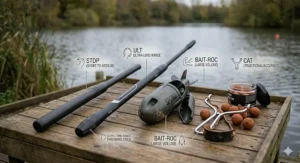
The Ultimate Bionic isn’t trying to be everything to everyone. It comes in 20mm and 25mm variants, made from carbon composite with a classic curved shape, non-slip handle, and a protective cover included. The 25mm version is the one that earns its place on this list: boilies of 24–25mm diameter are growing in popularity among UK specimen hunters targeting large commons and mirrors on big-pit venues like Cassien equivalents in France and the UK’s own Colne Valley complex.
The carbon composite construction keeps weight manageable on a larger-bore stick — something plastic 25mm sticks struggle to achieve, often becoming unwieldy over an extended baiting session. Accurate and comfortable even after extended use, according to UK buyers. The protective cover is a practical inclusion: stored in a rod bag sleeve, a carbon stick remains protected through the kind of knocks and bumps that happen during the inevitable lakeside trek.
This is a specialist purchase rather than an everyday choice. If you regularly fish with boilies above 22mm, or if your syndicate water runs a primarily big-bait approach, the Bionic earns its spot. If you’re using standard 20mm boilies, the Korda or Fox options are more than adequate.
✅ 25mm variant handles large specialist baits with ease
✅ Carbon composite keeps weight low on a larger bore
✅ Protective cover included — investment properly protected
❌ Specialist sizing — less versatile for standard 20mm use
❌ Towards the premium price bracket
Price range: £35–£50 — specialist kit that justifies its cost for the right application.
7. Prologic Boilie Cruzade Throwing Stick — Clean, Light, and Honest About What It Does
Prologic is a Scandinavian carp brand with a growing following among UK anglers who appreciate straightforward, well-priced tackle without the brand-name markup. The Boilie Cruzade throwing stick is available in 20mm and 24mm and is made from a very strong but lightweight plastic with a soft-touch non-slip handle and — a detail worth mentioning — open bottom access for easy cleaning or clearing stuck boilies. If you’ve ever spent five minutes trying to dislodge a soft pop-up from a stick mid-session, you’ll appreciate this immediately.
Claims of throwing up to 100 metres are optimistic (a common marketing tendency in this category), but distances in the 70–85 metre range are realistic with good technique, making it perfectly capable for the majority of UK commercial and club venues. The ultralight construction reduces session fatigue, and the soft-touch handle remains comfortable even on a cold November morning on the Lincolnshire fens.
Where the Cruzade sits in the market: above the budget no-name options, below the premium carbon tier, offering honest mid-range performance at a price that won’t cause regret if it gets left behind at a venue.
✅ Easy-clean bottom access — practical, real-world feature
✅ Available in 20mm and 24mm — covers standard and larger baits
✅ Soft-touch handle comfortable in cold British conditions
❌ Range claims are optimistic — manage expectations
❌ Less premium feel than Fox or Korda equivalents
Price range: £10–£20 — a clean, no-nonsense option for the sensible mid-range buyer.
How to Get the Most from Your Throwing Stick: A UK Angler’s Practical Guide 🎯
Matching Bore Diameter to Your Boilie Size
This is where most beginners go wrong, and the consequences are immediate. A 20mm throwing stick will fire a 20mm boilie competently and a 18mm boilie rather erratically — it bounces around the bore, loses spin consistency, and your grouping widens. A rough rule: your boilie should fit snugly but not tightly in the tube. If it rattles, the stick is too large. If you have to force it, it’s too small and your wrists will pay the price.
For typical UK carp fishing on pressured day-ticket venues — the kind covered extensively by Angling Times — most anglers are using 18–20mm boilies, making a 20mm stick the sensible default. Step up to 24mm or 25mm only if you’re specifically using larger baits for big fish targeting.
Technique: One-Handed vs Two-Handed
One-handed throwing — the stick held at the handle, arm sweeping forward — works fine to around 60–70 metres with practice. Beyond that, you’re fighting physics. The two-handed overhead technique, loading the stick behind the shoulder and driving both arms forward in a fluid arc, generates dramatically more velocity and is how experienced anglers consistently hit 90–100 metres. The Korda Eazi-Stik’s 20cm handle was specifically designed for double-handed use — something worth bearing in mind if distance is your primary concern.
Wet Weather Care: The British Problem
UK autumn and winter fishing means wet hands, wet bait, and a throwing stick that’s been lying on a damp unhooking mat for eight hours. Polycarbonate handles this fine; steel is rust-resistant if dried after use; carbon absorbs no moisture but the handle’s heat-shrink rubber can start to delaminate over time in persistently damp conditions. Dry your stick at the end of every session and store it in its sleeve — simple advice that doubles its lifespan.
Boilie Consistency and Softness
Throwing sticks are merciless with inconsistent baits. Hard, round boilies fly true. Soft boilies — whether fresh from the bag, thawed from frozen, or degraded by poor storage — deform under the force of the throw and lose their spin. Wetting the inside of the stick slightly can reduce this, though it also marginally reduces distance. The Angling Trust, the governing body for fishing in England, regularly publishes guidance on bait handling best practices that’s worth bookmarking.
Caring for Your Stick in the Field
A few additional UK-specific notes: keep polycarbonate sticks out of direct sunlight (genuinely relevant on the rare scorching British days), never leave carbon sticks in a car boot where they can roll around and crack, and clean the bore periodically with warm water and a cloth — boilie residue builds up and affects the internal friction, slightly reducing consistency over time.
Real-World Scenarios: Which Throwing Stick for Which UK Angler? 🏴
The Day-Ticket Regular (Budget-Conscious, Standard Distances)
Mark fishes two to three days per month at commercial day-ticket waters in the East Midlands — the kind of well-managed venues with swims at sensible distances. He’s using 18–20mm boilies, fishing at 40–70 metres, and doesn’t want to spend a fortune. The Korda Eazi-Stik or Fox Rangemaster fits his brief perfectly. Both deliver excellent accuracy at that range, cost under £25, and are proven across thousands of UK sessions. The Eazi-Stik’s lighter weight gives it a slight edge if he’s baiting heavily before a session.
The Big-Water Specialist (Distance, Fatigue, Long Sessions)
Sarah fishes syndicate waters in the Colne Valley and has recently added a couple of French trips. She’s regularly casting at 90–100 metres, uses 20–24mm baits, and pre-baits at dawn for two to three hours. Carbon is the obvious answer here — the JRC Extreme TX (22mm) or the Ultimate Bionic Carbon (25mm if she’s using larger baits) will save her forearm through a long pre-baiting session and deliver the accuracy that keeps her bait tight over the spot. The extra spend is entirely justified at her level of commitment.
The New Carp Angler (Learning, Mixed Bait Sizes, Tight Budget)
Jamie has just started carp fishing after years of match angling, is still experimenting with bait sizes from 14mm to 24mm, and needs to keep costs manageable while he finds his feet. The Hunter Pro Fantastik (10–24mm) or the DNA Leisure Steel Stick covers both needs: versatile sizing, bullet-proof construction, and a price that won’t sting if technique takes time to develop. The Fantastik’s versatility makes it slightly the better choice for someone still finding their preferred bait size. For additional guidance on getting started in carp fishing, the Carp Society offers excellent beginner resources.
Throwing Stick vs Catapult vs Spod: Which Deserves a Place in Your Quiver?
This is a comparison UK carp anglers debate regularly, and the honest answer is that you’ll eventually want all three — for different jobs. But understanding why helps you prioritise.
| Tool | Range | Accuracy | Best Application | Limitations |
|---|---|---|---|---|
| Throwing stick | 70–110m | Very high (boilies only) | Loose-feeding boilies at distance | Boilies only; technique-dependent |
| Catapult | Up to 50–60m | Moderate | Short-range feeding, particles, pellets | Limited range; scatter on distance |
| Spod/Spomb | Unlimited (cast-limited) | Very high | Mixed particle mixes, liquids, hemp | Heavy; requires dedicated rod/reel |
What this table really reveals: the throwing stick occupies a unique niche that neither the catapult nor the spod can fill. For loose-feeding individual boilies with consistency beyond 60 metres — the bread-and-butter tactic of UK carp fishing on pressured venues — it is simply irreplaceable. A catapult is a complement, not a substitute. A spod handles what a throwing stick cannot (liquids, particles, heavy mixes), but it spooks wary fish in shallow, clear water far more readily than a softly-landed boilie.
✨ Upgrade Your Baiting Game Today!
🔍 Ready to start hitting spots at distance? Browse these expert-tested throwing sticks for boilies and check current pricing on Amazon.co.uk. These carefully selected picks suit every budget and fishing style — click any highlighted product name to see today’s availability!
How to Choose Throwing Sticks for Boilies in the UK: 5 Expert Criteria 🎣
Choosing throwing sticks for boilies is, at its core, a simple decision — but these five considerations separate a purchase you’ll rely on for three seasons from one you’ll replace by next spring.
1. Match the bore to your boilie size. Non-negotiable. A 16mm stick for 18mm boilies, a 20mm stick for 18–20mm, a 24–26mm stick for larger baits. The bore should allow the boilie to travel through with minimal lateral movement — snug but free. Any significant wobble destroys spin consistency and kills accuracy.
2. Consider your typical session length. If you’re only baiting a handful of times per session, almost any stick will do. If you’re pre-baiting heavily at dawn or fishing multiple nights with regular topping-up, carbon or lightweight polycarbonate is meaningfully better for your forearm than heavier plastic or steel options. Carp fishing in the UK regularly involves 48–72 hour sessions — the kind of commitment where equipment weight genuinely accumulates.
3. Account for British weather. This sounds obvious, but wet, cold hands grip differently from dry warm ones. Look for textured rubberised handles. Avoid shiny, smooth-finish sticks in a wet climate — they’re a liability at 5°C in November. All seven sticks on this list pass this test; it’s the budget no-brand options that frequently don’t.
4. Think about bait hardness and freshness. If you regularly use fresh or thawed boilies (which are softer), you’ll need a stick that allows for slight bore wetting to cushion the throw. Wider bores are also more forgiving with softer baits, as there’s less compression force on each bait.
5. Don’t forget storage. UK carp anglers typically carry a lot of kit. A stick over 90cm long — and most are — needs a bag or rod sleeve. Products that come with neoprene covers (JRC Extreme TX, Ultimate Bionic) save you the additional purchase and keep a carbon stick from cracking in a cluttered car boot.
Common Mistakes When Buying Throwing Sticks for Boilies
The tackle industry is very good at making simple products sound complicated, which in turn makes buyers second-guess the obvious choices. Here are the mistakes that UK carp anglers actually make.
Buying the wrong diameter. The most common error, mentioned repeatedly by UK reviewers on Amazon.co.uk. Always check your boilie size against the stick’s bore before purchasing. The product description usually states this clearly; the buyer often skims past it.
Overvaluing range claims. “Throws up to 120 metres” sounds impressive. What it actually means is: a strong angler, using perfect technique, with hard fresh boilies, on a calm day, could theoretically achieve this once. Ignore maximum claims and focus on realistic 70–90 metre performance, which is what you’ll be fishing at 95% of the time.
Ignoring material in the context of frequency. Buying a steel stick when you fish three nights a week is a good way to develop repetitive strain in your throwing arm by March. Weight matters when you’re making 50–100 throwing motions per session.
Neglecting maintenance. Leaving boilie residue in the bore hardens over time and creates internal friction that reduces spin and distance. Rinse, dry, and re-sleeve your stick after every session. Two minutes of effort after packing up; significant difference in performance over a season.
Buying for impressive aesthetics. Carbon looks better than plastic. But a well-designed polycarbonate stick like the Korda Eazi-Stik will outperform a poorly-shaped carbon tube every day of the week. Shape, curve geometry, and bore diameter are the performance factors. Material is secondary.
UK Fishing Regulations & Considerations for Carp Anglers 📋
Throwing sticks for boilies are straightforward tools with no regulatory implications in isolation — but baiting practices in the UK are governed by fishery rules and, in some contexts, wider legislation worth being aware of.
The Environment Agency sets the rules on coarse fishing in England and Wales, including the requirement to hold a valid rod licence for anyone aged 13 or over fishing on most rivers and still waters. Rod licences are available from GOV.UK and represent a legal requirement, not an optional extra.
Many private fisheries and syndicates in England impose specific rules on baiting quantities, bait types, and pre-baiting timescales. The Angling Trust’s website provides a useful overview of member fishery governance. Some local authorities also have bylaws affecting baiting practices near protected wildlife sites or SSSI (Sites of Special Scientific Interest) — worth checking if you’re fishing in ecologically sensitive areas.
For the boilies themselves: UK-produced baits are manufactured under the Food Standards Agency framework where they use food-grade ingredients, and British brands typically use EU/UK-compliant ingredient labelling. Post-Brexit, some continental European bait brands have seen slightly adjusted UK pricing due to import adjustments, but the core boilie market remains well-supplied by domestic manufacturers.
Frequently Asked Questions ❓
❓ What size throwing stick do I need for 20mm boilies?
❓ Can I use a throwing stick for boilies smaller than 15mm?
❓ How far can you throw boilies with a throwing stick?
❓ Are carbon throwing sticks worth the extra cost in the UK?
❓ Do throwing sticks work with soft or thawed frozen boilies?
Conclusion: The Right Throwing Stick Is the One You’ll Actually Use
The honest truth about throwing sticks for boilies is this: the best one is the one that matches your bait size, suits your fishing frequency, and feels good in your hand at 5°C on a grey November morning on a Midlands reservoir. All seven sticks on this list are available on Amazon.co.uk, all represent genuine value at their respective price points, and none will embarrass you on the bank.
For most UK carp anglers, the Korda Eazi-Stik or Fox Rangemaster covers 90% of scenarios at a sensible price. Step up to the JRC Extreme TX or Ultimate Bionic Carbon when your fishing demands it. The Hunter Pro Fantastik earns its keep through sheer versatility. And for those who value durability above all else, the DNA Leisure Steel Stick will outlast kit that costs twice as much.
The carps haven’t moved. The spot is still out there. You just need something reliable to put the bait on it.
✨ Ready to Find Your Perfect Throwing Stick?
🔍 Browse the expert-tested throwing sticks for boilies listed above and check current pricing on Amazon.co.uk. Click any highlighted product name to see live availability — and tight lines for the season ahead!
Recommended for You 📖
- Best Bait Boats UK 2026: Top 7 Picks for Carp Fishing
- 7 Best Bait Tables for Carp Fishing UK (2026 Buying Guide)
- 7 Best Buzz Bars for Carp Fishing UK (2026) – Bank-Ready Picks
Disclaimer: This article contains affiliate links. As an Amazon Associate, I earn from qualifying purchases. If you purchase products through these links, we may earn a small commission at no additional cost to you.
✨ Found this helpful? Share it with your mates! 💬🤗
