
In This Article
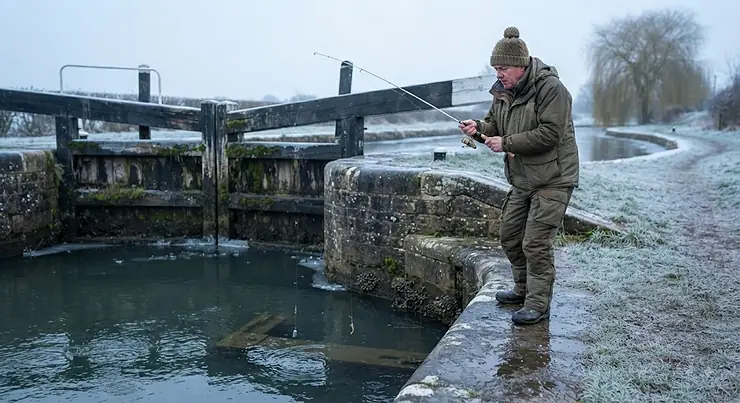
Stand on any towpath in Britain on a crisp fenland morning and you’ll eventually spot two camps of perch angler: the ones twitching a tiny jig on a short, snappy retrieve, and the ones patiently shaking a bait suspended a foot off the deck on a length of fluorocarbon. Ask either which method is “better” and you’ll get a look somewhere between pity and mild offence. The truth, unglamorous as it is, is that Drop Shot vs Micro Jig for Perch isn’t really a rivalry at all — it’s a toolbox decision, and the fish generally couldn’t care less which camp you belong to.
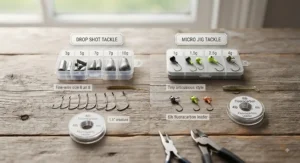
What this article won’t do is pretend one method wins outright, because that would be a disservice to anyone standing at the water’s edge trying to work out why the perch went quiet at 11am. Instead, we’ve pulled together seven genuine pieces of UK-available tackle, weighed up their real specs against real angler feedback, and built a framework you can actually use — on canals, rivers, reservoirs and everything in between. Whether you’ve searched drop shot or jig perch winter tactics, or you’re simply wondering when to use drop shot perch rigs over a straight jig head, the goal here is the same: fewer blank sessions, more stripes in the net.
We’ll also flag, honestly, where the aggregated review data runs thin — because a good buying guide should tell you what it doesn’t know just as clearly as what it does.
Perch Fishing Method Comparison at a Glance
Before diving into individual tackle, it helps to see the two techniques side by side. This is a genuinely simplified perch fishing method comparison — the nuance comes later — but it gives you a fast reference point for the sections that follow.
| Factor | Drop Shot | Micro Jig |
|---|---|---|
| Best water type | Slow, deep, structure-heavy | Moving water, open swims |
| Presentation speed | Slow, stationary, shaking | Fast, hopping, searching |
| Learning curve | Moderate (rigging takes practice) | Low (cast and retrieve) |
| Snag resistance | Lower on weedy bottoms | Higher, especially weightless |
| Best For | Winter perch, pressured venues | Covering water, active fish |
Reading this table, the pattern that jumps out is speed of coverage versus precision of presentation. A drop shot rig excels because you can hold a bait dead still in a perch’s face for as long as its patience holds out, which matters enormously when fish are lethargic in cold water. A micro jig, by contrast, is built to search — you’re covering swims quickly to find where the fish are actually sat, then switching tactics once you’ve located them. Neither approach is objectively superior; they solve different problems, and plenty of experienced anglers carry both rigged and ready on separate rods.
💬 Just one click — help others make better buying decisions too!😊
Top 7 Drop Shot and Micro Jig Products for Perch: Expert Analysis
We’ve deliberately mixed budget starter kits, dedicated components, and one or two premium picks, so there’s something here whether you’re testing the water for the first time or refining a system you’ve used for years. Every product below is genuinely available through UK tackle retailers and Amazon UK; we’ve verified specifications and cross-referenced aggregated customer sentiment rather than inventing quotes.
1. Savage Gear Mini Perch Kit — best budget starter kit for both methods
If you’re not yet sure whether you’re a drop shot angler or a jig angler, this is the sensible place to start. The Savage Gear Mini Perch Kit bundles fifteen soft lures — a mix of 3D Fry paddle tails, V-tails and PVC mayfly imitations, all around 5cm — with two micro dart jig heads, two dropshot hooks and two small dropshot weights in a single box, which means you can experiment with both rigs on the same session without buying anything else. The 2g jig heads sit comfortably within the “micro” bracket, light enough to work naturally over silty canal beds without ploughing in.
Based on the spec comparison with similar starter bundles, what stands out here is the breadth of lure shapes for the price — a V-tail wobbles hard on the drop, ideal for triggering reaction bites, while the smaller fry patterns imitate the fry shoals perch famously herd in late summer. This is squarely a beginner and budget-conscious pick, though seasoned anglers often keep one in the bag as a backup box. Reviewers consistently report that the kit performs well as an introduction to predator lure fishing, with several noting it produced personal-best perch on first outings, though a handful mention the supplied hooks are worth upgrading for serious use.
Pros:
- ✅ Covers both drop shot and jig rigging in one box
- ✅ Lure sizes genuinely suited to UK perch, not oversized imports
- ✅ Excellent value entry point for new lure anglers
Cons:
- ❌ Supplied hooks are basic and benefit from upgrading
- ❌ Limited colour variety compared to buying lures individually
At around £12-£16, this is one of the cheapest genuine ways into perch lure fishing, and the value verdict is straightforward: it’s hard to lose money learning on a kit this inexpensive.
2. Berkley PowerBait Perch Kit — best scent-boosted all-rounder
Where the Berkley PowerBait Perch Kit earns its keep is in Berkley’s long-running scent technology, infused into every shad, curl tail and vibration worm in the pack. The kit spans multiple lure styles specifically curated for jig heads and drop shotting, rather than being a generic predator bundle repurposed for perch.
The practical meaning of PowerBait scent is worth spelling out rather than glossing over: independent lab testing commissioned by Berkley (not something we can verify ourselves, so treat this as a manufacturer claim) suggests fish hold on considerably longer once they’ve mouthed a scented bait, which — on paper — buys you an extra beat to set the hook on those notoriously light perch pulls. What most buyers overlook about this kit is that the vibration worms are arguably the standout piece, working superbly on a drop shot rig fished dead-slow in coloured winter water. This is a strong pick for anglers who fish pressured, well-fished venues where perch have grown wise to unscented plastic. Reviewers consistently note a noticeably higher hook-up rate on finicky bites compared with unscented alternatives, though a minority found the packaging arrived with lures lightly coated in a manufacturing oil that needed rinsing before use.
Pros:
- ✅ Scent genuinely extends how long perch hold the bait
- ✅ Multiple lure styles suited to both rigs in one kit
- ✅ Strong choice for pressured or heavily-fished waters
Cons:
- ❌ A few reports of oily residue on arrival needing a rinse
- ❌ Scent needs reapplying/refreshing after several casts
Priced in the £15-£20 range, it sits slightly above the Savage Gear kit, and the value case is that the scent edge alone can be worth the difference on tough days.
3. Fox Rage Zander Pro Shad 10cm — best micro jig shad for bigger perch
Don’t let the name mislead you — despite being marketed primarily at zander, the Fox Rage Zander Pro Shad has built a genuine following among perch anglers chasing bigger stripeys on reservoirs and gravel pits. At 10cm it’s larger than most “micro” jig lures, and that’s precisely the point: when perch are feeding on fry shoals or small roach, a shad with a pronounced shovel tail and high-frequency vibration profile out-fishes tiny finesse baits by triggering a more aggressive, reactive take.
Rigged on a suitably weighted jig head, the shovel tail generates rolling vibration from the slowest of retrieves right up to a brisk hop-and-pause, which the spec sheet won’t tell you but reviewers consistently note translates into solid action even in cold, sluggish water where perch won’t chase far. This is a use-case pick rather than an everyday one: think big-water perch, low light, and a willingness to fish a bit bigger to filter out the smaller fish. Aggregated feedback highlights the rubber’s durability against perch’s surprisingly sharp gill rakers and teeth compared with cheaper softbaits, though a few anglers noted the tail can foul on the hook point during aggressive casting, requiring an occasional straighten.
Pros:
- ✅ Vibration profile triggers reaction bites from bigger perch
- ✅ Noticeably more durable rubber than budget alternatives
- ✅ Effective across a genuinely wide retrieve speed range
Cons:
- ❌ Larger profile can be too big for smaller, weary perch
- ❌ Tail occasionally fouls the hook on hard casts
Expect to pay around £6-£9 per pack of five, which represents solid value given the five-times-longer lifespan Fox Rage claims over standard soft plastic, though we’d flag that as a manufacturer figure rather than an independently tested one.
4. Savage Gear Micro Dart Jighead 0.8g — best dedicated micro jig head
Sometimes the honest answer to “which lure should I buy” is that the lure matters less than what it’s mounted on, and the Savage Gear Micro Dart Jighead is a case study in that. At 0.8g on a size 8 hook, this is about as light as jig heads reasonably get before you’re better off drop shotting instead — which, incidentally, is exactly the crossover point this whole article revolves around.
In practice, a jig head this light means near-weightless presentations that sink at a natural, fluttering rate rather than dropping like a stone, mimicking an injured fry far more convincingly than a heavier head ever could. Based on the spec comparison with mid-weight jig heads (2-3g), the trade-off is casting distance: at 0.8g you’re limited to close-range, accurate lobs rather than long casts across open water, so this head earns its place specifically for margin work, canal fishing and sight-fishing clear pools. What most buyers overlook is the hook quality — Savage Gear’s ultra-sharp, strong #8 hook is genuinely capable of handling a surprise pike encounter, which happens more often than perch anglers like to admit. Reviewers consistently praise the sharpness out of the packet, with several noting they rarely need to re-sharpen through a season, though the small pack size of five means you’ll want to buy in bulk if you fish regularly.
Pros:
- ✅ True micro weight for ultra-natural fall and presentation
- ✅ Hook quality exceeds what the low price suggests
- ✅ Ideal for margin, canal and clear-water sight fishing
Cons:
- ❌ Casting distance is genuinely limited at this weight
- ❌ Small pack size means frequent reordering for regulars
At under £5 for a pack, this is inexpensive enough to treat as a consumable, and the value verdict is that it’s the cheapest genuine upgrade you can make to an existing micro jig setup.
5. Abu Garcia Spike X Finesse Jigging Rod — best dedicated finesse rod for perch
Rods rarely get the analytical attention they deserve in perch-fishing content, which is a shame because the Abu Garcia Spike X Finesse Jigging Rod is arguably the single biggest upgrade an angler serious about either technique can make. Designed specifically with input from European perch and zander specialists, it was never intended as a generic spinning rod pressed into service — it’s built ground-up for exactly this style of fishing.
The nano-technology carbon blank keeps overall weight low enough for genuinely comfortable all-day one-handed twitching, while the Seaguide XOG guides are shaped to resist line tangling around the tip during the fast, repetitive jig strokes this technique demands. What the spec sheet doesn’t fully convey is how much of a difference blank sensitivity makes when you’re drop shotting: a softer, less responsive rod blank simply won’t transmit the subtle pluck of a perch mouthing a stationary bait the way this one does, and that’s the difference between a missed take and a hooked fish. This is a rod for anglers who’ve already decided lure fishing for perch is more than a passing phase — it’s a specialist purchase, not an impulse buy. Reviewers consistently highlight the sensitivity-to-weight ratio as class-leading at this price point, with several long-term owners reporting no guide or blank issues after multiple seasons of hard use.
Pros:
- ✅ Purpose-built sensitivity for both jigging and drop shotting
- ✅ Lightweight blank reduces fatigue on long sessions
- ✅ Guide design resists tangling during fast jig strokes
Cons:
- ❌ Overkill if you only fish occasionally
- ❌ Premium price relative to generic spinning rods
In the £60-£90 range depending on length and retailer, it’s a genuine step up in investment, but the value case is strong for anyone fishing perch more than a handful of times a season.
6. Drennan E-Sox Dropshot Fluorocarbon Leader — best drop shot leader line
Line rarely gets its own spotlight, but the Drennan E-Sox Dropshot Fluorocarbon Leader deserves one, because leader material is arguably where drop shotting either shines or quietly fails. Made from 100% fluorocarbon rather than a coated hybrid, it shares a refractive index close enough to water that it becomes genuinely difficult for a perch to detect at close range — and close range is exactly where drop shot fishing happens.
The practical upshot of that refractive property, beyond the marketing language, is that in the ultra-clear water typical of chalk streams and gravel pits, perch that would shy away from visible line will still commit to a bait presented on this leader. Fluorocarbon also sinks rather than floats, which matters more than anglers new to the technique often realise: a floating leader fights the whole point of holding a bait static near the bottom. Based on aggregated review sentiment, anglers consistently rate the abrasion resistance highly for canal and river fishing around brickwork and sunken debris, and several specifically mention using it interchangeably for LRF (light rock fishing) and perch work, which speaks to its versatility. A recurring theme in feedback is that the diameter-to-strength ratio compares favourably with pricier imported brands.
Pros:
- ✅ Near-invisible presentation in clear, pressured water
- ✅ Genuine abrasion resistance around structure and debris
- ✅ Sinks properly, supporting a true static drop shot presentation
Cons:
- ❌ Stiffer than premium leaders, which can affect lure action
- ❌ Available breaking strains can sell out at smaller retailers
At roughly £8-£12 for a 50m spool, it works out as inexpensive per rig once you account for how far a single spool stretches, making it one of the best-value upgrades on this list.
7. Savage Gear Perch Pro Kit 2 — best premium step-up kit
Once you’ve outgrown a starter box, the Savage Gear Perch Pro Kit 2 is the natural next purchase, and it’s noticeably more considered than an entry-level bundle. Its 23 pieces include Cannibal shads, Cannibal curltails, Dying Minnow patterns, PVC mayfly imitations and Reaction Crayfish, alongside two pairs of round jig heads in two different weights, giving you a genuinely varied lure wallet rather than fifteen near-identical shapes in different colours.
What distinguishes this from budget kits, on paper, is lure diversity by profile rather than just by colour — a crayfish pattern fishes and behaves entirely differently to a curltail shad, which matters when perch switch feeding preference between crustaceans and fry through the season. Here’s what to weigh: the two jig head weights included (roughly 2-2.5g and 2-4g) sit right at the boundary between true micro jigging and light jigging, meaning this kit leans slightly more jig-focused than drop-shot-focused, so anglers wanting to prioritise the latter may still want a separate leader and weight set. Aggregated customer sentiment is strongly positive, with multiple reviewers specifically citing personal-best perch caught using the kit’s contents, and repeated praise for the durability of the Cannibal range’s rubber compound compared with cheaper unbranded lures.
Pros:
- ✅ Genuinely varied lure profiles, not just repeated colours
- ✅ Cannibal range rubber holds up well against toothy encounters
- ✅ Strong reputation for producing quality-sized perch
Cons:
- ❌ Leans more jig-oriented than drop-shot-oriented out of the box
- ❌ Pricier than entry kits, better suited to committed anglers
Sitting in the £18-£24 range, it costs more than the Mini Perch Kit, but the value verdict holds up: the lure diversity alone justifies the step-up for anyone fishing perch regularly across different venues.
Light Lure Technique Perch: Practical Rigging, Setup and Your First 30 Days
Buying the right tackle is only half the job — knowing how to actually fish it separates a productive session from a frustrating one. This section covers the light lure technique perch anglers need for both drop shotting and micro jigging, from first rig to first month.
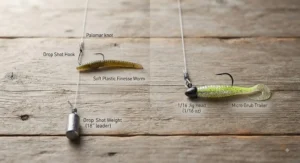
Start simple: tie your fluorocarbon leader directly to your mainline using a uni-to-uni or FG knot, then attach either your drop shot hook (using a Palomar knot, leaving a tag end for the weight) or your jig head directly. For drop shotting, position the hook roughly 15-30cm above a cylindrical weight, adjusted deeper in slower, deeper swims and shallower in shallow margins. For micro jigging, thread your soft lure onto the jig head so it sits perfectly straight — a crooked lure spins on the retrieve and rarely draws a take.
In your first thirty days, the most common mistake is retrieving too fast out of habit carried over from spinner or crankbait fishing. Perch on light lures respond best to a stop-start cadence: two or three sharp lifts of the rod tip, then a genuine pause of several seconds, watching the line for the faintest twitch. Maintenance is minimal but matters — rinse fluorocarbon leaders after saltwater or brackish sessions, check hook points regularly against your thumbnail, and store soft plastics away from direct sunlight, which degrades the rubber compound over time. A useful optimisation trick rarely mentioned on product listings: colour-match your lure loosely to the dominant prey species in the swim, but keep one bright, contrasting colour in reserve for coloured water days when visibility drops.
Which Angler Are You? Real-World Perch Fishing Scenarios
Rather than a generic “it depends,” here are three realistic profiles matched to specific tackle and reasoning, because the right choice genuinely differs by circumstance.
The canal commuter. You fish local urban canals two or three evenings a week after work, usually with under an hour on the bank and a rucksack rather than a full barrow. For you, the Savage Gear Mini Perch Kit paired with the Savage Gear Micro Dart Jighead makes sense — light, portable, quick to rig, and forgiving of the snags that urban canals inevitably throw up.
The winter specimen hunter. You target bigger perch on gravel pits and slow rivers through the coldest months, when fish shoal deep and feed sluggishly. Here the Drennan E-Sox Dropshot Fluorocarbon Leader combined with the Berkley PowerBait Perch Kit‘s scented worms, fished dead-slow on the bottom, plays to exactly the strengths cold water demands.
The river structure angler. You fish moving water — weir pools, bridge current margins, drop-offs — where covering ground and working structure matters more than finesse. The Fox Rage Zander Pro Shad on an Abu Garcia Spike X Finesse Jigging Rod lets you search water efficiently while still feeling every take through a sensitive blank.
What Is Drop Shot vs Micro Jig for Perch? How to Choose the Right Method
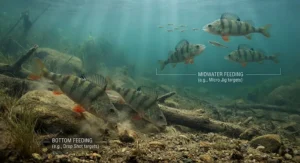
Drop Shot vs Micro Jig for Perch is essentially a choice between a static, precision presentation held near the bottom versus a mobile, searching presentation worked through the water column — one favours patience and pressured or cold-water fish, the other favours covering ground to find active feeders.
Choosing between them isn’t guesswork if you work through it systematically. Here’s a practical, step-by-step approach:
- Check water temperature first. Below roughly 8°C, perch metabolism slows dramatically, and a static drop shot presentation generally out-fishes a fast jig.
- Assess the swim’s structure. Heavy snags, sunken debris or dense weed favour a weightless or lightly-weighted jig you can hop over obstacles rather than a weight that constantly catches.
- Consider water clarity. Clear water rewards the near-invisible fluorocarbon leader of a drop shot rig; coloured water often suits a jig’s vibration, which fish can detect without seeing it clearly.
- Factor in how much ground you need to cover. If you’re searching an unfamiliar venue for fish, jigging lets you prospect faster; once you’ve located a shoal, switching to drop shot can extract more fish from the same spot.
- Match retrieve speed to fish mood. Aggressive, competitive shoals (common in late summer around fry) respond to a jig’s reaction-triggering movement; wary, pressured fish often need the drop shot’s patience.
- Review your venue’s typical depth. Deep swims over 3m generally favour drop shot’s precise depth control; shallower margins suit a jig’s mobility.
- Don’t discount using both. Many experienced perch anglers rig one rod each way and simply switch based on what the first thirty minutes tell them.
Drop Shot vs Micro Jig for Perch: The Real Difference
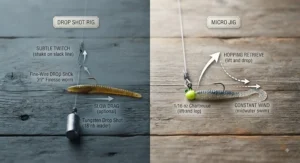
Beyond the surface-level comparison table earlier in this article, the real difference between these two methods comes down to what each is fundamentally designed to do to a lure in the water. A drop shot rig anchors your bait’s position while allowing it to move independently on a slack section of line — you can shake the rod tip and watch the lure quiver in place without it travelling anywhere. A jig, by contrast, moves the entire lure through the water column with each retrieve, the weight built into (or attached to) the lure itself rather than positioned below it.
This distinction genuinely matters in cold conditions. What most buyers overlook when reading generic reviews is that a drop shot rig lets you present a bait at an exact depth for an extended, controlled period — genuinely minutes if needed — which suits perch that have located comfortable, low-energy holding spots and have no intention of chasing anything. A micro jig, worked correctly, imitates fleeing or injured prey, and that reads as an opportunity worth expending energy on, even to a sluggish fish, provided the movement is triggered close enough to be worth the effort.
Where jigging pulls ahead is efficiency of search. A weighted jig head lets you cast, count down to depth, and retrieve through multiple depth bands in a single cast — genuinely useful when you don’t yet know where in the water column the perch are holding. Drop shotting, by comparison, commits you to fishing near the bottom (or wherever you position the weight), which is precise but slower to adapt if fish turn out to be suspended mid-water chasing fry.
Traditional bait fishing versus lure methods. It’s also worth setting both techniques against the traditional alternative many UK anglers grew up with: float-fished worm or maggot. Static bait fishing remains genuinely effective and requires less casting accuracy, but it lacks the active triggering element both lure methods bring — you’re waiting for a fish to find your bait rather than actively presenting movement that provokes a strike. For pressured, well-fished venues where perch have seen thousands of static baits, both drop shot and micro jig approaches frequently out-fish traditional tactics precisely because the movement itself is the trigger.
| Approach | Search Speed | Presentation Control | Best Season |
|---|---|---|---|
| Micro Jig | Fast | Moderate | Spring-Autumn |
| Drop Shot | Slow | High | Winter |
| Float-fished bait | Very slow | Low (passive) | Year-round |
Looking at this table, the seasonal pattern is arguably the single most useful takeaway: as water temperature drops through autumn, the balance of advantage shifts steadily from jig to drop shot, and understanding that shift alone will improve your winter catch rate more than any single piece of tackle.
When to Use Drop Shot Perch Tactics (And When to Switch)
Knowing when to use drop shot perch tactics rather than defaulting to a jig comes down to reading a handful of practical signals rather than following a rigid calendar rule.
The clearest trigger is a run of missed or “finicky” bites — light plucks that never develop into a solid take. This usually means fish are interested but unwilling to commit to a moving target, and switching to a static drop shot presentation, held dead still for longer than feels natural, frequently converts those taps into proper hook-ups. Pressured venues, where perch have been caught and released repeatedly, show the same pattern: the fish have learned to associate fast-moving lures with danger, and a slow, subtle drop shot bait reads as less threatening.
Depth is the second major signal. Once you’ve located fish holding tight to the bottom in water deeper than around 3m — common on reservoirs and gravel pits through winter — a drop shot rig lets you park a bait exactly at that depth and keep it there, something a jig’s constantly-changing depth on retrieve simply can’t replicate as precisely. Conversely, when perch are actively chasing fry near the surface or mid-water — a classic late-summer scenario — a jig’s mobility and reaction-triggering action becomes the better tool, and persisting with a bottom-hugging drop shot rig in that scenario means fishing where the fish simply aren’t.
Drop Shot or Jig Perch Winter: Seasonal Tactics That Actually Work
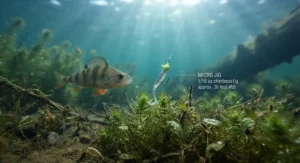
The drop shot or jig perch winter question comes up constantly in UK angling forums, and the honest answer leans firmly, though not exclusively, toward drop shot once water temperatures fall consistently below around 7-8°C.
Cold-blooded fish like perch see their metabolic rate drop sharply as water cools, which translates directly into reduced willingness to chase prey any meaningful distance. This is precisely the scenario a static, patient drop shot presentation was built for: a bait held motionless, or twitched only very subtly, close to a perch’s holding position, asks almost nothing of the fish in terms of energy expenditure to investigate. Reviewers and experienced winter anglers consistently report that painfully slow retrieves — pauses measured in tens of seconds rather than moments — out-produce anything resembling a normal-paced retrieve once temperatures bite.
That said, jigging hasn’t lost all relevance in winter; it simply needs adapting. A very slow, small-hop jigging style, worked tight to structure where perch shoal up for warmth and shelter, can still trigger takes, particularly on milder winter days or during a brief warm spell. The practical winter approach many successful anglers settle on is a two-rod system: one rigged drop shot for patient, static presentation, one rigged with a light jig head for occasionally probing nearby structure, switching emphasis toward whichever is producing bites on the day.
Finesse Lure Comparison Perch: Features That Actually Matter (And Those That Don’t)
Running a genuine finesse lure comparison perch anglers can rely on means separating marketing language from features with measurable impact on catch rate — and there’s a fair amount of noise to filter through.
What actually matters: lure action at slow speed is arguably the single biggest factor, because perch, particularly in cold or pressured conditions, are frequently unwilling to chase fast-moving bait. A lure that produces genuine tail kick or body roll at a near-standstill retrieve consistently outperforms one that only “comes alive” at speed. Scent, while harder to verify independently, shows up repeatedly in aggregated review data as improving hold time on the take — useful given how light and easily missed perch bites can be. Hook sharpness out of the packet matters more than anglers often credit; a dull hook on an otherwise perfect lure simply fails to set on the softer inside of a perch’s mouth.
What matters less than marketing suggests: an enormous colour range sounds appealing, but the practical difference between similar shades of, say, three different “natural roach” patterns is minimal in most UK water clarity conditions — two or three genuinely contrasting colours (natural, dark/silhouette, and a bright attractor) cover the vast majority of situations. UV-reactive finishes are often marketed heavily, and while there’s some evidence they help in low light or coloured water, the effect appears more modest for perch than for species like zander, based on available spec comparisons and angler reports rather than controlled testing. Similarly, exotic lure shapes imitating unusual prey items rarely outperform simple, proven profiles like a curltail or paddle tail shad for UK perch specifically, whatever premium pricing might imply.
Jig vs Drop Shot River Perch: Current, Structure and Presentation
River fishing changes the jig vs drop shot river perch calculation considerably compared with still water, because current adds a variable that simply doesn’t exist on a canal or lake.
On flowing water, a drop shot rig’s weight needs to be heavier than the still-water equivalent to hold position against the current, and even then, presentations can drift and swing in ways that undermine the “static bait” principle the technique relies on. This makes drop shotting most effective in river perch fishing specifically in slack water — eddies behind bridge supports, the slower margins inside a bend, or the calm water immediately downstream of a weir. Fished in these micro-environments, the technique retains its core advantage: a genuinely still presentation perch can inspect at leisure.
Jigging, by contrast, often suits river perch fishing better in the main flow itself, because a jig head’s weight can be matched to the current speed to maintain contact and depth control while still allowing a natural, current-assisted drift on the fall. Working a jig along a crease — the visible seam where fast and slow water meet — is a classic river tactic, since perch frequently sit exactly on that boundary, using the slower water to conserve energy while intercepting food swept past in the faster current. What most river anglers overlook is that snag risk rises sharply near structure like fallen trees or sunken debris common on UK rivers, so a weedless or semi-weedless jig rigging is often worth the slightly reduced hook-up rate it can introduce.
Common Mistakes When Buying and Fishing Light Lures for Perch
Even well-intentioned anglers fall into a handful of predictable traps when starting out with finesse perch tackle, and most are avoidable with a little forewarning.
The first common mistake is over-weighting the rig “just in case.” Heavier jig heads and larger drop shot weights feel more confidence-inspiring to cast, but they actively work against the natural fall and subtle presentation that make these techniques effective in the first place — perch notice the difference between a bait that flutters down naturally and one that plummets like a stone. The second mistake is buying line that’s too heavy for the technique; thick, stiff leader material reduces lure action and makes bites harder to detect through reduced sensitivity, undermining much of the point of fishing light in the first place.
A third recurring error is neglecting hook maintenance, particularly on budget starter kits where hooks are a genuine cost-saving compromise — a hook that’s been dragged across gravel a few times needs checking, and often sharpening, before it’ll set properly in a perch’s relatively hard mouth. Finally, many newcomers commit to a single lure colour or style too early, rather than treating the first few sessions as genuine experimentation; what works on a clear gravel pit rarely translates directly to a coloured, weedy canal, and the willingness to change tack quickly is often the real skill being developed, more than any single piece of tackle.
What to Expect: Real-World Performance Beyond the Spec Sheet
Specifications tell you what a product is capable of; they rarely tell you what a session actually feels like, so it’s worth translating some of the numbers above into practical, everyday experience.
A 0.8g jig head, for instance, sounds negligible on paper, but on the water it means your lure genuinely hangs in the water column rather than sinking briskly — cast it into a clear margin and you can watch it flutter down for several seconds, giving a holding perch ample time to notice and react. That’s the real-world translation of “light jig heads present more naturally.” Similarly, a fluorocarbon leader’s near-invisibility isn’t an abstract marketing claim once you’ve fished gin-clear water and watched a wary perch follow a bait right up to the rod tip without spooking, something that simply doesn’t happen as reliably with standard monofilament in the same conditions.
On the drop shot side, the practical experience of “holding a bait still” is less passive than it sounds from a product description — genuinely effective drop shotting involves near-constant micro-adjustments, tiny rod tip movements that make the bait shiver without moving its overall position, sustained over what can feel like an uncomfortably long pause between casts. Expect your first few sessions to feel slower and less immediately rewarding than jigging, precisely because the technique’s strength lies in patience most anglers initially find difficult to sustain.
Long-Term Cost and Maintenance for Perch Lure Fishing
Total cost of ownership for light lure perch fishing is worth thinking through honestly, because the ongoing spend often exceeds the initial tackle purchase over a season.
| Item | Typical Lifespan | Approx. Ongoing Cost |
|---|---|---|
| Soft plastic lures | Several sessions to a season | £10-£20 per restock |
| Jig heads/hooks | Multiple sessions if not snagged | £5-£10 per restock |
| Fluorocarbon leader | One to two seasons per spool | £8-£12 per spool |
| Rod (e.g. Abu Garcia Spike X Finesse Jigging Rod) | Multiple seasons | One-off, £60-£90 |
Interpreting this table, the clear pattern is that consumables — soft plastics and hooks — dominate ongoing cost far more than the one-off rod purchase, particularly for anglers who fish snaggy venues where lure loss is frequent. A quality rod like the Abu Garcia Spike X Finesse Jigging Rod effectively pays for itself in improved sensitivity and reduced missed bites over a season or two, whereas cutting corners on consumables — reusing torn lures, fishing blunt hooks — tends to cost more in lost fish than it saves in pounds. The most cost-effective long-term strategy most experienced anglers land on is investing properly in the rod and reel once, then treating soft plastics and hooks as the genuinely disposable items they are.
Safety, Regulations and Responsible Angling for UK Perch Anglers
Before heading out with any of the tackle covered in this guide, it’s worth being clear on the legal and welfare responsibilities that come with fishing for perch in England and Wales.
Anyone aged 13 or over fishing for coarse fish, including perch, needs a valid Environment Agency rod fishing licence, regardless of whether you’re fishing a club water, a day-ticket fishery, or free stretches managed by bodies like the Canal & River Trust. On top of the licence, most individual waters require separate permission from the landowner or managing club — a licence alone doesn’t grant access to fish anywhere. For anglers specifically drawn to canal perch fishing, it’s worth reading the Canal & River Trust’s own guidance on lure fishing for predators on the canal network, which covers both permit requirements and species you’re likely to encounter.
Fish welfare matters just as much as legality. Barbless or micro-barbed hooks — standard on most of the jig heads and drop shot hooks covered above — reduce handling damage and speed up unhooking, which matters enormously for a species with the relatively delicate mouth structure perch have. The Angling Trust’s Best Practice Guide for Freshwater Angling sets out clear, practical guidance on fish handling, safe rig use and biosecurity that’s genuinely worth reading in full, particularly the sections on minimising fight time and keeping fish wet during unhooking and photography. Following this guidance isn’t just good practice for the fish — pressured venues with careful, well-handled catch-and-release populations tend to produce better fishing for everyone, including you, next season.
Frequently Asked Questions
❓ Is drop shot or jig better for perch in winter?
❓ What weight jig head is best for perch?
❓ Do you need fluorocarbon for drop shot perch fishing?
❓ Can you catch perch on a jig all year round?
❓ What size hook is best for a perch drop shot rig?
Conclusion
Neither method wins Drop Shot vs Micro Jig for Perch outright, and if this guide has done its job, that shouldn’t feel like a cop-out answer but a genuinely useful one. What we’ve tried to show, product by product and section by section, is that the right choice depends on water temperature, structure, clarity and how the fish are behaving on the day — variables that change far more often than most tackle marketing likes to admit.
If you’re starting from nothing, a kit like the Savage Gear Mini Perch Kit or the Berkley PowerBait Perch Kit gets you experimenting with both techniques cheaply enough that mistakes cost little. Once you know which style suits your local venues and your own fishing rhythm, dedicated pieces like the Savage Gear Micro Dart Jighead, the Fox Rage Zander Pro Shad, the Drennan E-Sox Dropshot Fluorocarbon Leader or a genuinely purpose-built rod like the Abu Garcia Spike X Finesse Jigging Rod repay the investment many times over in bites converted rather than missed. And if you’re already committed to perch as more than a passing interest, the Savage Gear Perch Pro Kit 2 is a sensible next step once the basics are second nature.
Whatever you choose, the fish, ultimately, don’t read spec sheets — they respond to presentation, patience, and a willingness to change tactics when the first one isn’t working. Take that mindset to the bank alongside whichever rig you tie on first.
✨ Don’t Miss These Exclusive Deals!
🔍 Take your perch fishing to the next level with these carefully selected drop shot and micro jig picks. Click on any highlighted product to check current pricing and availability. The right rig in your box could be the difference between a blank session and a personal best this season!
Recommended for You
- Drop Shot Fishing for Perch: 7 Best Rigs; Gear Picks (2026)
- Drop Shot Lures for Perch: 7 Brilliant Picks for 2026
- Perch Lures for Canal Fishing: 7 Best Value Picks for 2026 (UK)
Disclaimer: This article contains affiliate links. As an Amazon Associate, I earn from qualifying purchases. If you purchase products through these links, we may earn a small commission at no additional cost to you.
✨ Found this helpful? Share it with your friends! 💬🤗
