

In This Article
A multiplier reel for beginners is a forgiving, adjustable-brake “multi” that a first-timer can learn on without constant tangles. It sits on top of the rod, winds line in quickly thanks to its gearing, and handles heavy leads better than most fixed spools. Its brakes tame the spool so your first casts don’t end in chaos.

Here’s the honest bit. According to FISHMAG’s UK multiplier guide, most anglers still prefer a fixed spool reel, because multipliers take time to master and tangle more easily. So why bother? Because a multi lets you run much heavier mono than a fixed spool can cope with. It hauls snagged rigs out of weed instead of surrendering them to the seabed, and in skilled hands it casts further. For rough-ground work, deep marks and heavier leads, it earns its keep.
The trade-off is the learning curve. Every multiplier reel for beginners lives or dies on two things: how well its brakes control overrun and backlash, and how patient you are for the first few sessions. Get the brake right and the reel is a joy. Get it wrong and you’ll spend the evening picking a bird’s nest out of 0.35mm mono by torchlight.
This guide covers seven real reels you can buy in the UK, from the best budget multiplier reel options to premium rough-ground workhorses. It also covers how a magnetic brake actually works, how to dodge the classic mistakes, and what to expect in your first month. I haven’t field-tested these reels myself. Everything below comes from published specifications and UK retailer and reviewer commentary gathered at the time of research, and where review evidence is thin, I say so.
Quick Comparison Table: Best Multiplier Reel for Beginners at a Glance
| Reel | Braking system | Best For |
|---|---|---|
| Penn 525 Mag4 | Adjustable magnetic brake with external knob | All-round beach and mixed-ground fishing |
| Daiwa Millionaire 7HT Mag | Magnofuge magnetic brake | Clean-ground casting with lighter lines |
| Tronixpro Guerilla Mono Mag 6500 | Single magnetic brake | Tight budgets and improving casters |
| Daiwa Sealine SL20SH “Slosh” | Centrifugal brake | Rough ground and light boat work |
| Fladen Maxximus 6500 | Magnetic plus 8-pin centrifugal | Cheapest sensible way into multipliers |
Read the table as a map of trade-offs, not a league table. The Penn 525 Mag4 is the safest single pick if you can stretch to around £160 or more. If you’re hunting the best budget multiplier reel, the Tronixpro Guerilla Mono Mag 6500 and the Fladen Maxximus 6500 both come in under £100, but the Fladen’s dual braking system is arguably gentler on a first-timer. The Daiwa Millionaire 7HT Mag is the dream machine for clean beaches, while the Slosh is the blunt instrument for kelp and conger.
💬 Just one click — help others make better buying decisions too!😊
Top 7 Multiplier Reels for Beginners: Expert Analysis
Prices below are ranges from UK retail listings at the time of research, so check current price before buying. Availability shifts, and a couple of these reels are older designs that some retailers have flagged as discontinued or replaced.
1. Penn 525 Mag4 — the forgiving all-rounder for UK beaches
The headline feature is the externally adjustable magnetic brake, and for newcomers it’s a gift. You turn a knob on the side plate to match wind, lead weight and nerve level, with no tools and no strip-down.
The 6.1:1 gearing brings in roughly 73cm of line per turn, and the reel weighs about 439g, which is light for a beach caster. It carries around 255m of 0.38mm mono and offers 9kg of drag. In practice, that fast retrieve winches big huss out of kelp but feels brisk for small whiting and dabs.
Based on the spec comparison, the 525 size is the sweet spot for shore work. It has enough capacity for heavier line over mixed ground and still casts well on clean beaches. Reviewers consistently describe it as a dependable first multiplier, and one UK verified buyer called it a perfect starter reel for the money. The recurring complaint is a slightly noisy drag click.
Pros:
- ✅ External magnetic brake knob is easy to adjust
- ✅ Light, balanced frame for a beach caster
- ✅ Strong gearing handles snags and heavier leads
Cons:
- ❌ Drag clicks louder than some anglers like
- ❌ Fast retrieve feels overkill for small fish
Expect to pay around £160-£210. For anyone who wants one reel to grow into rather than out of, that’s solid value.
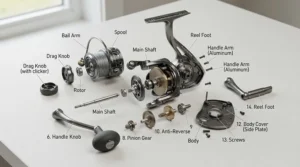
2. Daiwa Millionaire 7HT Mag — Magnofuge braking built for long, clean casts
The standout is the Magnofuge system, which lets the spool reach full speed early in the cast and then applies braking as spool speed falls. A 21-step dial gives you plenty of room to experiment.
It’s a lean machine. At 12.2oz (about 346g), it holds 300m of 15lb mono, retrieves at 5.8:1 (about 71cm per turn) and uses six bearings, five of them corrosion-resistant. That slim, light build suits lighter lines over clean ground, where distance is the goal and rocks aren’t a worry.
This is the reel for the beginner who already knows they’ll stick with beach fishing. FISHMAG notes the Mag version is far less prone to nests than the non-magnetic 7HT. The same article cautions that heavy brake settings can trim maximum distance. Owner feedback on retail listings is warm, with words like smooth, easy to use and great casting. A frequent caveat in reviews is that it isn’t cheap, and one forum poster complained about paint blistering and unhelpful warranty handling.
Pros:
- ✅ Fine-tunable brake dial with 21 settings
- ✅ Sweet, smooth retrieve with quality bearings
- ✅ Excellent line capacity for its size
Cons:
- ❌ Pricey compared with other first multipliers
- ❌ Not ideal for heavy rough-ground hauling
Budget roughly £200 upward, with wide variation between retailers. It’s superb value if you cast over clean sand, and poor value if you fish gnarly rock marks.
3. Tronixpro Guerilla Mono Mag 6500 — the sub-£100 casting bargain
Its party trick is a single magnetic brake of the type favoured on the tournament casting scene, plus a freely floating spool. It’s available in both right and left-hand versions.
On paper you get a 5.3:1 retrieve, 250m of 0.35mm line, 8kg of drag and hardened brass gears, all in a body weighing around 400g. That lower gear ratio is actually kinder with small fish, since you don’t need ultra-fast winding for most British species.
Here comes the honest caveat. FISHMAG suggests a single-magnet system may be trickier for beginners than multi-magnet designs, because there are fewer magnets controlling spool speed. In practice that means starting with the brake set high and trusting the thumb. Retail reviewers praise the reel as excellent value and a handy backup. That’s real sentiment from listings, though the review pool is smaller than for the Penn or Daiwa.
Pros:
- ✅ Great value for a magnetic multiplier
- ✅ Left-hand option available
- ✅ Sensible 250m capacity for most beach work
Cons:
- ❌ Single magnet demands more thumb discipline
- ❌ Less powerful than the Penn or Slosh
Expect roughly £60-£95, comfortably within the best budget multiplier reel territory. For a careful learner, it’s a bargain.
4. Daiwa Sealine SL20SH “Slosh” — cult-favourite grunt for kelp and conger
The star feature is brute-force simplicity. It’s a no-nonsense, level-wind-free design with a counterbalanced power handle, multi-washer drag and 6.1:1 gearing that rips tackle out of snags.
It weighs around 403g (14.2oz) with four ball bearings and holds roughly 250m of 20lb mono. Centrifugal braking and a five-point support frame complete the picture. That means robust and reliable rather than fancy. The reel suits rough ground, uptide boat work and light shore conger fishing.
Is it a beginner’s reel? Forum veterans have recommended it as user-friendly, but a centrifugal brake offers fewer quick adjustments than a magnetic dial, so you’ll need to learn how the pins work. FISHMAG describes the Slosh as a cult-following, low-cost workhorse with “nothing to go wrong”. Older forum comments note the gearbox angle feels awkward to some hands.
Pros:
- ✅ Tough, simple build with a strong reputation
- ✅ Fast gearing for pulling fish from snags
- ✅ Doubles as a boat reel
Cons:
- ❌ Centrifugal braking is less intuitive for newcomers
- ❌ Some retailers list it as discontinued or replaced
Expect around £100-£135 where stock remains. It’s good value, but check availability first.
5. Penn Fathom II Casting Special — premium rough-ground power with a forgiving brake
The headline here is the “knobby” magnetic brake, which you can tweak mid-cast alongside a full-metal body built for punishment.
The numbers are serious. The reel pairs 6.1:1 gearing with a marine-grade bronze main gear, 13.6kg of drag and 430m of 0.35mm mono. It weighs about 17.5oz, noticeably heavier than rivals. All that capacity and strength means you’ll rarely outgrow it, even if you start targeting bigger fish.
For a beginner, the logic is simple. This is the “buy once” option, and its brake adjustments are easy to reach. FISHMAG calls it a mega-hit among rough-ground anglers and also a capable beach reel, though it hopes newer Penn builds will last as long as the older ones. Expect the extra weight to tire your arms on long sessions. Reviewer sentiment is strongly positive, but the review pool for this specific variant is smaller than for the 525.
Pros:
- ✅ Full-metal construction built to last
- ✅ Huge line capacity and drag power
- ✅ Magnetic brake knob adjustable mid-cast
Cons:
- ❌ Heavier than lightweight beach multipliers
- ❌ Overkill if you only fish clean sand
Pricing sits at roughly £190-£230. That’s high for a first reel, but excellent value if you fish rough ground.
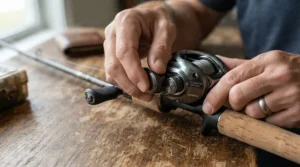
6. Fladen Maxximus 6500 — dual-brake safety net at the lowest entry price
The hook is dual braking: an 8-pin centrifugal brake plus an adjustable magnetic brake working together. In theory that gives a beginner two levers against overrun and backlash.
It’s a modest spec. You get a 5.3:1 retrieve, 250m of 0.35mm line, 2+1 bearings, a line-out alarm, a power handle and 16lb of listed drag, in a package under 400g. Don’t expect smoothness like a Daiwa. Do expect a functional reel at a price that won’t hurt if you wreck your first session.
It’s listed on amazon.co.uk, which makes it easy to check. I couldn’t find enough verifiable review data to summarise real user sentiment, so treat the spec sheet as your main guide and read current customer reviews yourself. It makes sense as a trial reel, particularly if you’re unsure whether multipliers suit you.
Pros:
- ✅ Dual brake system gives extra control
- ✅ Very low entry price
- ✅ Includes a line-out alarm
Cons:
- ❌ Only 2+1 bearings, so less smooth
- ❌ Limited verified long-term reviews
Expect around £70-£90. As a best budget multiplier reel contender, it’s a low-risk experiment.
7. Abu Garcia Ambassadeur 6500 C3 — the lightweight classic for estuaries and lighter lines
The charm is its heritage. This compact Swedish-built design weighs only about 305g, far less than the heavier Penn and Daiwa reels.
It offers 5.3:1 gearing, around 65cm per turn, a Carbon Matrix drag rated to 6.8kg, and a 6-pin centrifugal brake. Line capacity is about 320yd of 12lb mono. In practice, that means lighter line and lighter leads. It suits estuary and light beach fishing, and it also works as a light inshore boat reel.
The learning curve is steeper here. You adjust the centrifugal pins under the side plate rather than turning a dial, and the reel lacks the all-purpose power of the Penn. It’s best for beginners who prefer light, sporting tackle and are comfortable learning thumb control. Anglers on forums often say Abu 6500s are user-friendly, though these are opinions from older threads and I can’t verify a current review sample.
Pros:
- ✅ Very light and comfortable to hold
- ✅ Compact, proven design with a long pedigree
- ✅ Smooth drag for lighter species
Cons:
- ❌ Centrifugal pins need hands-on adjustment
- ❌ Less power for heavy leads or rough ground
Check current price, as UK retail listings vary widely. Value depends on your fishing style.
Top 7 Specification Comparison
| Reel | Gear ratio | Brake | Line capacity | Price range | Best For |
|---|---|---|---|---|---|
| Penn 525 Mag4 | 6.1:1 | Magnetic | ~255m of 0.38mm | £160-£210 | All-round beach |
| Daiwa Millionaire 7HT Mag | 5.8:1 | Magnetic | 300m of 15lb | £200+ | Clean-ground distance |
| Tronixpro Guerilla Mono Mag 6500 | 5.3:1 | Single magnetic | 250m of 0.35mm | £60-£95 | Tight budgets |
| Daiwa Sealine SL20SH | 6.1:1 | Centrifugal | 250m of 20lb | £100-£135 | Rough ground |
| Penn Fathom II Casting Special | 6.1:1 | Magnetic | 430m of 0.35mm | £190-£230 | Heavy-duty all-rounder |
| Fladen Maxximus 6500 | 5.3:1 | Dual | 250m of 0.35mm | £70-£90 | Lowest-risk entry |
| Abu Garcia Ambassadeur 6500 C3 | 5.3:1 | Centrifugal | ~320yd of 12lb | Check price | Lighter line, estuaries |
The pattern is obvious once you see it. Reels with magnetic brakes sit at both ends of the price scale, but the cheapest ones rely on you to learn the setup. The Penn 525 Mag4 and Daiwa Millionaire 7HT Mag buy you refinement, while the Tronixpro Guerilla Mono Mag 6500 and Fladen Maxximus 6500 trade polish for pocket-friendly pricing. If rough ground is on the menu, the Daiwa Sealine SL20SH and Penn Fathom II Casting Special are the muscle.
Setting Up Your First Multiplier: A Practical 30-Minute Guide
Amazon listings rarely tell you this, but a good setup matters as much as the reel itself. Spend half an hour on it at home and your first session will go far more smoothly.
Step 1: Load the line properly
Load mono with even tension, ideally through a damp cloth or with someone holding the spool of line. Stop a few millimetres below the rim of the spool. Overfilling invites overrun and backlash on the first cast, because loose coils spill off at speed.
Step 2: Set brakes high
On a magnetic brake reel, start at a high setting. On a centrifugal reel like the Daiwa Sealine SL20SH or Abu Garcia Ambassadeur 6500 C3, engage most of the pins. You can always back off later. Forum veterans routinely advise newcomers to start conservatively on the Daiwa Millionaire 7HT Mag and Penn 525 Mag4.
Step 3: Practise on grass
Use a light lead and cast across a field before any beach trip. Watch the spool as the lead drops. If the spool keeps spinning once the lead lands, tighten your brake.
Step 4: Maintenance basics
Rinse with fresh water after saltwater use, dry thoroughly and keep it away from heat. Check for sand in the clutch. The Penn Fathom II Casting Special has a fast gear-access side plate that simplifies cleaning and light servicing, which is a neat bonus for DIY-minded owners.
Common mistakes in the first 30 days
- Casting too hard before you’re ready
- Letting the lead hit the water before your thumb stops the spool
- Using braid before you’ve mastered mono

Overrun and Backlash: A Problem-to-Solution Guide for New Multiplier Users
Overrun and backlash is the number one reason beginners quit multipliers. It happens when the spool spins faster than the line is leaving, so loose loops pile up and snarl. Here are the five most common causes and fixes.
Problem 1: The spool outruns the lead at launch. Increase the brake strength. With a magnetic brake, turn the dial higher. With a centrifugal system like the one on the Daiwa Sealine SL20SH, engage more pins.
Problem 2: The lead lands and the spool keeps going. This is classic thumb timing. Press lightly on the spool as the lead enters its descent. Your thumb is the final brake.
Problem 3: A big gust ruins the cast. Wind slows the lead, so the spool runs ahead. Raise your brake on windy days. The Penn 525 Mag4 and Penn Fathom II Casting Special make this easy with an externally adjustable knob.
Problem 4: Stiff or soft line. Cheap, stiff line can spring off the spool. Use quality mono suited to your reel size.
Problem 5: Overfilled spool. Too much line builds loops. Drop the fill level slightly.
If a nest forms, don’t yank. Slowly tease out loops, starting from the spool end. Brute force turns a messy tangle into a permanent knot, and a stubborn one may mean cutting and re-tying.
Real-World Scenarios: Which Reel Fits Which Beginner?
Here are three profiles to help match a reel to your situation. Use them as reasoning aids, not rules.
The pier weekender on a tight budget. You fish from a pier twice a month, mostly for mackerel and whiting, on a budget under £100. The Fladen Maxximus 6500 or the Tronixpro Guerilla Mono Mag 6500 fits. Both are light on the wallet, and both leave room to upgrade later.
The estuary and light-line angler. You fish estuaries, use lighter leads and enjoy sporty tackle. The Abu Garcia Ambassadeur 6500 C3 suits this well because of its low weight and pedigree. You’ll fish a few times a month and don’t need heavy power.
The rough-ground rock-mark regular. You fish gnarly marks for bull huss and conger with heavier leads at least weekly. The Daiwa Sealine SL20SH or Penn Fathom II Casting Special is the sensible choice. Their strength and drag power matter more than ultimate casting distance.
The distance-focused beach enthusiast. You fish clean shingle, chase long casts and have a budget upward of £200. The Daiwa Millionaire 7HT Mag is the dream, while the Penn 525 Mag4 is the safer all-rounder.
How to Choose a Multiplier Reel for Beginners: 7 Steps
- Decide your fishing style. Clean beach, rough ground, estuary or boat? This steers everything else, including size and gear ratio.
- Pick the right size. A 6500-class or Penn 525-class reel is the standard shore size, per Veals’ guide to choosing a multiplier.
- Prioritise a magnetic brake. For a multiplier reel for beginners, an adjustable magnetic brake gives you the simplest control over overrun and backlash.
- Match the gear ratio to your fishing. Around 5.3:1 is gentler and sporty, while 6.1:1 suits snags and rough ground.
- Check line capacity. More isn’t always better. A 250m spool is plenty for most UK beach fishing.
- Consider handedness. Check whether a left-hand version exists. The Tronixpro Guerilla Mono Mag 6500 offers one.
- Set a realistic budget. Include line, a shock leader and a decent rod. A reel is only one part of the system.
Magnetic Brake vs Centrifugal Brake: What Actually Matters
Let’s demystify the magnetic brake. In plain terms, magnets near the spool create a drag that slows rotation, with no physical contact and so no wear. Turn the dial up and the spool slows more.
Centrifugal brakes work differently. Small pins or blocks slide outward as the spool spins faster, rubbing on the inside of the brake housing to slow it. They’re cheap and effective, but you have to open the side plate to switch pins on and off.
For a multiplier reel for beginners, the practical difference is speed of adjustment. A magnetic brake can be dialled up or down in seconds, even mid-session when the wind picks up. That makes experimenting less of a chore, which speeds up the learning curve considerably.
Each system has trade-offs. Magnetic brakes are generally more consistent, but heavy settings can shorten cast distance, as FISHMAG notes for the Daiwa’s Mag version. Centrifugal brakes tend to allow longer casts once you’ve mastered them, but they ask more of the angler. Dual systems, like the Fladen Maxximus 6500, hedge the bet.
If you’re buying your first reel, choose a magnetic brake. Later, when thumb control becomes second nature, you can experiment with lighter settings or a centrifugal reel like the Abu Garcia Ambassadeur 6500 C3.
Best Budget Multiplier Reel: What Your Money Really Buys
Cheap reels aren’t automatically bad, and expensive ones aren’t automatically right for you. Here’s what each price bracket tends to deliver, based on spec comparison.
| Price bracket | Reels | What you get | Best For |
|---|---|---|---|
| Under £100 | Fladen Maxximus 6500, Tronixpro Guerilla Mono Mag 6500 | Functional brakes, modest bearings | Trying multipliers cheaply |
| £100-£150 | Daiwa Sealine SL20SH, Abu Garcia Ambassadeur 6500 C3 | Proven designs, decent build | Rough ground or light-line fishing |
| £150+ | Penn 525 Mag4, Daiwa Millionaire 7HT Mag, Penn Fathom II Casting Special | Smoother bearings, refined brakes, stronger build | Long-term, buy-once ownership |
The big step up in smoothness and durability tends to arrive at the £150 mark. Below £100, expect compromises, though the Tronixpro Guerilla Mono Mag 6500 punches above its weight. If you’re asking for the best budget multiplier reel for a cautious first step, the Fladen Maxximus 6500 minimises financial risk, while the Tronixpro Guerilla Mono Mag 6500 maximises potential.
Whatever you buy, add spare money for line and a shock leader. A great reel loaded with poor line is a fast route to frustration.

Multiplier Reel vs Fixed Spool Reel: Which Suits a Beginner?
Let’s be frank. A fixed spool reel is easier. It tangles less, casts with minimal technique and forgives mistakes. One forum thread even advises newcomers to skip multipliers entirely. So why buy a multiplier reel for beginners at all?
| Feature | Multiplier | Fixed spool |
|---|---|---|
| Learning curve | Steeper | Gentle |
| Heavy line and leads | Excellent | Limited above ~25lb mono |
| Retrieve power | Strong | Moderate |
| Tangle risk | Higher (overrun and backlash) | Lower |
| Best For | Rough ground, heavy leads, skill-building | Easy fishing, lighter setups |
The table’s message is simple. A multiplier rewards effort with strength and control, while a fixed spool rewards ease. If you want a no-fuss session on the beach this weekend, buy a fixed spool. If you’re keen to learn a more controlled technique and fish heavier gear, a multiplier reel for beginners is a rewarding route.
The Learning Curve: What to Expect in Your First Month
Nobody masters a multiplier in one session. The learning curve is real, but it’s predictable, so you can plan for it.
Week one: survival. Expect a few nests. Keep your brake high, cast short and focus on thumb timing. Success means getting the lead out without a tangle.
Week two: confidence. You’ll start recognising the sound and feel of a spool running too fast. You begin to anticipate when to thumb it, and nests become rarer.
Weeks three and four: refinement. Now you can experiment, easing the magnetic brake slightly for distance. Don’t rush. Reduce the brake one notch at a time.
Remember that wind, lead weight and line type all change the equation. A setting that works at noon may fail at dusk. Keep a mental log, or even a scribbled note on your phone, of what worked in which conditions. That small habit shortens the learning curve more than any upgrade.
Features That Actually Matter (And Those That Don’t)
Marketing sheets overflow with numbers. Here’s how to filter them.
What matters: the braking system, because it determines how forgiving the reel feels. Size and line capacity matter too, since they set what you can cast and fish. Gear ratio matters for the type of ground you fish. Drag smoothness matters most when a strong fish runs.
What matters less: bearing counts. More isn’t automatically better, and a 2+1 bearing reel like the Fladen Maxximus 6500 can work fine if the build is sound. Colour schemes are irrelevant. Ultra-high maximum drag figures also rarely come into play at beginner level, whatever the box claims.
What to watch: weight. A light reel like the Abu Garcia Ambassadeur 6500 C3 reduces fatigue, while heavier reels like the Penn Fathom II Casting Special trade comfort for strength.
Safety, Rules and Licensing Guide for New Multiplier Users
Casting a heavy lead is genuinely dangerous if you’re careless. Check behind you, keep people clear and consider eye protection. Use an appropriate shock leader to protect against snap-offs when you cast.
Regulation-wise, saltwater fishing in the UK generally doesn’t require a rod licence, but freshwater fishing in England and Wales requires an Environment Agency rod licence, according to Your Angling Voice’s summary of angling legislation. Local bylaws and private-access permits can also apply, so check before you fish an unfamiliar mark.
Minimum sizes and bag limits apply to many species, particularly bass. Recent regulation changes have altered the recreational bass rules, so always check the latest official guidance before keeping any fish.
FAQ
❓ What size multiplier reel should I buy for beach fishing?
❓ How much should I spend on my first multiplier reel?
❓ Can I use braid on a multiplier reel as a beginner?
❓ Do multiplier reels come in left-hand versions?
❓ Is a magnetic brake better than a centrifugal brake for beginners?
Conclusion
Choosing a multiplier reel for beginners boils down to honest priorities. If you want the safest all-rounder and can stretch to around £160 or more, the Penn 525 Mag4 is the standout. If clean-ground distance is your passion and budget allows, the Daiwa Millionaire 7HT Mag is the treat. For the best budget multiplier reel, the Tronixpro Guerilla Mono Mag 6500 and Fladen Maxximus 6500 keep the entry price low. Rough-ground regulars should look at the Daiwa Sealine SL20SH or Penn Fathom II Casting Special, and light-line fans might fancy the Abu Garcia Ambassadeur 6500 C3.
Remember what really decides success. A magnetic brake gives you the simplest control over overrun and backlash, and patience carries you through the learning curve. Spend time on setup, practise on grass and treat early nests as tuition rather than failure.
Finally, respect the rules. Check the latest MMO bass fishing guidance on GOV.UK and any newer updates before keeping fish, since limits have been revised recently.
Recommended for You
- Beach Fishing Reels: 7 Proven Picks For UK Shores (2026)
- Fixed Spool Vs Multiplier Reel For Beach Casting: 7 Best Picks (2026)
- Beachcaster Rod For Cod Fishing: 7 Best Picks For 2026
Disclaimer: This article contains affiliate links. As an Amazon Associate, I earn from qualifying purchases. If you purchase products through these links, we may earn a small commission at no additional cost to you.
✨ Found this helpful? Share it with your friends! 💬🤗
