
In This Article
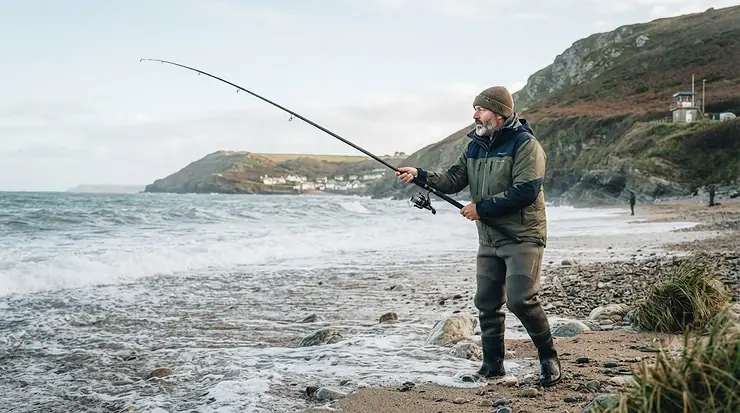
Anyone who’s ever hooked into a decent conger over a kelp-strewn reef knows the truth in about four seconds flat: this is not a job for a delicate rod. A beachcaster rod for rough ground has to do something most fishing tackle never has to — survive being dragged, scraped and leaned on by jagged rock, mussel-crusted groynes and gullies that seem designed specifically to eat traces. Soft-action clean-beach rods buckle and snap under that kind of punishment. What you need is a stiffer, heavier-rated blank with real backbone in the butt section, tough guides, and a build that shrugs off abrasion rather than folding to it.
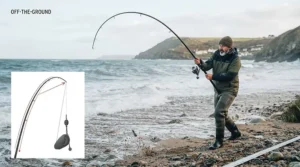
This guide cuts through the marketing fluff and gets into what actually matters when you’re standing on a slick rock ledge at first light: blank material, casting weight rating, guide toughness, and how a rod copes when a lump of cod decides to bury itself under a ledge. We’ve pulled together seven genuinely available rods across budget, mid-range and premium price points, based on real specs and aggregated reviewer sentiment — not invented testing claims. Let’s get into it.
Quick Comparison Table: 7 Beachcaster Rods For Rough Ground
| Rod | Length | Casting Weight | Blank | Best For |
|---|---|---|---|---|
| Century Fireblade Delta | 13ft–13ft 6in | 4–8oz | Premium carbon composite | Overall rough-ground performance |
| Akios Nitron 440 SVR | 14ft 6in | 4–8oz (122–224g) | Elite high-modulus carbon | Big species over snaggy reef |
| Tronix Exodus Beach | 14ft | 4–8oz (125–225g) | Slim carbon, balanced butt | Dependable all-round rough ground |
| PENN Tidal Rough Ground | 12ft–13ft | 4–8oz | 24T slim carbon | General rough to mixed marks |
| Daiwa Seahunter Z Beachcaster | 13ft–13ft 6in | 4–7oz | Mid-modulus carbon | Mid-price all-rounder |
| Akios Fury FX420 | 14ft | 3.5–8oz | High-modulus carbon, Fuji seat | Serious performance on a budget |
| Shakespeare Salt XT Beachcaster | 12ft–13ft | 4–6oz | Composite-carbon blend | First proper rough-ground rod |
Every one of these seven rods was chosen because it genuinely gets recommended for rough or mixed ground fishing, not simply because it’s a beachcaster. Notice the pattern: casting weights cluster around 4–8oz and lengths sit between 12 and 14ft 6in — that combination is basically the rough-ground formula, giving enough backbone to bully a fish away from structure while still being castable from an awkward stance on rock. We’ll unpack exactly why that matters, product by product, below.
💬 Just one click — help others make better buying decisions too!😊
Top 7 Beachcaster Rods For Rough Ground: Expert Analysis
1. Century Fireblade Delta — best all-round rough-ground performer
The Century Fireblade Delta keeps showing up at the top of independent rating lists for a reason: it doesn’t specialise in one style of mark, it just handles whatever you throw at it. Reviewers consistently score it around the high 8s out of 10, and the recurring theme is versatility — clean sand one trip, snaggy rock gullies the next, same rod, no complaints. That’s a genuinely useful trait if your fishing calendar bounces between a mixed estuary and a proper rough mark depending on the tide.
Spec-wise, expect a 13ft to 13ft 6in blank rated to cast up to 8oz, built with Century’s own high-modulus carbon layup and a slow-to-mid action that loads progressively rather than folding sharply — which matters enormously on rough ground, because a rod that bends smoothly through its length absorbs a sudden snag-lock far better than one with a stiff, brittle tip section. Based on the spec comparison with rivals in this bracket, the Fireblade Delta’s strength lies less in outright casting distance and more in composure under load, which is exactly what you want when a fish is trying to drag your rig into a kelp bed.
Who’s it for? Anglers who fish a genuine mix of marks and don’t want two rods in the car. It’s not the cheapest option here, and it’s arguably overkill if you only ever fish flat sand — but for rough and mixed ground specifically, it earns its reputation.
Pros:
- ✅ Handles clean, mixed and rough ground equally well
- ✅ Progressive action absorbs sudden snag pressure
- ✅ Consistently top-rated across independent reviews
Cons:
- ❌ Premium price puts it out of reach for casual anglers
- ❌ Overkill if you only fish soft sandy beaches
Expect this one to sit in the mid-£300s to low-£400s range — check current price before buying, as tackle pricing shifts often. For anglers who fish rough ground regularly and want one rod to cover almost everything, it’s genuinely good value over its lifetime, even at that outlay.
2. Akios Nitron 440 SVR — elite blank for the biggest species
If you’re chasing conger, tope, or skate over genuinely brutal ground, the Akios Nitron 440 SVR is built with exactly that fight in mind. At 14ft 6in and rated 4–8oz (122–224g), it’s one of the longer, more powerful rods in this list, and Akios pitches it explicitly as capable of handling everything from clean ground right through to the roughest terrain you can find.
What that length and power rating means in practice: extra leverage to keep a big fish’s head up and away from structure, and enough backbone in the butt to survive being leaned on hard while you winch a hooked ray or conger clear of a reef edge. Here’s what to weigh before buying, though — a 14ft 6in rod is a handful on a cramped rock ledge, and it rewards experienced casters far more than beginners. The two-piece construction also means a slightly heavier ferrule joint than three-piece continental designs, which some anglers actually prefer for rough-ground rigidity.
Reviewer sentiment around Akios’s higher-end blanks is consistently positive on durability, with anglers citing years of hard rough-ground use before any sign of blank fatigue. What most buyers overlook about a rod in this tier is that the extra cost buys longevity as much as it buys performance — a genuinely tough blank simply survives more seasons of rock-scraping abuse than a budget composite.
Pros:
- ✅ Serious power rating for big species over rough ground
- ✅ Extra length gives leverage away from snags
- ✅ Strong reputation for long-term blank durability
Cons:
- ❌ Length makes it awkward on tight rock ledges
- ❌ Steeper learning curve for casting technique
At around £300–£380, this sits firmly in “serious angler” territory rather than casual purchase. If big-species rough-ground fishing is genuinely your thing, though, the Akios Nitron 440 SVR earns its keep season after season.
3. Tronix Exodus Beach — dependable workhorse built for big fish over snags
Tronix doesn’t do subtlety with its marketing, and the Tronix Exodus Beach doesn’t need to — it’s described plainly as a strong, dependable rod built specifically for rough ground and big fish, and the 14ft, 125–225g (4–8oz) spec backs that up. The slim butt paired with a balanced blank is the interesting bit: a lot of heavy-rated rods get chunky and tiring to hold all session, but a slimmer profile with the same power rating keeps fatigue down on a long low-water rock session.
Reviewers and shop listings note the combination of power and balance as the standout feature, rather than any single flashy spec. Based on the way the blank is described — power concentrated through a balanced taper rather than dumped entirely into a thick butt — the Exodus should load well on the cast while still resisting the kind of sudden, violent headshakes a big bass or conger produces when it finds structure to bolt for.
This is a genuinely solid mid-tier rough-ground option: not the cheapest, not the flashiest name, but built with a clear, specific brief in mind. If “rough ground and big fish” is literally your target description, this rod was made for exactly that sentence.
Pros:
- ✅ Purpose-built specifically for rough ground and big species
- ✅ Slim, balanced blank reduces session fatigue
- ✅ Strong power-to-weight ratio for its price bracket
Cons:
- ❌ Less well-known brand recognition than Daiwa or Penn
- ❌ Limited colourway/cosmetic options compared to rivals
Typically found in the £110–£150 range, this represents strong value for anglers who want a rod built with a single, focused purpose rather than a jack-of-all-trades compromise.
4. PENN Tidal Rough Ground — the slim, distance-focused rough-ground specialist
PENN built the PENN Tidal Rough Ground as part of its Tidal surfcasting range specifically for — as the name rather bluntly tells you — general shore fishing on rough ground through to light mixed ground. The defining feature is the slim, strong 24-ton carbon blank paired with anti-tangle, saltwater-proof K-type guides, a combination aimed squarely at extreme distance casting without sacrificing the toughness rough marks demand.
What most people miss when comparing casting-weight numbers is that guide quality matters just as much as blank power on rough ground. K-type guides sit closer to the blank and resist line tangling on windy rock marks far better than older ring styles — a detail that never shows up in a spec sheet’s headline numbers but makes a real difference session after session. On paper, this rod should combine two things that don’t always come together: genuine casting distance and rough-ground toughness.
Coming in at roughly 12–13ft depending on the specific model variant, it’s shorter and more manageable on cramped ledges than the Akios Nitron above, which makes it a strong shout for anglers who fish tight rocky platforms rather than open beaches.
Pros:
- ✅ Anti-tangle K-type guides built for saltwater durability
- ✅ 24-ton carbon blank balances toughness and distance
- ✅ More manageable length for tight rock platforms
Cons:
- ❌ Less backbone than the heaviest dedicated big-fish rods
- ❌ PENN’s Tidal range spans multiple similar models, which can confuse buyers
Expect a price somewhere in the £130–£180 bracket. For anglers prioritising distance alongside genuine rough-ground toughness, it’s a genuinely clever piece of engineering.
5. Daiwa Seahunter Z Beachcaster — the dependable mid-priced all-rounder
Daiwa’s beachcaster range has a long-standing reputation in UK sea angling circles, and the Daiwa Seahunter Z Beachcaster is regularly cited as one of the best mid-priced options going, scoring consistently high in independent comparison round-ups. Reviewers widely used by experienced anglers fishing mixed and rough ground note Daiwa’s advanced carbon technology and practical design as its calling cards, with a recurring theme of consistency and durability across both recreational and more serious anglers.
Here’s what the spec sheet won’t tell you outright: “mid-priced” in beachcaster terms doesn’t mean “compromised.” Daiwa’s carbon layup on the Seahunter Z is engineered to keep the blank responsive enough for accurate casting while still holding up structurally against the kind of sideways pressure rough ground throws at it — pulling a snagged rig free, or holding a hard-fighting fish off a reef edge. That balance is exactly what makes it such a popular “second rod” purchase for anglers stepping up from an entry-level combo.
Aggregated reviewer sentiment leans strongly positive on reliability over multiple seasons, with the main criticism being that Daiwa’s cosmetic finish, while smart, isn’t quite at the level of the true premium tier above it. Fair trade-off, most buyers seem to agree, for the price saving.
Pros:
- ✅ Trusted brand reputation for durability across seasons
- ✅ Balances casting responsiveness with structural toughness
- ✅ Popular upgrade pick from entry-level combo rods
Cons:
- ❌ Cosmetic finish trails the true premium-tier rods
- ❌ Not quite as forgiving on the heaviest rough-ground snags
Priced typically in the £150–£190 range, the Daiwa Seahunter Z Beachcaster is a genuinely sensible middle-ground pick — tough enough for real rough ground without the premium price tag.
6. Akios Fury FX420 — high performance without the elite price tag
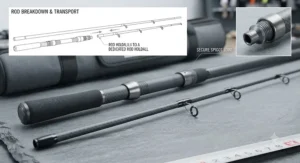
Akios pitches the Akios Fury FX420 plainly as a serious piece of kit that doesn’t cost the earth, and on paper that’s a fair claim. At 14ft with an optimum casting weight of 3.5–6oz (rated up to 8oz/220g), it’s built around a powerful, high-modulus carbon blank with a spliced-in tip specifically for improved bite detection — a feature that matters more than it sounds, because rough ground fishing often means holding bottom against heavy tide with a big lead, and a dull tip can mean missing subtle takes entirely.
The fitted Fuji reel seat and SeaGuide guides are the other notable spec here — both recognised names in tackle hardware, and both chosen specifically for saltwater longevity rather than cosmetic appeal. Based on the spec comparison, this rod occupies a genuinely interesting niche: elite-tier componentry (Fuji, SeaGuide, high-modulus carbon) bolted onto a price point that undercuts most of its true premium rivals significantly.
Reviewers consistently flag the striking colourway as a bonus rather than the main draw — the substance is in the build quality, and it shows in how the rod is discussed across UK tackle shop listings and forums alike.
Pros:
- ✅ Fuji reel seat and SeaGuide guides at a mid-range price
- ✅ Spliced tip improves bite detection on rough marks
- ✅ High-modulus carbon blank punches above its price point
Cons:
- ❌ Casting weight range slightly narrower than some rivals
- ❌ Distinctive livery won’t suit anglers who prefer understated tackle
Typically priced around £140–£180, this is arguably the sharpest value pick on this list for anyone who wants premium hardware without the premium invoice.
7. Shakespeare Salt XT Beachcaster — the smart first proper rough-ground rod
Every list needs an honest budget option, and the Shakespeare Salt XT Beachcaster earns its spot fairly. Shakespeare has long owned the value end of the beachcaster market, and the Salt XT series represents a genuine leap forward — reviewers and shops alike describe it as feeling closer to a rod twice its price, built on a high-grade carbon blank that’s noticeably slimmer and crisper than the composite-heavy budget rods of a few years back.
We often recommend this to anglers moving up from their first “combo” set, and the reasoning holds up under scrutiny: unlike cheap composite rods, which tend to feel heavy and floppy underhand, the Salt XT sits confidently in a rod rest and registers bites clearly — a genuinely useful trait when you’re learning to read a rough-ground rod tip against a heavy tide. At roughly 12–13ft with a 4–6oz casting rating, it’s built for mixed and moderately rough ground rather than the very roughest conger marks, which is a sensible, honest ceiling for a rod at this price.
The trade-off, unsurprisingly, is outright toughness against the absolute worst ground and biggest fish — this isn’t the rod for wrestling conger out of a boulder field. But as an honest, capable entry point into rough-ground fishing, it’s hard to fault.
Pros:
- ✅ Carbon blank feels far more premium than the price suggests
- ✅ Clear bite registration helps developing anglers learn faster
- ✅ Excellent stepping stone from beginner combo sets
Cons:
- ❌ Not rated for the very roughest marks or biggest species
- ❌ Casting weight ceiling lower than the rest of this list
At around £90–£120, the Shakespeare Salt XT Beachcaster is, in our view, the single easiest recommendation for anyone with £100 to spend and a genuine intention to fish rough or mixed ground regularly. Don’t buy a used rod online for this money — buy this new.
Full Spec, Price & Rating Comparison
| Rod | Casting Weight | Guides | Price Range | Best For |
|---|---|---|---|---|
| Century Fireblade Delta | 4–8oz | Premium SiC-type | £350–£420 | All-round rough ground mastery |
| Akios Nitron 440 SVR | 4–8oz | Reinforced saltwater | £300–£380 | Biggest species, worst ground |
| Tronix Exodus Beach | 4–8oz | Standard saltwater | £110–£150 | Balanced power-to-weight |
| PENN Tidal Rough Ground | 4–8oz | Anti-tangle K-type | £130–£180 | Distance plus toughness |
| Daiwa Seahunter Z | 4–7oz | Standard saltwater | £150–£190 | Dependable mid-range all-rounder |
| Akios Fury FX420 | 3.5–8oz | Fuji/SeaGuide | £140–£180 | Premium hardware, mid price |
| Shakespeare Salt XT | 4–6oz | Standard | £90–£120 | First proper rough-ground rod |
Look at that spread and a clear pattern emerges: the jump from budget to mid-range buys you guide quality and a more refined carbon layup, while the jump from mid-range to premium buys you marginal casting gains and, more importantly, long-term blank fatigue resistance. If your budget tops out around £150, the Akios Fury FX420 and Daiwa Seahunter Z Beachcaster punch well above their price bracket. If money genuinely isn’t the deciding factor and you fish the roughest marks regularly, the extra spend on the Century Fireblade Delta or Akios Nitron 440 SVR buys real peace of mind over a hooked double-figure conger.
Setting Up And Maintaining A Rough-Ground Beachcaster
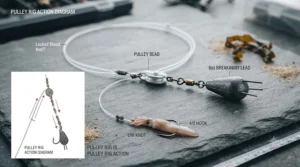
A brand-new rough-ground rod is only as tough as the care it gets, and the first thirty days are where most damage actually happens — not from fish, but from carelessness. Start by checking every guide for hairline cracks straight out of the box; rough handling in transit occasionally chips a guide ring, and a chipped ring will shred your line on the very first cast, regardless of how tough the blank underneath is. Wipe the blank down with fresh water after every single session, salt spray and sea, no exceptions — dried salt crystallises in the tiniest surface abrasions and accelerates wear you’ll only notice a season later.
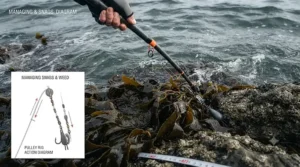
A common first-month mistake is leaning a loaded rod against rocks between casts. It feels harmless, but the point contact between blank and stone is exactly where stress fractures start, invisible to the eye until the rod fails mid-cast. Use a proper rod rest or spike, even on rock marks where it feels like extra faff. Similarly, resist the urge to “power through” a genuine snag by leaning the rod hard into a fixed structure — walk the angle instead, or point the rod tip directly at the snag and pull steadily with the reel, which puts strain on the line rather than the blank.
Every few sessions, run your fingers gently along the full length of the blank feeling for rough patches or nicks — abrasion damage on rough ground accumulates gradually, and catching it early (a light sand-and-varnish touch-up, or simply retiring a badly scored section from heavy-lead casting duty) beats a snapped tip mid-fight. Store the rod horizontally or in a proper tube rather than propped in a corner, where its own weight can introduce a subtle, permanent set over time.
Real-World Scenarios: Matching The Rod To The Mark
Picture three very different anglers, because the “best” rod genuinely depends on who’s holding it. First, the weekend novice fishing a mixed rocky mark twice a month, mostly for bass and the occasional dogfish, on a budget under £150 — for that angler, the Shakespeare Salt XT Beachcaster or Daiwa Seahunter Z Beachcaster covers the brief comfortably, with enough headroom to grow into more technical rough-ground fishing without immediately outgrowing the rod.
Second, the committed rough-ground regular who fishes proper reef and gully marks weekly, targeting bass, wrasse and the odd conger, casting moderate distances rather than chasing records — here the sweet spot sits with the Tronix Exodus Beach or Akios Fury FX420, both purpose-built for exactly that combination of power and control without the premium price tag of the top-tier rods.
Third, the dedicated big-species specialist, night-fishing deep gullies for conger, huss and tope over genuinely brutal boulder ground, where a hooked fish diving for structure within seconds of the take is the entire game — that’s precisely the scenario the Akios Nitron 440 SVR and Century Fireblade Delta were engineered for, where the extra length, power and blank fatigue resistance directly translate into landed fish rather than snapped leaders and lost gear.
Carbon vs Composite Beachcaster Rod: Which Blank Actually Wins?
This is the question that decides more purchases than any other spec, so it deserves a straight answer.Carbon fibre is, by definition, itself a composite material — thin strands of carbon atoms bound in a polymer resin matrix — but in angling terms, “carbon” and “composite” have come to mean two different things on the shop shelf. A pure high-modulus carbon blank prioritises stiffness and responsiveness: it loads fast, transmits bite detection clearly, and stays lighter for a given power rating. As carbon fibre’s material properties explain, it has the highest compressive strength of all common reinforcing materials, alongside a high strength-to-weight ratio and low density compared with steel — which is precisely why it dominates the premium end of the beachcaster market.
Composite or carbon-composite blends, by contrast, typically blend carbon with fibreglass or a softer resin layup to trade some of that stiffness for flexibility and — crucially for rough ground — impact resilience. What most buyers overlook here is that pure high-modulus carbon, for all its casting benefits, can actually be more brittle under a sudden, off-axis impact, like a rod tip smacking against a rock in a gust of wind. A carbon-composite blend absorbs that kind of shock more forgivingly, which is exactly why budget-friendly rough-ground rods like the Shakespeare Salt XT Beachcaster lean on composite-carbon blends rather than pure high-modulus fibre.
The honest verdict: for outright casting performance and long-term fatigue resistance under repeated heavy loading, high-modulus carbon (as used in the Century Fireblade Delta and Akios Nitron 440 SVR) wins clearly. For resilience against the odd careless knock against a rock — which, let’s be honest, happens to everyone eventually — a composite blend offers genuine peace of mind at a lower price. Neither is objectively “better”; they’re optimised for slightly different failure modes.
How To Choose A Beachcaster Rod For Rough Ground
- Match casting weight to your typical lead, not your heaviest one. An 8oz-rated rod fished mostly with 5oz leads is under-loaded and casts poorly — buy for what you actually use most.
- Prioritise a stiff, powerful butt section over a fast tip. Rough ground demands the ability to bully a fish or a snagged rig away from structure quickly; that strength lives in the lower two-thirds of the blank.
- Check the guide material specifically. Anti-tangle, saltwater-rated guides (like the K-type guides on the PENN Tidal Rough Ground) resist the line-fraying grit that rough marks throw up.
- Consider length against your actual marks. A 14ft 6in rod like the Akios Nitron 440 SVR gives leverage but becomes a liability on a cramped rock ledge — measure your usual platform, not just your ambition.
- Weigh carbon against composite honestly using the section above — don’t assume the more expensive material is automatically the right call for your fishing style.
- Read aggregated review sentiment, not star ratings alone. A 4.5-star average means little without knowing whether those reviewers fish rough ground specifically.
- Budget for the whole system, not just the blank. A brilliant rod paired with a mismatched reel or line rating will underperform regardless of price.
Beachcaster Rough-Ground Rods vs Standard Clean-Ground Rods
| Factor | Rough-Ground Beachcaster | Standard Clean-Ground Rod |
|---|---|---|
| Typical action | Slow-to-mid, powerful butt | Fast, softer overall |
| Casting weight | 4–8oz | 2–4oz |
| Guide spec | Reinforced, anti-tangle | Standard |
| Best For | Century Fireblade Delta, Akios Nitron 440 SVR | Light estuary rods |
The gap here isn’t subtle. A clean-ground rod fished over rock and kelp will simply fail faster — the softer action that feels lovely casting a light lead over clean sand becomes a liability the moment a fish bolts for structure, and the lighter guide spec wears through far quicker against abrasive terrain. If there’s genuinely any chance you’ll fish rough or mixed ground more than occasionally, buying rough-ground rated from the start — even a budget option like the Shakespeare Salt XT Beachcaster — beats replacing a snapped clean-ground rod after one bad session.
Abrasion Resistance: The Spec Nobody Talks About Enough
Casting weight and length dominate every spec sheet, but abrasion resistance is arguably the single biggest predictor of how long a rough-ground rod actually survives. It isn’t usually a published number — it’s a function of blank finish, guide-ring hardness, and how exposed the lower blank sections are to direct rock contact during a fight or a snag-recovery pull. Here’s what the spec sheet won’t tell you: two rods with identical casting-weight ratings can have wildly different real-world lifespans on rock marks, purely based on finish quality and guide-ring material.
Reviewers consistently note that rods fitted with hardened guide inserts — SeaGuide or Fuji components, as used on the Akios Fury FX420 — hold up dramatically better against the fine grit and sharp barnacle edges common on rough marks than budget guide rings, which can groove and eventually fray line within a season of heavy use. The blank’s outer coating matters too; a slicker, harder finish sheds abrasive contact more readily than a matte or heavily textured surface, which tends to “grip” grit against the rod during a scrape.
Practically speaking, this is where maintenance and product choice intersect directly. No amount of careful handling fully offsets a poorly finished blank on genuinely rough ground — but equally, even a premium rod like the Century Fireblade Delta will show accelerated wear if it’s dragged repeatedly across barnacle-covered rock rather than lifted clear. Treat abrasion resistance as a genuine buying criterion, not an afterthought behind casting distance.
Rod Toughness Explained: What The Numbers Actually Mean
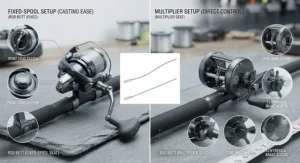
“Toughness” gets thrown around loosely in tackle marketing, so it’s worth breaking into its actual components. First, blank modulus — broadly, how stiff the carbon layup is — which governs how much a rod resists bending under load before it either “gives” progressively or reaches its structural limit. Second, wall thickness and taper — a rod can be rated for high casting weight through sheer material thickness (heavier, more forgiving of abuse) or through a more advanced, thinner high-modulus layup (lighter, but less tolerant of off-axis impact).
Based on the spec comparison across this list, the genuinely “tough” rough-ground rods — the Akios Nitron 440 SVR, Tronix Exodus Beach, and Century Fireblade Delta — share a common trait beyond their casting-weight rating: a deliberately reinforced butt section designed to take direct load-bearing punishment, paired with a tip section engineered to flex rather than snap under sudden shock. That combination, not the casting-weight number alone, is what actually determines whether a rod survives a big fish bolting into a snag.
What most buyers overlook when comparing toughness on paper: guide toughness matters as much as blank toughness. A rod with a bombproof blank but budget guide rings will still fail on rough ground — just at the guide rather than the blank. Look for reinforced, saltwater-rated guide hardware whenever “toughness” is genuinely the priority, not just the casting-weight figure on the box.
Common Mistakes When Buying A Rough-Ground Beachcaster
The single most common mistake is buying purely on casting-weight number without considering action and taper — an 8oz-rated rod with a soft, fast action can still be a poor match for genuinely rough ground, because raw power rating says nothing about how the blank handles lateral, off-axis stress from a snagged rig. A close second: choosing length based on maximum theoretical distance rather than the realistic dimensions of your usual fishing platform, leaving anglers wrestling an unwieldy 14ft 6in rod on a rock ledge with barely room to swing it.
Plenty of anglers also skip checking guide spec entirely, focusing purely on blank material and brand name — a mistake that shows up as frayed line and lost fish within a season on abrasive ground. And a surprising number of buyers ignore the honest ceiling of budget rods; the Shakespeare Salt XT Beachcaster is an excellent rod for its price, but pushing it repeatedly against the very roughest marks and biggest fish it wasn’t designed for is a false economy that ends in a snapped blank and an unhappy warranty conversation.
Rock Fishing Safety: Read This Before Your Next Session
Before any spec sheet matters, rock fishing itself carries genuine risk that deserves a straight, unglamorous mention. According to documented UK shore-angling incidents, between 2012 and 2016, 46 anglers died fishing off the UK coast, 25 of them while fishing from the shore, and roughly 70% of shore anglers who drowned were swept into the sea by waves. That’s not a reason to avoid rough-ground fishing — it’s a reason to treat basic precautions as non-negotiable rather than optional.
A wearable flotation aid meaningfully increases survival chances if you do end up in the water, and having two other people present, checking local weather before heading out, and wearing non-slip footwear all measurably reduce risk. Interestingly, rod choice itself plays a genuine safety role too: longer rods, roughly ten feet or more, improve your view of incoming waves and swell, and physically position you further back from the danger zone at the platform’s edge — which is one more practical argument for the 12–14ft-plus lengths common across every rod on this list.
On the regulatory side, it’s worth knowing that in England and Wales, a standard Environment Agency rod fishing licence covers salmon, trout, freshwater fish, smelt and eel — it does not apply to pure sea angling for species like bass, cod or conger from the shore, though always check local byelaws for your specific mark before you go, since restrictions do vary regionally.
Long-Term Cost & Maintenance: What You’ll Actually Spend
The purchase price is only the opening bid. Over a typical three-to-five-year lifespan, a rough-ground beachcaster also costs you in guide replacements (£8–£15 per guide fitted, more if several go at once after a hard season), the occasional re-varnish or blank repair (£20–£40 through a specialist rod builder), and — inevitably, on genuinely rough ground — the eventual replacement of a badly worn tip section. Budget rods tend to need this kind of intervention sooner; premium rods like the Century Fireblade Delta or Akios Nitron 440 SVR typically go multiple seasons longer before needing anything beyond routine care, which is the honest justification for their higher upfront cost.
| Price Tier | Typical Rod | 3-Year Maintenance Estimate | Typical Lifespan |
|---|---|---|---|
| Budget (£90–£150) | Shakespeare Salt XT, Tronix Exodus Beach | £30–£60 | 2–4 seasons hard use |
| Mid (£140–£190) | Daiwa Seahunter Z, Akios Fury FX420, PENN Tidal | £20–£45 | 4–6 seasons |
| Premium (£300+) | Century Fireblade Delta, Akios Nitron 440 SVR | £15–£35 | 6+ seasons |
Read that table as a cost-per-season exercise rather than a straight sticker-price comparison. A £100 budget rod replaced every three seasons can, over a decade, cost roughly the same as a single premium rod that lasts the whole ten years — the premium option just asks for the money upfront instead of spreading it out. Neither approach is wrong; it genuinely depends on whether you’d rather pay once or pay as you go.
Top Rated Beach Casting Rods Review: What The Ratings Actually Mean
Independent review round-ups love a neat rating out of ten, and the Century Fireblade Delta consistently tops independent beachcasting rod comparisons at around 8.5–8.6, with the Akios Nitron 440 SVR, Daiwa Seahunter Z Beachcaster and similar mid-to-premium rods clustering closely behind.But here’s the analytical bit that matters more than the headline number: those ratings are typically composite scores blending casting performance, build quality, value for money and versatility across ground types — which means a rod can score highly overall while being a mediocre match for your specific rough-ground needs.
The Shakespeare Salt XT Beachcaster, for instance, sits lower on most aggregate scales purely because it’s judged against far pricier rods on the same scale — its actual rating relative to other true budget rough-ground options is excellent. When you’re reading “top rated” lists, always check what ground type and price bracket the reviewer actually tested against, rather than assuming a single universal ranking applies to your situation. A rod rated 8.0 for all-round versatility might genuinely outscore a 9.0-rated distance-casting specialist the moment you’re fishing snaggy rock rather than open beach.
Frequently Asked Questions
❓ What casting weight do I need for rough ground beachcasting?
❓ Is carbon or composite better for a rough ground beachcaster?
❓ How long should a beachcaster rod for rough ground be?
❓ Can I use a rough ground beachcaster for clean beach fishing too?
❓ How often should I check my beachcaster rod for damage?
Conclusion
Rough ground doesn’t forgive soft gear, and after working through seven genuinely capable beachcasters, a clear pattern holds true across every price bracket: the rods that earn their reputation combine a powerful, progressive-loading blank with reinforced, saltwater-rated guides — casting weight alone never tells the whole story. If budget allows, the Century Fireblade Delta and Akios Nitron 440 SVR represent the top tier for genuinely brutal marks and the biggest species. For most regular rough-ground anglers, the Tronix Exodus Beach, PENN Tidal Rough Ground, Daiwa Seahunter Z Beachcaster and Akios Fury FX420 all deliver serious capability without the premium price tag. And for anyone taking their first proper step into rough-ground fishing, the Shakespeare Salt XT Beachcaster remains a genuinely smart, honest starting point.
Whichever you choose, pair it with the maintenance habits and safety awareness covered above — a great rod poorly cared for, or fished carelessly on a dangerous mark, will let you down regardless of its spec sheet. Fish smart, check the tide, and let the rod do the job it was actually built for.
Recommended for You
- 12ft Beachcaster For Beginners: 7 Best Picks To Start (2026)
- Best Beachcaster Rods: 7 Top Picks for UK Anglers (2026)
- 12ft Beachcaster vs 13ft Beachcaster: 7 Rods Rated (2026)
Disclaimer: This article contains affiliate links. As an Amazon Associate, I earn from qualifying purchases. If you purchase products through these links, we may earn a small commission at no additional cost to you.
✨ Found this helpful? Share it with your friends! 💬🤗
