
In This Article
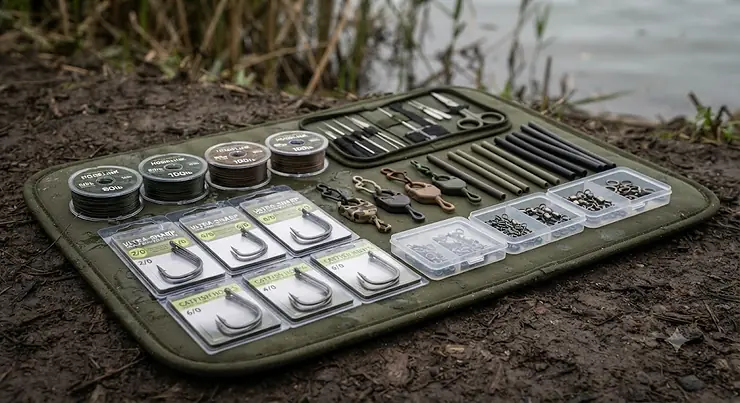
Somewhere between the tackle shop counter and the edge of a catfish lake, most anglers hit the same wall: nobody actually explains what half this terminal tackle is for. You’ve got your rod sorted, your reel is loaded, and then someone mentions “run rigs” and “boom sections” like you’re supposed to just know. A catfish terminal tackle kit is the collection of hooks, swivels, sinker slides, beads and hooklink material that connects your mainline to the bait — the bit that actually does the fighting when a fifty-pound wels decides your swim isn’t for you anymore.
This guide cuts through the confusion. We’ve pulled together seven real, currently available products — from £10 starter boxes to dedicated catfish-specific components — and broken down exactly what each one does, who it suits, and where it’ll let you down. Wels catfish (Silurus glanis) are now firmly established in English stillwaters, and the tackle market has quietly caught up: what used to mean improvising with pike gear now means purpose-built swivels rated to 150lb and hooklink that shrugs off a catfish’s sandpaper mouth. Whether you’re kitting out a first session or replacing worn components before a serious campaign, the right catfish terminal tackle kit saves you both money and fish.
We’ll cover budget bits-boxes, mid-range specialist components, and premium storage systems, with honest analysis drawn from real specifications and aggregated reviewer feedback — not marketing copy lifted from a listing page.
Quick Comparison Table
| Product | Type | Best For | Price Range |
|---|---|---|---|
| Eagle Claw Catfish Tackle Kit | All-in-one kit | Total beginners wanting everything in one box | Under £25 |
| Catfish Pro Black Barrel Swivels | Dedicated swivels | Anglers targeting double-figure UK cats | Under £10 |
| Owner Mutu Circle Hooks | Circle hooks | Best hook-up ratio, catch-and-release | £8-£12 range |
| Leeda Complete Tackle Box + Rig Box | Storage system | Organising a growing terminal tackle collection | £25-£35 range |
Looking at this snapshot, the pattern is straightforward: cheaper options bundle generic components into one box, while pricier picks isolate a single job — swivels, hooks, or storage — and do it properly. If you’re assembling your very first catfish terminal tackle kit, starting with an all-in-one box and upgrading individual weak points (usually the swivels first) tends to be more cost-effective than buying premium everything on day one. We’ll unpack why in the sections below.
💬 Just one click — help others make better buying decisions too!😊
Top 7 Catfish Terminal Tackle Kit Products: Expert Analysis
Here’s where we get into specifics. Each of these seven products is real, currently sold, and suited to a different stage of the catfishing journey — from your first tentative session to a rig built to survive a fish that outweighs your dog.
1. Eagle Claw Catfish Tackle Kit — best all-in-one starter kit for beginners
If you want to walk out of the shop (or click “buy”) with everything needed to build a working catfish rig, this is the obvious starting point. The kit bundles roughly 80 pieces — around 40 assorted freshwater hooks, 17 swivels, six snelled hooks, sinkers, floats, a pre-tied catfish rig, a line clipper and a hook remover — all inside a reusable tackle box. In practice that means you’re not standing at the bank realising you forgot swivels or a spare hook.
The real-world value here is breadth rather than depth: nothing in the box is specialist-grade, but every category of terminal tackle you need is represented, so a genuine first-timer can rig up without a shopping list. Based on the spec sheet, the steel and tin sinkers and generic swivels are adequate for smaller stillwater cats and general coarse work, but they’re not rated for the kind of abuse a 60lb-plus wels puts on tackle. Aggregated reviewer sentiment is consistent on this point — buyers repeatedly describe it as “good for what you need to catch catfish” and ideal “for starting out,” while also noting the components aren’t of the highest quality. That’s an honest trade-off for the price, not a flaw hidden in fine print.
Pros:
- ✅ Genuinely everything a beginner needs in one box
- ✅ Includes a pre-tied catfish rig to learn from
- ✅ Reusable tackle box doubles as long-term storage
Cons:
- ❌ Swivels and hooks aren’t rated for large specimen cats
- ❌ Some components feel basic under close inspection
At under £25, this sits firmly in beginner-budget territory, and as a genuine introduction to what a catfish terminal tackle kit contains, it earns its place — just don’t expect it to survive a serious lake record attempt.
2. NGT Loaded Carp Terminal Tackle Box — best budget bits box for building rigs
This one isn’t marketed specifically as catfish gear, but don’t let that put you off — it’s one of the most useful budget boxes for anyone learning to build rigs from scratch, catfish included. Inside you get roughly 175 individual pieces: carp hooks in sizes 6, 8 and 10, boilie screws, shock beads, anti-tangle sleeves, tail rubbers, lead clips, quick links, PVA clips and four different styles of swivel (dual ring, big eye, quick change and standard), all housed in a compact bit box.
What most buyers overlook about a box like this is that it’s less a “catfish kit” and more a rig components starter library — exactly what you need when you’re first learning what a lead clip actually does versus a quick-change swivel. For smaller UK cats, juvenile fish, or float-fished livebait rigs on day-ticket waters, the components here are perfectly serviceable. For genuine big-fish work, you’ll want to graduate the swivels and hooklink to something heavier, but as a way to understand rig anatomy without spending much, it’s hard to beat. Reviewers on similar NGT bit boxes consistently mention good value for the sheer piece count, with the usual caveat that quality control on budget swivels can be hit and miss.
Pros:
- ✅ Huge piece count teaches rig-building fundamentals cheaply
- ✅ Four swivel types included for direct comparison
- ✅ Compact bit box keeps everything organised
Cons:
- ❌ Not rated for large double-figure catfish
- ❌ Carp-hook sizing needs upsizing for serious cats
Priced under £10, this is arguably the best-value entry point on this list for anyone who wants to understand terminal tackle rather than just own it.
3. FLADEN 35pc Coast & Sea Heavy Terminal Tackle Set — best heavy-duty budget components
Originally designed for coastal and sea fishing, this 35-piece set has quietly become a favourite improvisation among UK catfish anglers who need genuinely strong hardware without paying specialist prices. The box includes treble hooks and single hooks from size 5/0 down to 2/0, Norwegian coastlocks, 11mm split rings and size 2 swivels, all in a compact storage tray.
Here’s what the spec sheet doesn’t spell out: saltwater terminal tackle is built to resist corrosion and handle serious pulling power, which happens to overlap neatly with what a catfish rig demands. The coastlocks and heavier split rings are genuinely useful for building leader systems and attaching sinkers, and the size 2 swivels sit at a strength comparable to entry-level dedicated catfish swivels. On paper, this means you’re getting saltwater-grade toughness at coarse-fishing prices — a smart substitution rather than a compromise. The trade-off is that the treble hooks included aren’t ideal for catfish (single circle or J-pattern hooks are safer for catch-and-release), so expect to supplement rather than use the box wholesale.
Pros:
- ✅ Genuinely corrosion-resistant, sea-grade hardware
- ✅ Coastlocks and split rings ideal for leader building
- ✅ Compact box keeps components tidy on the bank
Cons:
- ❌ Treble hooks aren’t suited to catfish welfare
- ❌ Swivel sizing needs checking against your target species
In the £8-£12 range, this is a clever budget substitution rather than a purpose-built catfish product — treat it as a parts bin for leaders and hardware rather than a complete rig solution.
4. Catfish Pro Black Barrel Swivels — best dedicated swivels for serious cats
This is where the list shifts from generalist to specialist. Catfish Pro is a UK brand built specifically around wels catfishing, and its black barrel swivels are rated at 80lb, 100lb and 150lb — figures that map directly onto the fight a genuine double-figure (or triple-figure) British catfish will put up. The black finish also matters more than it sounds: less flash in clear stillwater means fewer spooked fish on finicky pressured lakes.
What most buyers overlook about swivel strength is that the rating only tells half the story — a swivel that doesn’t rotate freely under load will still cause line twist regardless of its breaking strain, which is exactly the failure mode that loses big fish on long, powerful runs. Based on the spec comparison with the generic swivels bundled in beginner kits, the jump to a purpose-rated barrel swivel is one of the cheapest, highest-impact upgrades an angler can make. Reviewers on UK tackle retailers consistently describe these as reliable and appropriately rated for both UK cats and abroad sessions, with the main praise centred on consistent smooth rotation rather than flashy extras.
Pros:
- ✅ Rated specifically for catfish-strength fights (up to 150lb)
- ✅ Low-visibility black finish for pressured waters
- ✅ Purpose-built by a specialist UK catfish brand
Cons:
- ❌ Sold as swivels only — no hooks or hooklink included
- ❌ Overkill strength-wise for smaller stillwater cats
Priced under £10 for a pack, this is the upgrade most beginner kits are quietly missing, and it’s the single component worth prioritising once you’ve landed a couple of fish on generic gear.
5. Catfish Pro Catlink XT Hooklink — best abrasion-resistant hooklink material
Ask any experienced UK cat angler what actually loses fish and hooklink abrasion comes up constantly — a catfish’s mouth isn’t soft like a carp’s; it’s closer to coarse sandpaper, and standard mono or fluorocarbon leaders can fray through in a single determined run. Catlink XT is a soft, supple, green-coloured hooklink material built specifically to resist that wear while staying manageable enough to tie proper knots with.
The practical interpretation here matters more than any spec sheet figure: supple hooklink presents bait more naturally and tangles less on the cast, while the abrasion resistance means you’re not re-tying rigs mid-session out of paranoia. Reviewers and UK catfish forums consistently flag this material as a “top seller” among specialist hooklinks, with the recurring theme being confidence — anglers report trusting it through extended fights rather than second-guessing every run. It’s not the cheapest hooklink on the market, but compared with the cost of losing a personal-best fish to a frayed leader, the maths favours spending the extra few pounds.
Pros:
- ✅ Purpose-built abrasion resistance for catfish teeth and jaws
- ✅ Soft and supple for natural bait presentation
- ✅ Widely trusted among dedicated UK catfish anglers
Cons:
- ❌ Costs more per metre than generic mono leader
- ❌ Green colour less discreet on very clear, pale-bottomed lakes
At roughly £10-£15 per spool, this is a mid-range investment that punches above its price point — arguably the single most important upgrade in this entire kit list for anyone serious about landing, not just hooking, a big catfish.
6. Owner Mutu Circle Hooks — best hook pattern for hook-up ratio
Circle hooks have a reputation problem among traditionalists — the “don’t strike” rule feels counterintuitive until you’ve actually used one properly. Owner is a long-established Japanese hook manufacturer, and the Mutu circle pattern has become a genuine favourite among UK wels specialists specifically because it turns and sets in the corner of the mouth almost automatically once a fish moves off with the bait.
Here’s what the spec sheet won’t tell you, but experienced anglers note repeatedly: circle hooks dramatically reduce deep-hooking and gut-hooking compared with traditional J-hooks, which matters enormously for catch-and-release catfishing where fish welfare is non-negotiable on most day-ticket waters. The trade-off is a genuine change in technique — you have to resist striking and instead let the rod tip load up and the fish hook itself, which takes a session or two to trust. Sharpness and corrosion resistance are consistently praised in angler write-ups covering UK wels sessions, where anglers specifically reference Owner and ESP patterns as reliable choices for abrasive-mouthed species.
Pros:
- ✅ Excellent hook-up ratio once technique is understood
- ✅ Significantly reduces deep-hooking for catch-and-release
- ✅ Sharp, corrosion-resistant Japanese steel construction
Cons:
- ❌ Requires unlearning the instinct to strike on the bite
- ❌ Premium pricing versus generic circle hook alternatives
In the £8-£12 range for a pack, these are a genuinely premium upgrade — the kind of component experienced anglers switch to once they’ve lost a fish or two to poor hook placement.
7. Leeda Complete Tackle Box + Rig Box — best premium storage system
Once your terminal tackle collection grows beyond “everything in one bag,” storage stops being a luxury and starts being the thing standing between an organised session and a tangled mess on the bank. The Leeda Complete Tackle Box + Rig Box system pairs a tough ABS plastic main box with a dedicated rig box for pre-tied traces and a smaller accessory box for loose swivels, beads and hooks — all with snap-lock clips and removable dividers.
What most buyers overlook about tackle storage is the UV factor: the tinted lids on this system genuinely protect line and hooklink material from sunlight degradation, which matters if you’re leaving pre-tied rigs made up for weeks between sessions. Based on the build spec — reinforced ABS plastic and secure snap clips — this is designed to survive being dropped, sat on, and rattled around in a car boot, which cheaper single-compartment boxes rarely manage long-term. It’s not cheap, but for anglers who’ve already invested in the Catfish Pro swivels and Catlink hooklink above, protecting that investment properly starts to make financial sense.
Pros:
- ✅ Separate rig box keeps pre-tied traces tangle-free
- ✅ UV-tinted lid protects hooklink and line from sun damage
- ✅ Genuinely durable ABS construction with secure clips
Cons:
- ❌ Premium price for what is “just” storage
- ❌ Overkill if you’re only carrying a handful of components
At around £25-£35, this is the last thing most beginners buy and the first thing serious catfish anglers wish they’d bought sooner — a genuinely premium pick that protects everything else on this list.
Beginner Catfishing Setup: Practical Usage Guide
Getting your first proper beginner catfishing setup right isn’t about buying everything at once — it’s about sequencing your purchases sensibly. Start with an all-in-one option like the Eagle Claw Catfish Tackle Kit so you understand what a working rig looks like end to end, then upgrade the two components that matter most: swivels and hooklink.
For your first thirty days, a few habits save real money and fish. Check knots before every session, not just when you first tie them — nylon and braid both weaken with repeated casting and UV exposure. Store hooklink material away from direct sunlight (this is where a decent tackle box earns its keep). Sharpen or replace hooks after landing two or three fish; catfish jaws are bony and blunt points faster than most anglers expect. The most common first-month mistake isn’t equipment failure at all — it’s under-gearing, using carp-strength swivels and line on a species that regularly doubles a carp’s fighting weight. Budget for at least one swivel and hooklink upgrade within your first few sessions, even if the rest of your catfish terminal tackle kit stays basic for now.
Real-World Scenario: Matching Tackle to Angler Type
Picture three anglers arriving at the same Essex catfish lake on a Saturday morning. The first is a teenager on his third-ever session, budget under £30, borrowing his dad’s rod — for him, the Eagle Claw Catfish Tackle Kit or NGT Loaded Carp Terminal Tackle Box makes complete sense; he needs breadth of components to learn rig anatomy, not maximum breaking strain.
The second is a weekend regular who’s landed a handful of twenty-pounders and wants to start targeting the lake’s known fifty-plus residents. She should be pairing Catfish Pro Black Barrel Swivels with Catlink XT Hooklink and Owner Mutu Circle Hooks — the mid-range trio that bridges generic tackle and full specialist setups without the premium storage overhead.
The third is a dedicated specimen hunter running multiple rods across a session that might last 48 hours, with several rigs pre-tied and ready to swap. For him, the Leeda Complete Tackle Box + Rig Box isn’t a luxury — pre-tied traces need protecting from sun and tangling exactly the way his system provides, and the time saved re-rigging mid-session pays for the box within a couple of trips.
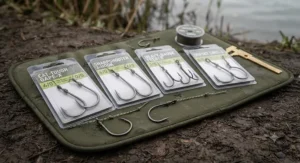
Problem → Solution: Common Catfish Rig Failures Fixed
Even experienced anglers run into the same handful of terminal tackle problems repeatedly. Here’s what usually causes them and how to fix each one.
Problem: Hooklink frays or snaps mid-fight. This is almost always generic mono meeting a catfish’s abrasive mouth. Solution: switch to a dedicated abrasion-resistant material like Catlink XT Hooklink, and check it for nicks after every fish, not just every session.
Problem: Line twist builds up over a session. Usually a weak or worn swivel failing to rotate under load. Solution: upgrade to purpose-rated components such as Catfish Pro Black Barrel Swivels, and retire any swivel that feels stiff when tested by hand.
Problem: Fish are deep-hooked on catch-and-release waters. This points to hook pattern rather than bad luck. Solution: switch to circle hooks like the Owner Mutu Circle Hooks and, crucially, resist striking — let the rod load naturally.
Problem: Pre-tied rigs arrive at the lake tangled or sun-damaged. Storage is the culprit here. Solution: a dedicated rig box, such as the one included with the Leeda Complete Tackle Box + Rig Box, keeps traces separated and shielded from UV.
Rig Components Explained
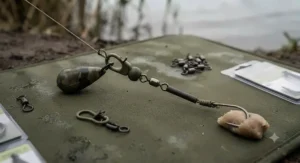
Every catfish terminal tackle kit boils down to the same handful of jobs, even when the branding makes it sound complicated. The hook is the only part that actually contacts the fish — size and pattern (circle versus J-hook) determine both hook-up ratio and fish welfare. The swivel prevents line twist and, on running rigs, allows the mainline to slide freely so a taking fish doesn’t feel resistance until it’s already committed. Hooklink is the short, often heavier-rated section between hook and mainline, chosen specifically to resist abrasion from teeth, gill covers or lakebed debris.
Beyond those three essentials, most kits also include beads (which cushion knots and protect swivels from repeated impact), sinker slides or lead clips (which let you adjust or drop weight quickly, sometimes for angler safety on snag-prone waters), and stops or sleeves that fix components at a set position along the rig. Understanding this basic anatomy is worth more than any single product purchase — once you know what each part does, you can mix budget and specialist components intelligently rather than buying whole kits blind. This is precisely the gap that separates an NGT Loaded Carp Terminal Tackle Box used thoughtfully from the same box used as a black box nobody understands.
How to Choose the Best Catfish Terminal Tackle for Beginners
Working out the best catfish terminal tackle for beginners comes down to seven practical checks:
- Match strength to your target fish — don’t buy carp-rated swivels if the lake record is over 80lb.
- Prioritise hooklink quality early — it’s the cheapest upgrade with the biggest impact on landed fish.
- Choose circle hooks if catch-and-release matters — most UK catfish waters require it.
- Buy an all-in-one kit first, then upgrade weak points — don’t try to assemble a specialist setup from scratch on day one.
- Check swivel ratings, not just swivel count — a box of 50 weak swivels is worse than 10 strong ones.
- Factor in storage from the start — sun-damaged hooklink is a genuinely common beginner mistake.
- Ask your venue about tackle rules — many day-ticket cat lakes specify minimum line strength and barbless or micro-barbed hooks.
Budget Tackle Essentials: What You Actually Need First
If funds are tight, resist the urge to buy a huge assorted box and instead prioritise a short list of budget tackle essentials: a handful of correctly-rated swivels, a spool of abrasion-resistant hooklink, appropriately sized circle or strong J-hooks, and basic beads or sleeves to protect your knots. Everything else — elaborate rig components, specialist boom sections, multiple hook patterns — can wait.
A realistic starter budget sits somewhere in the low-to-mid tens of pounds: a box like the NGT Loaded Carp Terminal Tackle Box covers volume cheaply, while a single pack of Catfish Pro Black Barrel Swivels adds genuine strength where it matters most. What most beginners overlook is that spending slightly more on the two or three components that actually take the strain — swivels and hooklink — delivers far better value than spreading a tight budget evenly across an entire generic kit.
Catfish Terminal Tackle Set vs Buying Components Separately
A pre-assembled catfish terminal tackle set, like the Eagle Claw Catfish Tackle Kit, wins on convenience and cost-per-piece — you’re getting dozens of components for one modest price, which is unbeatable value for learning rig anatomy. The trade-off is quality ceiling: bundled kits use generic mid-tier components across the board because that keeps the overall price down.
Buying separately — pairing Catfish Pro Black Barrel Swivels with Catlink XT Hooklink and Owner Mutu Circle Hooks, for instance — costs more upfront per component but lets you specify exactly the strength and pattern each part needs, with no weak links diluting the setup. On paper, this means a beginner chasing volume and variety should lean towards a set, while anyone targeting known double-figure-plus fish should build their rig from individually chosen, purpose-rated parts. Most experienced UK cat anglers end up doing both — a bundled kit for spares and experimentation, specialist components for the rig that’s actually in the water.
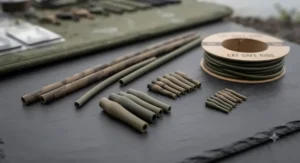
Common Mistakes When Buying Catfish Terminal Tackle
The most frequent beginner mistake is buying by piece count rather than strength rating — a 100-piece box sounds generous until you realise none of the swivels are rated above 20lb. A close second is neglecting hooklink entirely, treating it as an afterthought when it’s arguably the single component most likely to fail under a big fish’s fighting power.
Anglers also commonly overlook hook welfare requirements — many UK catfish venues mandate barbless or micro-barbed patterns, and turning up with standard barbed trebles (like those bundled in some sea-fishing sets) can mean an awkward conversation with the bailiff. Finally, storage gets treated as an afterthought rather than an investment; leaving pre-tied rigs loose in a bag, exposed to sunlight and tangling against other tackle, quietly degrades exactly the components anglers spent the most money on.
What to Expect: Real-World Performance
Specs on a packet rarely translate directly to bank-side experience, so here’s what actually happens once these components meet a genuine UK catfish. A properly rated swivel like the Catfish Pro Black Barrel Swivels won’t feel dramatically different from a cheap one during a calm retrieve — the difference shows up specifically during a sustained, powerful run, where a weak swivel seizes and starts transferring twist straight up the mainline.
Circle hooks such as the Owner Mutu Circle Hooks feel odd for the first session or two — the instinct to strike is hard to override — but by the third or fourth take, most anglers report it becoming automatic, and hook-up consistency noticeably improves. Abrasion-resistant hooklink like Catlink XT doesn’t announce itself either; it’s a non-event, which is exactly the point. The real-world test isn’t what you notice during the fight — it’s what doesn’t go wrong.
Long-Term Cost & Maintenance
Terminal tackle is consumable by nature, so total cost of ownership matters more than the sticker price of any single kit. Hooks should be inspected for dulled points after every fish and replaced roughly every few sessions if used regularly — a sharp hook set costs a few pounds and prevents missed takes that no amount of expensive hooklink can compensate for. Swivels rarely need replacing unless damaged, but hooklink material should be treated as a rolling cost, budgeted in every few sessions rather than bought once and forgotten.
Over a full season, a beginner starting with an all-in-one kit and gradually upgrading swivels, hooklink and hook patterns typically spends less overall than someone who buys premium everything upfront and later discovers their storage or line strength was mismatched. Proper storage — the kind offered by the Leeda Complete Tackle Box + Rig Box — genuinely extends component lifespan by protecting hooklink from UV degradation, which is one of the more overlooked long-term savings in this whole category.
Safety, Regulations & Compliance Guide
Before any of this tackle touches water, UK anglers aged 13 and over need a valid Environment Agency rod fishing licence to fish for freshwater fish, including catfish, across England and Wales. Individual venues then layer their own rules on top — many catfish lakes specify barbless or micro-barbed hooks, minimum landing net and unhooking mat sizes given how large and heavy wels catfish can grow, and specific line-strength minimums to avoid fish being played to exhaustion on undergunned tackle.
Fish welfare should shape your terminal tackle choices directly: circle hooks reduce deep-hooking, abrasion-resistant hooklink shortens fight times by reducing break-offs (which otherwise leave a fish trailing tackle), and correctly rated swivels prevent the kind of prolonged, twisting fights that stress a fish unnecessarily. According to the Canal & River Trust, catfish are the largest freshwater fish species found in UK waters, which is exactly why oversized, specimen-rated components aren’t overkill — they’re a welfare requirement once fish start reaching double or triple figures.
✨ Don’t Miss These Exclusive Deals!
🔍 Take your catfish terminal tackle kit to the next level with these carefully selected products. Click on any highlighted item to check current pricing and availability. These tools will help you build a rig your next big catfish won’t forget!
Frequently Asked Questions
❓ What should be in a basic catfish terminal tackle kit?
❓ How strong should catfish swivels be?
❓ Are circle hooks better than J-hooks for catfish?
❓ Can I use carp terminal tackle for catfish?
❓ Do I need a licence to fish for catfish in the UK?
Conclusion
A genuinely good catfish terminal tackle kit isn’t about owning the most expensive gear on the market — it’s about matching component strength honestly to the fish you’re actually likely to hook. For a first session, an all-in-one option like the Eagle Claw Catfish Tackle Kit or NGT Loaded Carp Terminal Tackle Box teaches rig anatomy at minimal cost. As sessions rack up and target fish grow, the smartest upgrades are targeted rather than total: swap in Catfish Pro Black Barrel Swivels, add Catlink XT Hooklink, and consider Owner Mutu Circle Hooks for welfare and hook-up ratio, before finally protecting the whole collection in something like the Leeda Complete Tackle Box + Rig Box.
According to Wikipedia’s entry on the wels catfish, the species can live for at least thirty years and grow substantially larger in warmer European waters than the UK typically produces — which is exactly why British-rated tackle, built around realistic domestic fish sizes, tends to be the smarter buy over imported gear designed for continental giants. Get the fundamentals right — hook, swivel, hooklink — and everything else on this list becomes optional refinement rather than necessity.
Recommended for You
- Best Catfish Rod: 7 Brilliant Picks for UK Cat Anglers in 2026
- Catfish Rod Under £80: 7 Best Budget Picks for 2026
- Top Catfish Rods Under £150: 7 Proven Picks for 2026
Disclaimer: This article contains affiliate links. As an Amazon Associate, I earn from qualifying purchases. If you purchase products through these links, we may earn a small commission at no additional cost to you.
✨ Found this helpful? Share it with your friends! 💬🤗
