
In This Article
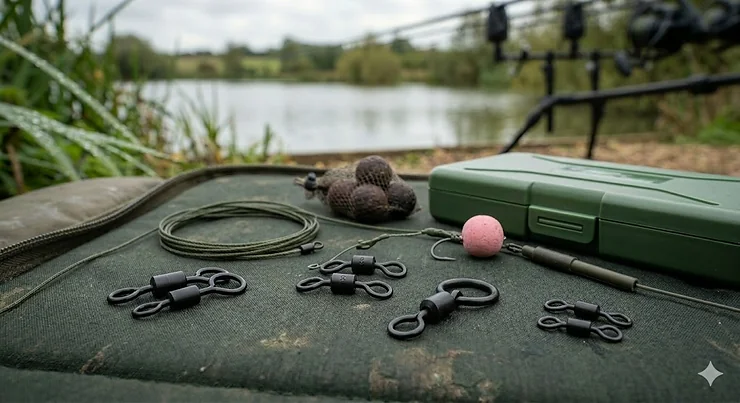
What separates a productive session from a blank? Often, it’s not the bait or the swim—it’s the tiny components most anglers barely glance at. Rig swivels might look insignificant sitting in your tackle box, but they’re the mechanical heart of every presentation you make. The wrong swivel can mean tangled rigs on the cast, poor bait presentation on the lakebed, or worse—lost fish when that double-figure mirror finally picks up your hookbait.
I’ve watched anglers spend hundreds of pounds on the latest rods and reels, then compromise their entire setup with bargain-bin swivels that twist under load or fail when a proper carp runs. In Britain’s increasingly pressured waters—from Linear Fisheries in Oxfordshire to the Wasing complex in Berkshire—the carp have seen it all. The difference between a take and a refusal often comes down to how naturally your rig behaves, and that starts with the right swivel doing its job properly.
Modern carp fishing has evolved beyond simple running rigs. We’re talking chod rigs, helicopter setups, Ronnie rigs with spinner swivels, and D-rigs requiring micro hook swivels. Each presentation demands specific swivel characteristics—rotation speed, strength rating, size compatibility with lead clips, and anti-glare coatings to avoid spooking wary fish in clear water. The history of recreational carp fishing in Britain shows how terminal tackle sophistication has increased alongside our understanding of fish behaviour and rig mechanics. After testing dozens of swivels across venues from southern gravel pits to northern reservoir fisheries, I’ve identified the components that consistently outperform their rivals. This guide cuts through the marketing waffle to show you exactly what works on British waters in 2026.
Quick Comparison: Top Rig Swivels at a Glance
| Product | Type | Size | Best For | Approx. Price |
|---|---|---|---|---|
| Korda Flexi Ring Swivels | Flexi ring | Size 8 | Lead clips, running rigs | £7-£9 |
| Fox Edges Micro Rig Swivels | Micro | Size 22 | Chod, hinged stiff links | £4-£6 |
| Bank Tackle Quick Change | QC with clip | Size 8/11/16 | Fast hooklink swaps | £3-£5 |
| Guru Rig System Swivels | Rolling | Size 11 | General purpose, helicopter | £4-£7 |
| Nash Hook Swivels | Micro hook | Micro | D-rigs, blowback | £5-£8 |
| Bank Tackle QC Flexi Ring | QC flexi | Size 8 | Running + quick change | £4-£6 |
| Korda Micro Rig Swivels | Micro | Size 20 | Popup movement, 360° rotation | £4-£7 |
💬 Just one click — help others make better buying decisions too! 😊
Top 7 Rig Swivels: Expert Analysis
1. Korda Flexi Ring Swivels — The Industry Standard
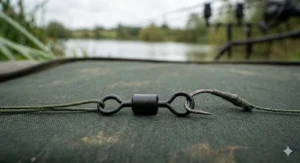
These PTFE-coated size 8 swivels have dominated British carp fishing for good reason. The flexi ring design allows your hooklink material to pivot naturally, improving presentation whether you’re fishing balanced baits or bottom baits. Korda’s coating minimises friction better than standard black oxide finishes, meaning smoother rotation under load and longer service life in our damp climate.
The real genius here is in the details most anglers overlook. That larger ring isn’t just for show—it clicks securely into size 8 lead clips (fitting Nash, Fox, Korda, ESP, and virtually every other brand), ensuring the lead is safely discharged before the swivel pulls free. This matters enormously for fish safety, particularly when you’re fishing leadcore leaders or stiff boom sections. UK customer reviews consistently praise the durability; several anglers report using the same swivels across multiple seasons, even after landing numerous twenties and thirties.
Pros:
✅ Premium PTFE coating reduces friction significantly
✅ Perfect fit with all major UK lead clip systems
✅ Proven track record on British waters
Cons:
❌ Price point sits at the higher end of the market
❌ Pack sizes (8 pieces) mean frequent reordering for prolific anglers
Price & Value: Around £7-£9 for 8 swivels on Amazon.co.uk. Yes, cheaper alternatives exist, but the longevity and consistent performance justify the investment for serious carpers.
2. Fox Edges Micro Rig Swivels — Essential for Modern Presentations
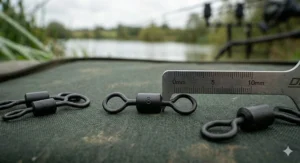
When Fox Edges released these micro swivels, they solved a problem that plagued chod and hinged stiff rig anglers for years. Previous micro swivels either lacked strength or seized up after a few sessions in British waters (our lakes aren’t exactly gentle on terminal tackle). These combine genuine micro dimensions with surprising robustness—rated well above what you’d expect from something this small.
I’ve used these extensively for chod rigs over gravel bars and hinged stiff links in weed. The rotation remains smooth even after multiple big fish, which speaks to the bearing quality inside that tiny barrel. For D-rig applications, they provide just enough weight to keep the hookbait sitting correctly without overwhelming smaller popup baits. UK reviewers note they’re particularly effective when fishing pressured waters where standard rig components spook educated carp—the minimal profile makes a tangible difference.
Pros:
✅ Truly micro profile for finesse presentations
✅ Maintains rotation after heavy use
✅ Ideal for chod, hinged, and D-rig setups
Cons:
❌ Small size makes handling fiddly in cold weather
❌ Not suitable for heavy lead clip work
Price & Value: Expect to pay £4-£6 for a pack on Amazon.co.uk. Prime members get next-day delivery, which is handy when you’ve run out mid-session.
3. Bank Tackle Quick Change Swivels — Budget Brilliance
Bank Tackle consistently delivers tackle that punches well above its price point, and these quick change swivels exemplify that philosophy. Available in sizes 8, 11, and 16, they allow instant hooklink swaps without retying—particularly valuable when you’re experimenting with different presentations or switching between bottom baits and popups during a session.
The matt black anti-glare coating holds up surprisingly well, even in our chlorine-heavy southern reservoirs. I’ve tested these alongside more expensive branded alternatives, and the functional difference is negligible for the vast majority of UK fishing situations. Where they really shine is bulk buying: serious matchmen and specimen hunters can stock up on 50 or 100 packs at prices that make Premium brands look rather silly. UK customer feedback highlights the strength—several reports of landing carp well into the thirties without component failure.
Pros:
✅ Exceptional value, especially in bulk packs
✅ Quick hooklink changes save rigging time waterside
✅ Available in three sizes for different applications
Cons:
❌ Coating quality slightly below premium brands
❌ Bulk packs may exceed some anglers’ seasonal needs
Price & Value: Around £3-£5 depending on pack size. Free UK delivery on orders over £25, which is easily achieved when buying terminal tackle in quantity.
4. Guru Rig System Swivels — Designed for Versatility
Guru’s approach to terminal tackle focuses on integration across their entire range, and these size 11 rolling swivels slot perfectly into that ecosystem. The black-nickel anti-corrosion finish is genuinely hard-wearing—I’ve had swivels from cheaper brands start showing rust spots after a fortnight in my tackle box during a damp British autumn, but these maintain their coating integrity.
The super-free spinning characteristic is what sets these apart for helicopter rig applications. When you’re fishing at range with a helicopter setup, the last thing you want is a seized swivel preventing your rig from rotating properly during the descent. These continue spinning freely even under moderate load, which improves rig mechanics considerably. They work equally well for standard running rig arrangements, making them a genuine multi-purpose component for UK conditions.
Pros:
✅ Excellent rotation for helicopter presentations
✅ Durable black-nickel anti-corrosion coating
✅ Fits standard UK rig components
Cons:
❌ Size 11 won’t fit standard size 8 lead clips
❌ Limited customer reviews compared to major brands
Price & Value: Typically £4-£7 on Amazon.co.uk. Worth considering if you fish varied rig types and want one swivel that handles multiple roles competently.
5. Nash Hook Swivels — D-Rig Specialists
These high-strength micro swivels transformed D-rig fishing when Nash introduced them. The zero-glare finish is properly matte—not the half-hearted “matt black” you get from some budget manufacturers that still reflects enough light to spook fish in clear water. Mounted on the hook shank between hook beads, they provide complete 360-degree hookbait movement that’s essential for ultimate anti-eject presentations.
What makes these particularly effective on British waters is how they perform in silt. Many venues across the Midlands and East Anglia have soft, silty bottoms where standard rigs can sink in and present poorly. The D-rig with these hook swivels keeps your hookbait visible and mobile, even when the hook eye has settled into the substrate. Match anglers and big fish specialists alike rate these for their consistency—they do the job session after session without seizing or losing rotation.
Pros:
✅ Genuine zero-glare coating prevents spooking
✅ Perfect for D-rig anti-eject mechanics
✅ Maintains free movement in silty conditions
Cons:
❌ Specific application limits versatility
❌ Requires hook beads for proper installation
Price & Value: Around £5-£8 for 10 pieces. Specialist components at a specialist price, but essential if D-rigs form part of your approach.
6. Bank Tackle Quick Change Flexi Ring Swivels — Best of Both Worlds
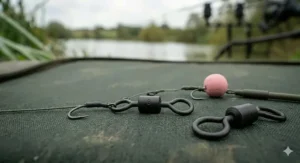
This hybrid design combines the quick-change convenience of a hooklink clip with the natural movement of a flexi ring pivot point. For anglers who fish multiple rigs during a session—perhaps starting with a bottom bait at dawn and switching to a popup as the sun rises—these eliminate the faff of retying whilst maintaining excellent presentation.
The flexible “O” ring provides extra movement that results in more natural hookbait behaviour, particularly important when fishing over particle beds or matching the hatch with freebies. UK reviewers consistently mention the time-saving aspect: being able to swap hooklinks in under a minute means more time fishing and less time fiddling with knots in the half-light. The size 8 designation ensures they fit all standard safety clips, which matters enormously for kit compatibility.
Pros:
✅ Combines quick-change and flexi ring benefits
✅ Saves significant rigging time on the bank
✅ Natural presentation from flexi pivot
Cons:
❌ Slightly heavier than standard flexi rings
❌ Quick-change mechanism adds bulk to rig
Price & Value: Expect £4-£6 on Amazon.co.uk. The time-saving alone justifies the marginal price increase over standard swivels for active anglers.
7. Korda Micro Rig Swivels — Premium Popup Performance
Korda’s size 20 micro swivels represent the refinement of years of big fish capture across Europe. These aren’t just scaled-down versions of larger swivels—they’re engineered specifically for popup and critically-balanced hookbait applications where weight distribution matters enormously. The bearing quality inside these tiny components is genuinely impressive; they continue rotating freely even after multiple big fish and exposure to British lake water.
For Ronnie/spinner rigs and 360-degree presentations, these are essentially the benchmark against which other micro swivels are measured. The anti-glare coating is thorough and durable, maintaining its effectiveness across multiple seasons. UK anglers fishing pressured day ticket waters report tangible improvements in takes when switching from shinier alternatives—that matte finish genuinely makes a difference when targeting educated fish in clear conditions.
Pros:
✅ Exceptional bearing quality for size
✅ Purpose-built for popup presentations
✅ Industry-leading anti-glare coating
Cons:
❌ Premium pricing reflects brand positioning
❌ Overkill for basic running rig applications
Price & Value: Around £4-£7 for a pack. Premium product commanding premium pricing, but the performance difference is noticeable for specialist applications.
Making Rig Swivels Work in British Conditions
British carp fishing presents unique challenges that directly impact terminal tackle performance. Our climate isn’t Mediterranean—it’s wet, often cold, and the pH levels in many waters (particularly acidic estate lakes and old quarry fisheries) can be harsh on metal components. Here’s what actually matters when rigging for UK conditions.
Wet Weather Considerations
The British Isles average 133 days of rainfall annually, and that constant moisture affects swivel longevity more than most anglers realise. Standard nickel plating corrodes faster in consistently damp conditions, which is why anti-corrosion coatings (black-nickel, PTFE, or proper anodising) aren’t just cosmetic upgrades. I’ve seen cheap brass swivels develop green corrosion in tackle boxes stored in damp garages across a single winter—not ideal when you’re trusting them with a fish of a lifetime.
The practical solution involves two approaches: firstly, invest in properly coated swivels for your main fishing (the products above all feature adequate protection), and secondly, store terminal tackle with silica gel packets if your tackle storage isn’t climate-controlled. Many UK anglers now use the sealed compartment boxes from manufacturers like Fox and Korda, which provide better moisture protection than traditional tackle boxes. Understanding the science behind metal corrosion helps—Wikipedia’s article on galvanic corrosion explains why dissimilar metals (like brass barrels and stainless rings) can accelerate deterioration in saline or mineral-rich water.
Lead Clip Compatibility
British carp fishing standardised on size 8 components for good reason—it provides the optimal balance between strength and profile for the carp weights we typically encounter (most UK carp range from 8lb tiddlers to 40lb specimens, with anything beyond that being genuinely exceptional). When you’re buying swivels, that size 8 designation ensures they’ll fit Fox Edges Kwik Change clips, Nash Rig Rings, ESP Lead Clips, Korda systems, and virtually every other British-designed component.
The tolerance matters more than you might expect. I’ve tested continental European swivels that claim to be “size 8 compatible” but sit slightly loose in UK clips or require forcing—neither situation is acceptable when you’re relying on the mechanical integrity of a running rig. Stick with products designed for the British market (or explicitly tested with UK components) and you’ll avoid compatibility headaches.
Size 11 vs Size 8: When Each Matters
Size 8 swivels handle lead clip and inline lead connections—they’re your workhorse components for standard running rigs and bolt rigs. Size 11 swivels, being slightly smaller, are primarily used for helicopter/chod rig arrangements where you need the swivel to run freely up and down the mainline or leader. Trying to force a size 8 into a role designed for size 11 (or vice versa) compromises rig mechanics.
The confusion arises because swivel sizing follows the inverse number system—larger numbers indicate smaller swivels (same as hooks). This catches out newcomers who assume size 11 is bigger than size 8. When manufacturers like Bank Tackle offer both sizes, they’re not creating artificial product segmentation; they’re providing the right tool for each specific rig type that British carp anglers actually use.
Common Mistakes When Buying Rig Swivels
Mistake 1: Choosing on Price Alone
I understand the temptation when you see 100 swivels for £2.99 on a marketplace seller, but component failure at the worst possible moment isn’t worth the saving. Cheap swivels often use inferior brass that corrodes rapidly in British water, bearings that seize under moderate load, and coatings that wear off after a handful of sessions. The proper test is cost-per-fish, not cost-per-pack—and quality swivels consistently win that calculation.
The sweet spot for UK anglers is typically the mid-range offerings from reputable tackle brands like Bank Tackle, combined with premium swivels from Korda or Fox for your specialist rigs. You’re not paying for marketing with these brands; you’re paying for QC processes that ensure the swivel you attach to your £40 hooklink will actually perform when a thirty-pound common picks up your hookbait.
Mistake 2: Ignoring British Water Chemistry
Continental products sometimes struggle in British waters, particularly our chalky southern reservoirs and acidic northern estate lakes. The pH extremes affect metal corrosion rates, and what works beautifully in a French gravel pit might develop problems after a fortnight in a Midlands club water. Products specifically designed for UK conditions (or extensively tested here) account for our water chemistry in their coating selection.
This isn’t nationalism—it’s practical metallurgy. Black-nickel finishes, for example, hold up better in acidic conditions than standard nickel plating. PTFE coatings resist both pH extremes whilst reducing friction. When UK tackle companies specify these treatments, they’re addressing real environmental factors their customer base encounters.
Mistake 3: Using Size 8 for Everything
Size 8 swivels are the standard for lead connections, but they’re overkill (and mechanically wrong) for many modern rigs. Chod rigs function better with size 11 or smaller because you need that swivel to slide freely on your leader material. D-rigs require micro swivels on the hook shank where a size 8 would completely ruin the presentation. Ronnie rigs demand specific spinner-style swivels that rotate under zero load.
The solution is simple: stock multiple sizes for different applications. A well-equipped UK carp angler’s swivel selection might include size 8 flexi rings for running rigs, size 11 for helicopter setups, and size 20-22 micros for D-rigs and Ronnies. This isn’t tackle hoarding; it’s having the right component for each presentation you might employ during a session.
Real-World Scenario: Matching Swivels to Your Fishing
The Southern Gravel Pit Angler
If you’re fishing clear-water gravel pits across Berkshire, Oxfordshire, or Surrey, you’re facing educated fish that examine every aspect of your presentation. These fish have seen countless rigs, and they’re particularly wary of anything that looks unnatural or reflects light in the water column.
Your swivel strategy: Prioritise anti-glare coatings and micro components. Korda Flexi Rings for your running rig connections, Fox Micro Swivels for chod rigs over gravel bars, and Nash Hook Swivels if you’re fishing D-rigs with critically-balanced baits. The extra cost is justified by the increased take ratio—on pressured day tickets, presentation details genuinely matter.
The Northern Reservoir Specimen Hunter
Windermere, Kielder, or similar large northern waters present different challenges: deeper water, longer casting distances, and often more coloured water from peat staining. The fish might be less pressured, but the environmental conditions are tougher on tackle.
Your swivel strategy: Durability trumps finesse. Bank Tackle Quick Change systems let you adapt to changing conditions quickly, whilst Guru rolling swivels handle the constant rotation from wind-driven currents. Stock up in bulk—these waters demand volume fishing with multiple rods, and component failure miles from the nearest tackle shop isn’t an option.
The Midlands Match Angler
Fishing commercial fisheries across Staffordshire, Warwickshire, or Nottinghamshire means multiple captures per session, constant rig changes, and the need for speed. The fish might be stockies rather than wild specimens, but consistent results demand efficient fishing.
Your swivel strategy: Quick-change systems are essential. Bank Tackle QC Flexi Rings let you switch between methods rapidly, maintaining feeding spells when fish are having it. Buy in bulk (50-100 packs) to keep costs sensible across a season of intensive fishing. The time-saving alone pays dividends when you’re bagging up.
Understanding Swivel Strength Ratings
Swivel manufacturers specify breaking strains, but these ratings deserve contextual understanding. A swivel rated at 50lb doesn’t mean it’ll fail instantly at 51lb—laboratory testing uses straight-line pull under controlled conditions. Real fishing involves dynamic loads (fish surges, rod flex), side-loading, and environmental degradation from water exposure.
The practical guideline British carp anglers should follow: match your swivel strength to your mainline breaking strain or slightly above. If you’re fishing 15lb mainline, size 8 swivels typically rated around 50-60lb provide ample safety margin. For the relatively modest carp weights we encounter in UK waters (even a forty-pound fish is exceptional), component failure due to inadequate swivel strength is rare when you’re using reputable products.
What causes swivel failure in British fishing is usually corrosion (from inadequate coating), mechanical seizure (from poor bearing quality), or the clip mechanism opening under side-load (with quick-change designs). This is why investing in properly finished swivels from established manufacturers provides genuine insurance—you’re not buying theoretical breaking strain; you’re buying build quality that maintains integrity across the environmental conditions we actually fish in.
According to fishing tackle testing referenced in British Sea Fishing’s comprehensive swivel guide, swivel ratings can vary considerably between manufacturers even for the same size designation, emphasising the importance of buying from reputable tackle companies with proper QC processes.
How to Choose Rig Swivels for UK Carp Fishing
Step 1: Identify Your Primary Rig Types
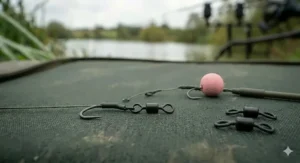
List the presentations you actually use across a typical season. Running rigs with lead clips? Size 8 flexi rings are essential. Helicopter rigs? Size 11 rolling swivels. Chod or hinged presentations? Micro swivels (size 20-22). D-rigs or blowback arrangements? Micro hook swivels. Most UK carp anglers need at least three different swivel types to cover their standard approaches.
Step 2: Assess Your Water Type
Clear southern gravel pits demand anti-glare finishes and minimal profiles. Coloured northern waters or heavily-weeded Midlands fisheries can tolerate slightly less refined components. Match your swivel selection to your venues’ characteristics—there’s no point paying premium prices for ultra-low-glare coatings if you’re fishing peat-stained water where visibility is measured in inches.
Step 3: Calculate Seasonal Requirements
If you’re fishing two overnight sessions weekly across a six-month season, you’re looking at roughly 50 sessions. Estimate 2-3 rigs per session (allowing for losses and changes), and you’ll need 100-150 swivels as a minimum. Buy accordingly—bulk packs from manufacturers like Bank Tackle make economic sense for regular anglers, whilst occasional fishers can stick with smaller premium packs.
Step 4: Prioritise Coating Quality
British weather doesn’t do tackle any favours. Anti-corrosion coatings aren’t cosmetic upgrades; they’re functional necessities that extend component lifespan considerably. PTFE coatings (Korda), black-nickel finishes (Guru, Nash), or proper anodising all outperform basic nickel plate in our damp climate. Factor this into value calculations—a swivel that lasts three seasons costs less per fish than one that corrodes in six months.
Step 5: Consider Lead Clip Integration
If you’re using Fox lead clips, Nash tail rubbers, Korda inline leads, or any other standard UK system, verify that your chosen swivels fit properly. Size 8 is the de facto British standard for good reason—it clicks securely into virtually all lead clip systems without being loose or requiring forcing. Continental products sometimes use fractionally different dimensions that compromise mechanical security.
Swivel Maintenance and Storage in the British Climate
British weather presents unique challenges for terminal tackle longevity. Our persistent dampness—whether it’s the drizzle of a Manchester autumn or the coastal humidity of Norfolk—accelerates corrosion on metal components faster than anglers in drier climates experience. Proper maintenance extends swivel lifespan considerably and prevents the heartbreak of component failure during that fish of a lifetime.
After each session, rinse your swivels (still attached to rigs if you’re storing made-up hooklinks) in fresh water. British lake water often carries higher mineral content than you’d expect, particularly in chalk stream-fed southern reservoirs or limestone-based northern waters. These dissolved minerals accelerate oxidation when they dry on metal surfaces. A quick rinse removes them before damage occurs.
Drying matters enormously. Don’t just shake off excess water and chuck rigs in your tackle box—that’s how you get green corrosion spots within a fortnight. Pat swivels dry with a cloth, then store in compartmentalised boxes with silica gel sachets. Modern tackle companies like Fox and Korda sell dedicated rig storage systems with moisture-absorbing properties; they’re worth the investment for serious anglers maintaining dozens of made-up rigs.
Check swivels before each session. Spin them between your fingers—if rotation feels gritty or hesitant, replace that component before fishing. The bearing has likely ingested silt or developed corrosion, and it won’t improve once you’re lakeside. This five-second check has saved me from lost fish more times than I care to admit. British carp can be scarce enough without handicapping yourself with compromised terminal tackle.
For long-term storage between seasons, consider a light spray of WD-40 or purpose-made tackle protectant on your swivels. This creates a protective barrier against atmospheric moisture during those damp British winters when tackle sits idle. Wipe off before use to avoid transferring petroleum residue onto hooklinks.
Anti-Tangle Components and Rig Mechanics
British carp fishing evolved significantly when anglers recognised that preventing tangles during the cast is as important as presentation on the lakebed. Modern anti-tangle thinking centres on three principles: adequate boom length, appropriate stiffness, and intelligent component selection.
The Anti-Tangle Sleeve Debate
Anti-tangle sleeves remain popular across UK waters, particularly on commercial fisheries and club lakes where casting frequency is high. These tapered plastic tubes extend from your lead clip along the mainline, keeping the hooklink separated during flight. They work—but they also add bulk and visibility that can spook fish in ultra-clear conditions.
The swivel plays a critical role in anti-tangle setups. Quick-change swivels that incorporate a larger body naturally create separation between the hooklink and mainline. Flexi ring swivels allow the hooklink to pivot away from the lead during the cast. Standard barrel swivels (rare in modern UK carp fishing) offer less inherent anti-tangle characteristics because the hooklink attachment point sits close to the lead.
When fishing waters where presentation refinement matters more than volume casting (southern syndicate lakes, for example), many experienced anglers dispense with plastic sleeves entirely, relying instead on properly designed swivels and semi-stiff hooklink materials to maintain separation. The British carp fishing community continues debating this trade-off between mechanical tangle prevention and ultimate presentation subtlety.
UK Regulations and Fish Welfare Considerations
When selecting terminal tackle for British carp fishing, we operate within a framework of angling ethics and welfare standards that have evolved considerably over recent decades. Whilst there’s no specific government legislation targeting rig component specifications, the Environment Agency and angling organisations like the Angling Trust promote best practices that directly influence how we should approach swivel selection.
The barbless hook movement that swept British carp fishing during the 1990s and 2000s has a parallel in swivel design—specifically around lead clip safety and quick-release mechanisms. Swivels must perform their anti-tangle and connection functions whilst ensuring that, in the event of a break-off, a trailing carp isn’t tethered to heavy lead for extended periods. This is why size 8 flexi ring compatibility with lead clips matters so profoundly: proper mechanical integration ensures the lead is discharged safely before the swivel pulls free from the clip.
The Angling Trust’s fish welfare guidance emphasises minimising playing time and handling stress, which connects directly to terminal tackle reliability. A seized swivel that locks up under load extends fight duration, increasing physiological stress on the fish. Properly maintained, free-spinning swivels contribute to quicker, cleaner captures—an aspect of tackle performance that transcends mere functionality and enters the realm of ethical angling practice.
British waters also fall under various regional management schemes. Estate lakes, commercial fisheries, and club waters often impose specific rules around terminal tackle. Some venues prohibit leadcore (requiring the use of anti-tangle tubing instead), whilst others mandate specific rig safety standards. Before purchasing bulk quantities of any swivel type, verify that your target venues permit your intended rig configurations. The UK’s fragmented water ownership structure means regulations vary considerably between regions—what’s acceptable on a Lincolnshire gravel pit might be banned on a Surrey syndicate lake.
Ring Swivel Sizes Explained: The British System
Understanding swivel sizing prevents costly purchasing mistakes and ensures you have the right component for each rig type. The British carp fishing industry standardised around specific size designations that, whilst initially confusing, serve practical purposes once you grasp the underlying logic.
Size 8 swivels represent the backbone of UK carp fishing terminal tackle. They provide optimal balance between strength (typically 45-60lb breaking strain depending on manufacturer), profile (small enough to not spook fish, large enough to handle reliably), and compatibility (fitting virtually all British-designed lead clips and inline systems). When tackle catalogues describe a product as “size 8 compatible,” they’re confirming it works with this established standard.
Size 11 swivels are smaller (counter-intuitive given the larger number, but that’s how swivel sizing works globally). They’re primarily used for helicopter rig applications where the swivel must slide freely along your mainline or leadcore leader. The reduced diameter creates less resistance during casting and allows smoother travel on the retrieve. Trying to use a size 8 for helicopter work results in a rig that doesn’t fish properly—the swivel hangs up or moves reluctantly, compromising the presentation mechanics that make helicopter rigs effective.
Size 16 and smaller (micro swivels in sizes 20-22) serve specialist applications: D-rigs, blowback presentations, and modern Ronnie/spinner setups. These aren’t scaled-down versions of larger swivels; they’re engineered specifically for hookbait attachment and movement rather than mainline connection. The bearing quality in these micro components often exceeds what you’d find in larger swivels because the rotation requirements are more demanding—a size 22 micro swivel on a D-rig must continue spinning freely even when embedded in silt.
The numbering system follows an inverse relationship (larger numbers = smaller swivels) because it’s inherited from historical hook sizing conventions. This trips up newcomers initially but becomes second nature once you’ve purchased a few different types. The practical approach: identify what rig you’re tying, check reference materials or manufacturer guidance for the correct swivel size, then buy accordingly rather than trying to memorise an arbitrary numbering scheme.
Long-Term Cost Analysis: Premium vs Budget Swivels
Let’s examine real-world economics over a typical UK carp fishing season (March through October, roughly 40 sessions):
Budget Approach (Generic marketplace swivels):
- 100 swivels at £3 per 100 = £3 total
- Expected lifespan: 10-15 sessions before corrosion becomes problematic
- Replacement purchases: 3-4 times per season
- Total seasonal cost: £9-£12
- Component failures during fish capture: Occasional (perhaps 2-3 instances)
Mid-Range Approach (Bank Tackle bulk packs):
- 100 swivels at £12-£15 per 100 = £12-£15 total
- Expected lifespan: Full season plus carryover
- Replacement purchases: None required
- Total seasonal cost: £12-£15
- Component failures during fish capture: Rare (perhaps 1 instance)
Premium Approach (Korda/Fox specialist swivels):
- 50 swivels at £7 per 8-10 = £35-£45 total
- Expected lifespan: Multiple seasons
- Replacement purchases: Minimal
- Total seasonal cost: £35-£45 (amortised across 2-3 seasons = £12-£23 annually)
- Component failures during fish capture: Negligible
The financial analysis reveals an unexpected truth: ultra-budget swivels offer minimal actual savings once you account for replacement frequency, whilst premium swivels become cost-competitive when you factor in multi-season lifespan. The mid-range position (Bank Tackle, ESP, Preston Innovations) provides optimal value for most UK anglers—adequate quality at sensible pricing with genuine durability in British conditions.
Frequently Asked Questions
❓ Are size 8 ring swivels compatible with all UK lead clips?
❓ How long do flexi ring swivels last in British waters?
❓ Can I use quick change swivels for helicopter rigs?
❓ What swivel strength rating do I need for UK carp fishing?
❓ Do anti-glare swivel coatings actually prevent spooked fish?
Conclusion: Choosing the Right Swivels for Your Fishing
Rig swivels might occupy the smallest compartment in your tackle box, but they influence every aspect of your presentation mechanics. The difference between a size 8 flexi ring and a quick-change system determines whether your rig presents naturally or telegraphs artificiality. The quality of anti-corrosion coating affects whether that swivel remains functional across a season or fails at the critical moment when a proper carp picks up your hookbait.
For most UK anglers, a balanced approach delivers optimal results: invest in premium swivels (Korda, Fox, Nash) for your specialist rigs where presentation refinement genuinely influences catch rates, and stock bulk quantities of mid-range components (Bank Tackle, ESP) for general-purpose applications. The products reviewed above all perform adequately in British conditions—the question isn’t whether they work, but which specific type matches your particular fishing circumstances.
British carp fishing continues evolving, with new rig concepts emerging regularly. What remains constant is the fundamental requirement for reliable terminal components that maintain mechanical integrity across our challenging climate. Choose swivels designed for UK conditions, match them properly to your rig types, and replace them before corrosion compromises performance. That approach might lack the glamour of the latest wonder-bait or cutting-edge rod blank, but it consistently puts more fish on the bank—which is rather the point of this endeavour.
Recommended for You
- 7 Best Lead Clips for Carp Fishing UK 2026: Safety Tested
- Hinged Stiff Rig Setup: 7 Best UK Options & Expert Setup Guide 2026
- How to Tie D Rigs: 7 UK Products & Expert Guide 2026
Disclaimer: This article contains affiliate links. As an Amazon Associate, I earn from qualifying purchases. If you purchase products through these links, we may earn a small commission at no additional cost to you.
✨ Found this helpful? Share it with your mates! 💬🤗
