
In This Article
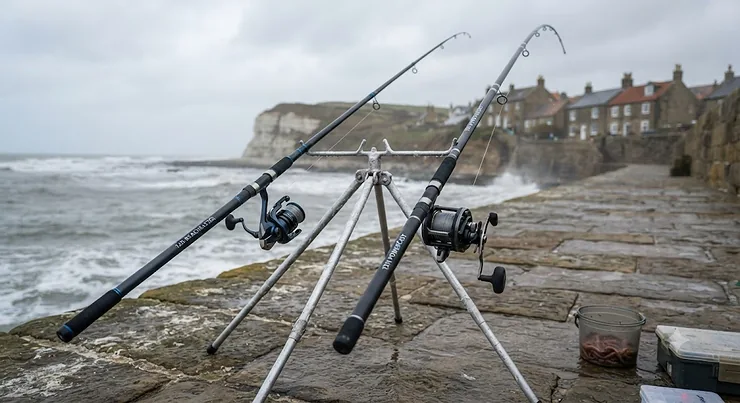
Stand in any British beach car park on a Saturday morning and you’ll hear the same argument rumbling between the tailgates: twelve foot or thirteen? It sounds like a trivial twelve inches of carbon, yet that single foot changes how a rod loads, how far it throws, and how your shoulder feels after four hours leaning into a headwind. The 12ft beachcaster vs 13ft beachcaster debate isn’t really about bragging rights outside the tackle shop — it’s about matching a tool to your marks, your casting style, and the fish you’re actually chasing. A 12ft beachcaster is generally the nimbler, easier-loading option for estuaries, harbour walls and anglers who haven’t yet grooved a big pendulum cast, while a 13ft beachcaster trades a little handling for extra leverage, a higher line angle above the surf, and genuine extra yardage once your technique catches up with the blank. For background on the wider sport this kit serves, surf fishing has a long history on Britain’s open beaches, and understanding that context helps explain why rod length became such a contested variable in the first place.
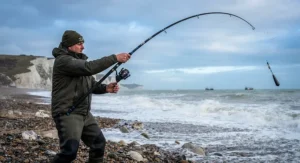
Neither length is objectively “better” — they’re specialised for slightly different jobs. This guide breaks down exactly which one earns a spot in your rod bag, using seven real, currently available UK rods spanning budget, mid-range and genuinely premium territory. We’ve dug into blanks, actions and casting weights, and layered honest analysis on top of the raw numbers — the kind of context you won’t find on a standard product listing. Whether you’re hunting the best beach caster rod for a first estuary session or trying to settle a family argument about whether 12 or 13ft wins on an open strand, you’ll find a straight answer below.
Quick Comparison Table
| Attribute | 12ft Beachcaster | 13ft Beachcaster |
|---|---|---|
| Typical casting weight | 4–6oz | 4–8oz |
| Best for | Estuaries, piers, beginners | Open beaches, distance work |
| Line angle over surf | Lower | Higher |
| Learning curve | Gentler | Steeper, more reward |
| Portability | Easier in a small car, tighter marks | Bulkier, needs more swing room |
Reading this table on its own would be a mistake, because length alone doesn’t decide the winner — the rest of this guide unpacks why. A 12ft beachcaster tends to suit anglers fishing clean, sheltered marks or those still building casting technique, since the shorter lever is more forgiving and easier to control through the power stroke. A 13ft beachcaster earns its keep on open, surf-battered beaches where extra height above the breaking waves and a longer arc translate into real, measurable yardage once you can load the tip properly.
💬 Just one click — help others make better buying decisions too!😊
Top 7 Beachcasters: Expert Analysis
We’ve mixed genuine 12ft and 13ft options across three price bands so you can see exactly how length, action and blank material interact in practice, rather than reading specs in isolation.
1. Daiwa Seahunter Z Beachcaster — best budget 12ft all-rounder
The Daiwa Seahunter Z Beachcaster is the rod most UK tackle shops reach for when a newcomer asks for something affordable that won’t fall apart after a season. Built around a two-piece carbon composite blank in the 12ft6 length, it’s rated for a modest 4–6oz casting weight, which in practice means it loads easily with a standard overhead or off-the-ground cast rather than demanding a committed pendulum. Based on the spec comparison against pricier rods in this list, the Seahunter Z sacrifices ultimate distance and tip sensitivity for a forgiving, easy-loading action that suits someone still finding their casting rhythm. Reviewers consistently report that it punches above its price bracket for general bait fishing — whiting, flatfish, dogfish and the occasional codling — though a few note the guides are basic and benefit from an upgrade after a couple of seasons of heavy use. What most buyers overlook about this model is that it doubles as a very capable estuary rod, so it’s not purely a “beginner beachcaster” that gets outgrown; plenty of experienced anglers keep one in the car for exactly that reason.
Pros:
- ✅ Genuinely low entry price for a Daiwa-branded blank
- ✅ Easy-loading action suits developing casting technique
- ✅ Doubles up well as a light estuary rod
Cons:
- ❌ Basic guide set limits long-term upgrade potential
- ❌ Casting weight ceiling caps it below rougher, heavier marks
Prices for the Daiwa Seahunter Z Beachcaster typically sit around £85–£110 depending on retailer and stock, and at that price it’s hard to argue with as a first “proper” beachcaster rather than a supermarket combo.
2. Shakespeare Salt XT Beachcaster — best value fast-action 13-footer
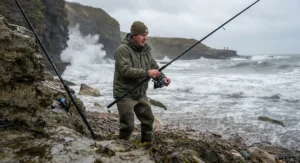
Stepping up to 13ft, the Shakespeare Salt XT Beachcaster is built from a genuinely slim, high-grade carbon blank with a fast action and a 4–8oz casting weight rating, putting it firmly in “proper beach rod” territory rather than budget-combo land. The fast taper means the power is concentrated in the tip and upper-mid section, so the rod unloads quickly through the cast — useful once you’ve got timing, but a rod that will feel unforgiving if your rhythm is off. Here’s what to weigh: that fast, heavy-power action is exactly what rough-ground anglers want for punching baits past the breakers, yet it’s less suited to the delicate presentations a progressive-action rod handles better. Reviewers consistently praise the low blank diameter for reducing wind resistance on the retrieve, and the Zirconium Oxide-lined guides are a genuine step up from entry-level rings, resisting the line-grooving that ruins cheaper guides after a season of sand and salt.
Pros:
- ✅ Slim, fast-action carbon blank built for distance
- ✅ Quality Zirconium Oxide guides resist line wear
- ✅ Comfortable X-Shrink handle grips well when wet
Cons:
- ❌ Fast action punishes an inconsistent casting stroke
- ❌ Heavier power rating overkill for light estuary work
At around £95–£120, the Shakespeare Salt XT Beachcaster represents one of the strongest value propositions in the 13ft class, especially for anglers who’ve already got a season or two of casting under their belt.
3. Daiwa Sandstorm Surf 12ft6 Multiplier — best 12ft distance caster
If you want the shorter length without giving up serious casting ability, the Daiwa Sandstorm Surf 12ft6 Multiplier is the pick. Built on an HVF carbon fibre blank rated to a genuine 100–200g (roughly 4–7oz) casting weight, it’s a fast-action rod designed specifically around multiplier reels, using a sliding DPS reel seat so you can fine-tune balance to your own casting style. On paper this means you get a shorter, easier-to-swing lever that still has the backbone to load a heavy lead — a combination that suits anglers fishing rock marks or piers where a full 13ft rod becomes awkward to manoeuvre. Reviewers consistently report distances in the region of 130–140 yards with a basic overhead thump once the rod is matched to a well-loaded multiplier, which is respectable for a rod this manageable in length. The full shrink-grip handle is worth flagging too, since it holds firm in the wet, sandy conditions where smoother handles start to slip mid-cast.
Pros:
- ✅ HVF carbon blank delivers real distance for its length
- ✅ Sliding DPS seat lets you balance rod to reel
- ✅ Full shrink grip stays secure in wet conditions
Cons:
- ❌ Multiplier-only guide spacing rules out fixed-spool reels
- ❌ Bold yellow livery is love-it-or-hate-it cosmetically
Expect to pay in the £165–£190 range for the Daiwa Sandstorm Surf 12ft6 Multiplier, which sits it comfortably in the mid-tier bracket alongside rods that, in our view, don’t cast as far.
4. Daiwa Sandstorm Surf 13ft6 Fixed Spool — best all-round 13ft for beginners
Sharing the same HVF carbon platform as its 12ft6 sibling, the Daiwa Sandstorm Surf 13ft6 Fixed Spool swaps the sliding multiplier seat for a fixed reel seat and split EVA grip, making it the more approachable option for anglers who’ve learned on fixed-spool tackle. The extra 12 inches of length keeps more line above a rolling surf and extends the casting arc, and Daiwa’s own listed maximum distance sits around 175 yards for the fixed-spool version — a touch behind the multiplier variant, which tracks with what you’d expect from fixed-spool aerodynamics generally. What the spec sheet won’t tell you, but retailer feedback suggests, is that the reel seat’s fixed positioning makes it noticeably easier to set up correctly straight out of the box compared with sliding-seat rods, which is genuinely useful if you’re not confident balancing a rod yourself. This is the rod we’d point a bass-and-cod angler toward if they fish open, sandy beaches and want one 13-footer that does most things well.
Pros:
- ✅ Same proven HVF carbon blank as the 12ft6 model
- ✅ Fixed reel seat simplifies setup for fixed-spool users
- ✅ Longer arc keeps line higher above breaking surf
Cons:
- ❌ Slightly shorter max distance than the multiplier version
- ❌ At 750g it’s noticeably heavier over a long session
Pricing for the Daiwa Sandstorm Surf 13ft6 Fixed Spool generally runs £165–£195, and it’s one of the more sensible “grow into it” 13ft rods on the market for someone moving up from a shorter beginner rod.
5. Penn Tidal XR Beachcaster — best mid-range 13ft workhorse
The Penn Tidal XR Beachcaster sits neatly between the budget and premium tiers, rated for a 112–225g casting weight — call it a genuine 4–8oz — and built to survive being dragged over rocks and left leaning against a groyne between casts. Based on the spec comparison, Penn’s XR range prioritises durability over outright sensitivity, which is a sensible trade for anglers fishing mixed or rough ground where a delicate tip would be a liability rather than an asset. Reviewers consistently place it a shade below the premium Daiwa and Shakespeare options on outright casting distance, but ahead of them on sheer toughness, which is exactly the trade-off you’d want from a rod built for conger, huss and bigger species on rougher marks. It’s a rod bought by anglers who’ve decided length matters less than a blank that shrugs off the occasional accidental knock against a rock.
Pros:
- ✅ Robust build tolerates rough-ground abuse well
- ✅ Wide 4–8oz rating covers most UK bait fishing
- ✅ Solid reputation for reliability over repeated seasons
Cons:
- ❌ Trails premium rods on outright casting distance
- ❌ Blank feels less lively than lighter competitor carbons
Typical prices for the Penn Tidal XR Beachcaster land around £135–£155, making it a sensible step-up purchase once a budget rod’s limitations start to show.
6. Anyfish Anywhere Four&Bait Mk2 — best British specialist combo
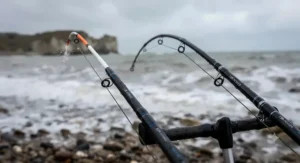
British rod builder Anyfish Anywhere has a strong reputation among competition and club anglers, and the Anyfish Anywhere Four&Bait Mk2 is designed specifically to cast 6oz plus bait — a rating aimed squarely at serious UK beach and estuary fishing rather than generalist saltwater use. Based on the spec comparison, this positions it as a genuine alternative to the mass-market Daiwa and Shakespeare rods for anglers who want a blank tuned by people who actually compete with it. What most buyers overlook about specialist-brand rods like this one is that the smaller production runs often mean more consistent quality control blank-to-blank, since there’s simply less volume to cut corners on. It won’t have the brand recognition of Daiwa or Penn on a shelf, but among UK match and club circles it’s a name that carries real weight, and that reputation is earned through use rather than marketing spend.
Pros:
- ✅ Purpose-built 6oz-plus-bait rating for serious UK shore work
- ✅ Strong reputation within UK competition angling circles
- ✅ Smaller production runs support tighter quality control
Cons:
- ❌ Less widely stocked than the major mass-market brands
- ❌ Fewer independent long-term reviews to draw on
Expect to pay roughly £100–£120 for the Anyfish Anywhere Four&Bait Mk2, positioning it as a mid-range rod with a specialist pedigree rather than a generalist one.
7. Century Fireblade 13ft — best premium UK-built blank
At the top of this line-up sits the Century Fireblade 13ft, a UK-manufactured rod built around a multi-phase, high-tensile composite butt with a 3K-3K carbon twill layup and a hybrid glass-and-carbon “rapid recovery” tip, rated to a 125–175g (4–6oz) casting weight. That hybrid tip construction is the standout feature here: pairing glass with high-tensile carbon produces a tip that flexes further before it fully loads, translating into noticeably clearer bite registration for smaller, more cautious species like flatfish and whiting. Century’s computer-controlled oven-cure manufacturing process is the kind of detail that rarely shows up on a spec sheet but genuinely affects consistency between individual rods coming off the same production line. On paper this means you’re paying a premium not for extra casting weight — its 4–6oz rating is actually more modest than several cheaper rods on this list — but for build precision, UK manufacture, and a casting feel that experienced anglers consistently describe as noticeably different from mass-produced alternatives.
Pros:
- ✅ UK-manufactured blank with tight quality control
- ✅ Hybrid glass/carbon tip excels at bite detection
- ✅ Forward-sloping Delta guides genuinely reduce line tangles
Cons:
- ❌ Significant price jump over the rest of this list
- ❌ Lower 4–6oz rating limits use on rougher, heavier marks
The Century Fireblade 13ft typically retails around £240–£280, reflecting its UK manufacture and componentry rather than any marketing premium — it’s a rod bought by anglers who’ve already worked out exactly what they want from a beachcaster.
Practical Usage Guide: Setting Up and Caring For Your New Beachcaster
Getting a new rod out of the box right matters more than most first-time buyers realise. Start by seating the reel correctly: for a fixed-spool setup, the reel foot should sit centrally in the reel seat with the bail arm roughly in line with the first guide, while multiplier users should position the reel so the spool sits comfortably under the casting hand without straining the wrist through the power stroke. Wind your line on under tension — a loosely spooled reel is one of the most common causes of tangles and reduced casting distance in the first month of ownership. Before your first proper session, practice a handful of gentle, controlled casts at low tide with a practice lead rather than a hooked rig, letting you feel how the specific blank you’ve bought loads and unloads without risking a tangle in your terminal tackle.
Maintenance is straightforward but easy to neglect. Rinse the rod in fresh water after every saltwater session, paying particular attention to the guides and reel seat threads, where salt crystals accelerate corrosion and eventually seize moving parts. Check guide linings periodically for grooving, since a damaged guide will fray expensive line surprisingly quickly. Store the rod horizontally or in a proper rod tube rather than leaning it in a corner, where its own weight can introduce a permanent set into the blank over months of storage. The single biggest first-30-days mistake we see is over-casting a new rod at full effort before the angler has learned its specific timing — ease into it, and the rod will reward you with both distance and longevity.
Real-World Scenarios: Matching the Rod to the Angler
Consider three different UK anglers and how the 12ft beachcaster vs 13ft beachcaster choice plays out for each. A university student living near a Cornish estuary, fishing two or three evenings a week after lectures, is realistically best served by something like the Daiwa Seahunter Z Beachcaster — its 12ft6 length is easy to carry on foot or by bike, its gentler action suits developing technique, and its modest price tolerates the inevitable knocks of student life. A weekend angler commuting from Bristol to open beaches along the Somerset or Devon coast, fishing perhaps twice a month for cod and bass across a full tide, gets more from a 13ft rod like the Daiwa Sandstorm Surf 13ft6 Fixed Spool or Penn Tidal XR Beachcaster, where the extra line height above the surf and greater casting range genuinely extend the water they can cover in a session.
Then there’s the retired angler with decades of casting experience, fishing rough, mixed ground for conger and bigger species several times a week, who has both the technique and the specific need to justify a Century Fireblade 13ft or a rod like it — someone at this stage of the hobby is buying refinement and bite detection, not raw beginner-friendliness. None of these three anglers is wrong; they’re simply fishing different marks, different frequencies, and different target species, which is exactly why “just buy the longest rod” is bad advice dressed up as confidence.
How to Choose a 12ft or 13ft Beachcaster
Choosing between these two lengths comes down to a handful of practical questions rather than gut instinct:
- Identify your typical mark. Sheltered estuaries and harbour walls favour a 12ft rod; open, surf-exposed beaches reward the extra reach of a 13ft rod.
- Be honest about your casting technique. Beginners generally find a shorter, easier-loading blank more forgiving while they build a consistent power stroke.
- Match the casting weight to your bait and lead. A 4–6oz rating suits lighter rigs and smaller species; step up to 4–8oz for bigger baits and heavier leads.
- Consider your transport and storage. A 13ft two-piece rod needs a longer car and more swing room on a crowded beach than a 12ft equivalent.
- Set a realistic budget band. Decide whether you’re buying a first rod to learn on or a long-term rod to grow into, since that changes which price tier makes sense.
- Check reel compatibility. Confirm whether the blank’s guide spacing is designed around a multiplier or a fixed-spool reel before you commit.
- Weigh species and ground type. Rougher ground and bigger species generally favour the added backbone of a 13ft, heavier-rated rod.
Common Mistakes When Buying a Beachcaster
The most frequent error is buying more rod than the angler’s current casting technique can control — a stiff, fast-action 13ft rod in inexperienced hands often casts shorter than a well-matched 12ft rod, because the caster can’t fully load the blank. A close second is ignoring reel compatibility: pairing a multiplier-specific rod with a fixed-spool reel, or vice versa, causes real casting problems because guide spacing is designed around how each reel type pays out line. Buyers also frequently underestimate maintenance, assuming a rinse “when I remember” is sufficient, when salt corrosion on guides and reel seats happens faster than most people expect. Finally, plenty of anglers fixate on maximum casting weight as a proxy for quality, when in practice a rod rated well beyond what you’ll ever cast is simply harder to load and less enjoyable to fish with all season.
Rod Action Explained: Fast, Medium-Fast and Progressive
Rod action describes where along the blank the bend concentrates during a cast, and it’s arguably more important to your casting experience than length or price. A fast action rod — like the Shakespeare Salt XT Beachcaster in our line-up — bends mainly in the top third, unloading quickly and rewarding a sharp, well-timed casting stroke with real distance, but it’s less forgiving of sloppy technique. A progressive (sometimes called “through”) action, more common on shorter estuary-style rods, bends further down into the mid-section and butt, spreading load more evenly and forgiving a less precise cast at the cost of some outright distance. Medium-fast action sits between the two and is often the sensible default for anglers still working out their casting style, since it offers a reasonable compromise between forgiveness and performance. As a rule of thumb, quicker casters with good timing tend to prefer faster actions and can often go a foot shorter in length for the same range, while slower, more methodical casters frequently get more out of a longer, more progressive blank.
Blank Material: Carbon Fibre vs Composite vs Fibreglass
Nearly every rod in this guide uses some form of carbon fibre reinforced polymer in its construction, but “carbon” covers a wide spread of actual performance. High-modulus carbon fibre blanks, like the HVF carbon used in the Daiwa Sandstorm Surf rods, are lighter and more sensitive for a given power rating, transmitting bite detection clearly but generally costing more to produce. Composite blanks, blending carbon with fibreglass — as seen in the Century Fireblade 13ft‘s hybrid tip — sacrifice a little outright lightness for extra durability and a softer, more forgiving flex that some anglers actually prefer for bite detection on smaller species. Pure fibreglass blanks have largely disappeared from serious beachcasting because they’re heavier and less sensitive for the same power, though they remain nearly indestructible, which is why you still find them on some budget or junior combo rods. What most buyers overlook is that blank material interacts directly with action: a stiff, high-modulus carbon blank tends to produce a naturally faster action, while composite and glass-tipped blanks lean progressive almost by default, so the two specs aren’t independent choices.
12ft Beachcaster vs 13ft Beachcaster: The Detailed Breakdown
Boiling the 12ft beachcaster vs 13ft beachcaster debate down to a single sentence: length changes leverage, and leverage changes both how far you can cast and how much technique you need to get there. A 12ft rod is a shorter lever, meaning it accelerates the lead through a shorter arc — easier to control, quicker to master, but with a naturally lower ceiling on maximum distance once you’re both fishing at full ability. A 13ft rod is a longer lever, generating higher tip speed for the same physical effort once you’ve learned to time the cast properly, and it also keeps more of your line above a breaking surf, reducing the “belly” that tide and waves put into slack line and can cost you both distance and bite detection. Where this gets interesting is ground type: on rocky or pier marks with limited swing room behind you, a 13ft rod’s extra length becomes a genuine handicap rather than an advantage, which is exactly why several 12ft rods in our line-up, like the Daiwa Seahunter Z Beachcaster, remain popular even among anglers who own longer rods for open beaches. The honest verdict is that most UK anglers eventually own both lengths for different marks rather than picking a permanent winner.
Finding the Best Beach Caster Rod for Your Style of Angling
There’s no single best beach caster rod that suits every angler, because “best” depends entirely on where and how you fish. For a beginner learning on estuaries or harbour walls, the Daiwa Seahunter Z Beachcaster or a similarly gentle-action 12ft rod is the sensible starting point, since a forgiving blank builds confidence faster than a stiff one that punishes mistakes. For someone graduating to open beaches and wanting genuine distance without a premium price tag, the Daiwa Sandstorm Surf 13ft6 Fixed Spool or Penn Tidal XR Beachcaster both represent honest mid-tier value. Competition-minded anglers or those fishing serious tides for cod and bass tend to gravitate toward specialist British builds like the Anyfish Anywhere Four&Bait Mk2, where the rod has been tuned specifically around UK match conditions rather than adapted from a generic saltwater platform. And for anglers who’ve already worked out exactly what casting feel they want and are willing to pay for UK manufacture and bite-detection refinement, the Century Fireblade 13ft earns its premium price through build quality rather than marketing.
Long-Term Cost & Maintenance
A beachcaster’s true cost extends well past the purchase price, and it’s worth thinking in terms of cost-per-season rather than sticker price alone. A £90 budget rod that needs replacing after two hard seasons of rough-ground fishing may work out more expensive over five years than a £150 mid-range rod that survives the full period with basic care, simply because you’re not paying for a second full rod purchase. Guides are usually the first component to fail, particularly on cheaper rods with basic ring linings that groove under repeated abrasive line contact — budgeting for an occasional guide re-wrap, typically £15–£30 per guide at a tackle shop, can extend a rod’s working life significantly. Reel seats and grips wear more slowly but do eventually degrade with sustained salt exposure, and a thorough freshwater rinse after every session remains the single cheapest thing you can do to protect your investment, regardless of which price tier your rod sits in.
Safety and Regulations for Beach Anglers
Beach fishing carries real risks that go beyond the tackle itself, and tidal cut-off is one of the most common causes of RNLI call-outs involving anglers. The RNLI’s own tide safety guidance makes clear that checking tide tables before you head out, and staying aware of the tide’s direction while you’re fishing, is the single most effective way to avoid being caught out on a falling or rising beach. Fishing from rocks carries additional risk, and the RNLI specifically recommends a lifejacket and never fishing alone in that setting, since a slip near open water can turn serious very quickly. On the regulatory side, anglers targeting bass need to be aware that recreational catch limits and seasonal closures change periodically, so it’s worth checking current rules before you keep any fish rather than relying on last year’s memory of the regulations.
Frequently Asked Questions
❓ Is a 12ft or 13ft beachcaster better for a beginner?
❓ What casting weight do I need for a 12ft beachcaster vs 13ft beachcaster?
❓ Does rod action matter more than length when beach casting?
❓ What blank material is best for a beach caster rod?
❓ How much should I budget for a good 12 or 13ft beachcaster?
Conclusion
The 12ft beachcaster vs 13ft beachcaster choice ultimately comes down to where you fish and how your casting technique has developed, not which number sounds more impressive on a rod tube. Shorter rods reward beginners and suit tighter marks with limited swing room, while longer rods pay off on open beaches once you’ve got the timing to load them properly — and plenty of serious UK anglers end up owning both for exactly that reason. Whichever length you land on, pairing it with the right action and blank material for your fishing style matters just as much as the number stamped near the handle, and understanding current bass fishing regulations is worth a few minutes of your time before you head out with any new rod, since retention rules can change between seasons. From the budget-friendly Daiwa Seahunter Z Beachcaster to the premium Century Fireblade 13ft, there’s a genuine option in this guide for every stage of the hobby — the trick is being honest with yourself about which one actually matches how, and where, you fish.
✨ Don’t Miss These Exclusive Deals!
🎣 Take your beach fishing to the next level with these carefully selected rods. Click on any highlighted item to check current pricing and availability, and land the kind of session your mates will be jealous of!
Recommended for You
- Best Barbel Boilies: 7 Top UK Picks for Big Fish (2026)
- Best Barbel Pellets: 7 Proven UK Picks for 2026
- Barbel Bait Under £20: 7 Brilliant Budget Picks (2026)
Disclaimer: This article contains affiliate links. As an Amazon Associate, I earn from qualifying purchases. If you purchase products through these links, we may earn a small commission at no additional cost to you.
✨ Found this helpful? Share it with your friends! 💬🤗
